

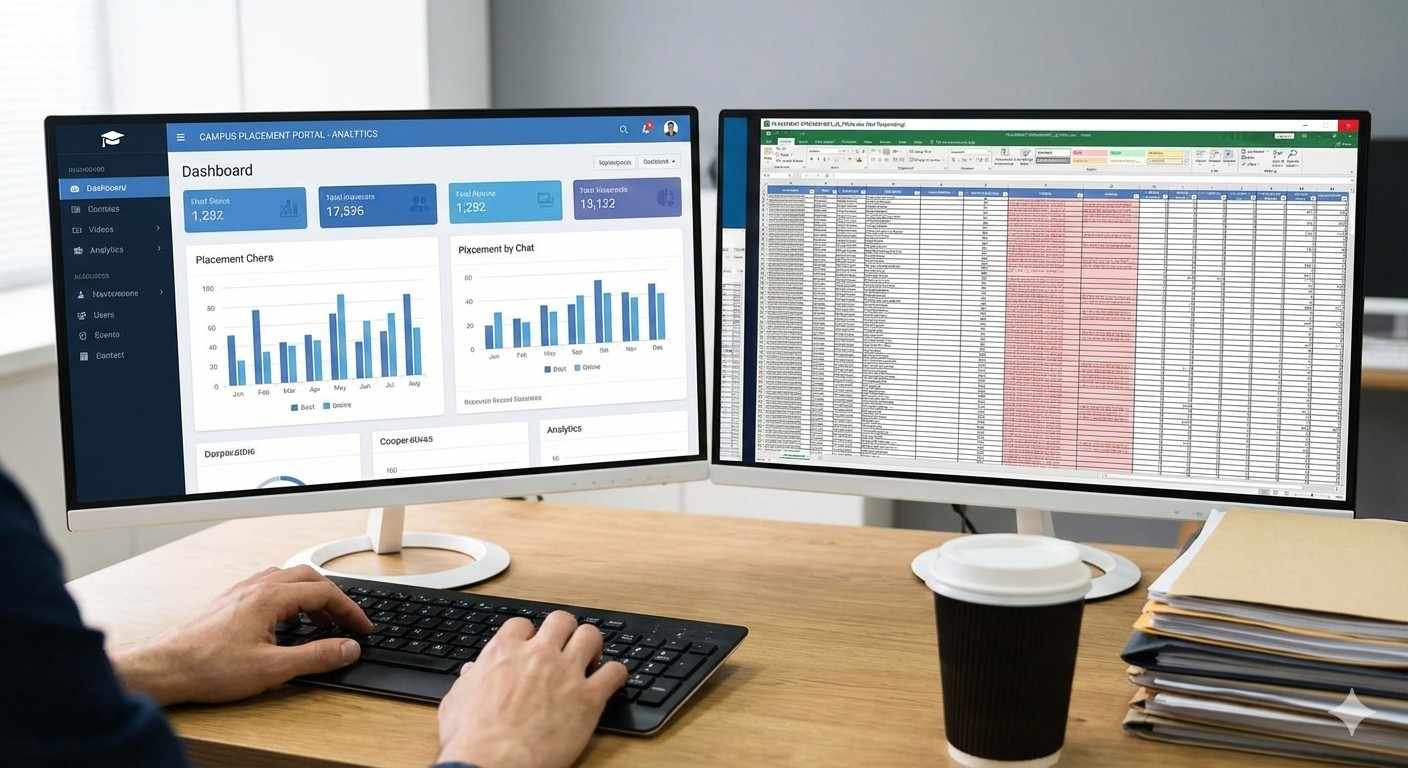

Campus placement has evolved from a seasonal administrative task into a year-round, high-stakes institutional responsibility. Universities today manage thousands of students, hundreds of recruiters, multiple eligibility rules, concurrent drives, and increasingly, virtual placement drives and virtual campus interviews. Yet, despite this growing complexity, many placement offices still rely heavily on spreadsheets to manage campus placements. At small volumes, spreadsheets may seem sufficient. But as placement seasons scale—across departments, campuses, and recruiter expectations—spreadsheets don’t just slow things down. They break. This blog explores what actually breaks first when universities rely on spreadsheets for campus placement, how modern campus placement systems are designed to handle scale, and why institutions moving toward structured placement outcomes are shifting to platforms like Superset.
The Scaling Reality of Modern Campus Placement
Modern campus placement has expanded far beyond a single final-year hiring season. Universities now manage multiple, overlapping workflows that increase operational complexity at every stage.
- Multiple virtual placement drives across the academic year: Placement activities are spread throughout the year, requiring continuous coordination, scheduling, and communication with students and recruiters.
- Hybrid and fully virtual campus interviews: Universities must manage online interview links, panel availability, real-time updates, and candidate flow—tasks that demand structured digital systems.
- Tier-based eligibility and cohort-specific hiring rules: Different companies apply varied criteria based on academic performance, skills, or program tiers, making manual filtering error-prone.
- Parallel recruiter workflows across departments and campuses: Placement teams often run multiple drives simultaneously, increasing the risk of clashes and misalignment.
- Post-offer tracking, drop-outs, deferrals, and joining status: Placement outcomes now extend beyond offers, requiring ongoing visibility into final hiring results.
This scale introduces complexity in data accuracy, communication, coordination, and compliance—areas where spreadsheets were never designed to perform reliably.
Why Spreadsheets Became the Default Tool for Campus Placement
- Easy to start with: Spreadsheets require no setup, training, or technical support. Placement teams can immediately begin tracking student data, recruiter details, and drive schedules, making them a quick solution for early-stage campus placement operations.
- No initial cost: Most institutions already have access to spreadsheet tools, eliminating the need for upfront investment. This makes them especially appealing for smaller universities or placement cells operating with limited budgets.
- Familiar to staff: Placement officers and administrative teams are already comfortable using spreadsheets. This familiarity reduces resistance to adoption and avoids the learning curve associated with new systems.
- Flexible for ad-hoc tracking: Spreadsheets allow quick customisation for temporary needs, such as last-minute eligibility lists or one-off campus placements, without predefined workflows.
While spreadsheets are suitable for basic, low-volume campus placement tracking, they are not designed for dynamic data. As campus placements grow in scale and complexity, their limitations become increasingly evident.
Where Campus Placement Spreadsheets Break Down at Scale
- Data Integrity Breaks First: Managing registrations, eligibility, shortlists, offers, and joining status across multiple spreadsheets leads to duplicate data, conflicts, and errors that damage recruiter trust.
- Communication Becomes Fragmented: Relying on emails, WhatsApp, and shared files causes missed updates, incorrect schedules, and confusion during large or virtual placement drives and virtual campus interviews.
- Eligibility Management Collapses: Complex criteria like branch rules, backlogs, skills, and multiple-offer limits are error-prone in spreadsheets, resulting in wrong shortlists and compliance risks.
- Virtual Placement Execution Suffers: Spreadsheets can’t handle dynamic scheduling, parallel panels, video interviews, or real-time tracking, forcing manual coordination and increasing operational stress.
A Blind Spot in Spreadsheet-Based Campus Placements from The Recruiter Experience
- Delayed shortlists: In spreadsheet-driven campus placement processes, shortlisting depends on manual filtering and multiple approvals. This slows down hiring decisions and frustrates recruiters working within tight timelines.
- Incorrect candidate data: Frequent edits, duplicate files, and version mismatches often lead to outdated or incorrect student information being shared, reducing recruiter confidence in the process.
- Poor pipeline visibility: Spreadsheets offer no real-time view of where candidates stand—applied, shortlisted, interviewed, or selected—forcing recruiters to rely on constant follow-ups.
- Manual follow-ups: Recruiters must repeatedly contact placement teams for updates, interview schedules, or clarifications, increasing coordination overhead.
A campus placement portal solves these challenges by offering real-time access to eligible candidates, centralised communication, and structured interview workflows. Platforms like Superset streamline recruiter interactions, enable faster turnaround times, and create a professional, transparent campus placement experience that encourages recruiters to return year after year.
Post-Offer Tracking: The Most Neglected Phase of Campus Placement
Post-offer tracking is often overlooked in campus placement, as many universities treat offer release as the final milestone. However, this phase determines the actual success of campus placements. When managed through spreadsheets, visibility breaks down, and outcomes become unreliable.
Key challenges universities face:
- Offer acceptances: Spreadsheets lack real-time status updates, making it hard to know which students have formally accepted offers.
- Dropouts: Students backing out after acceptance often go unrecorded, inflating placement numbers.
- Deferred joinings: Tracking students joining at a later date becomes fragmented and error-prone.
- No-shows: Universities struggle to identify students who never join despite accepting offers.
- Final joining confirmation: Manual follow-ups delay confirmation and reporting accuracy.
How campus placement systems solve this:
- Track offers to joining outcomes: Maintain end-to-end visibility from offer to actual onboarding.
- Measure placement effectiveness: Identify gaps between offers made and students who join.
- Share accurate reports: Provide reliable, auditable data to management and stakeholders.
This level of insight is critical for long-term placement planning and is impossible to achieve consistently with spreadsheets.
Reporting and Insights: Where Spreadsheets Fall Silent
Placement data creates value only when universities can analyse it quickly and accurately. Spreadsheets, however, fall short as campus placement operations grow in volume and complexity.
- Cross-year comparisons: Spreadsheets store data in isolated files, making it difficult to compare placement performance across academic years or identify long-term trends.
- Department-level insights: Manual filtering is required to assess how individual departments or programs are performing, increasing the risk of errors.
- Recruiter performance analysis: Tracking recruiter engagement, offer-to-join ratios, and repeat participation becomes fragmented and unreliable.
- Dropout pattern identification: Identifying when and why students drop out post-offer is time-consuming and often overlooked.
As a result, placement officers spend weeks manually compiling reports for management reviews.
A campus placement system like Superset solves this by transforming raw placement data into real-time dashboards, clear placement trend insights, and actionable reports. This enables universities to shift from reactive placement execution to data-driven, proactive placement planning.
Why Campus Placement Systems Are Built for Scale
Campus placement systems are purpose-built to handle the growing complexity and volume of modern campus placements—something spreadsheets cannot sustain as operations expand. Unlike manual tools, these systems are designed to support large student cohorts, multiple recruiters, and parallel hiring workflows without breakdowns.
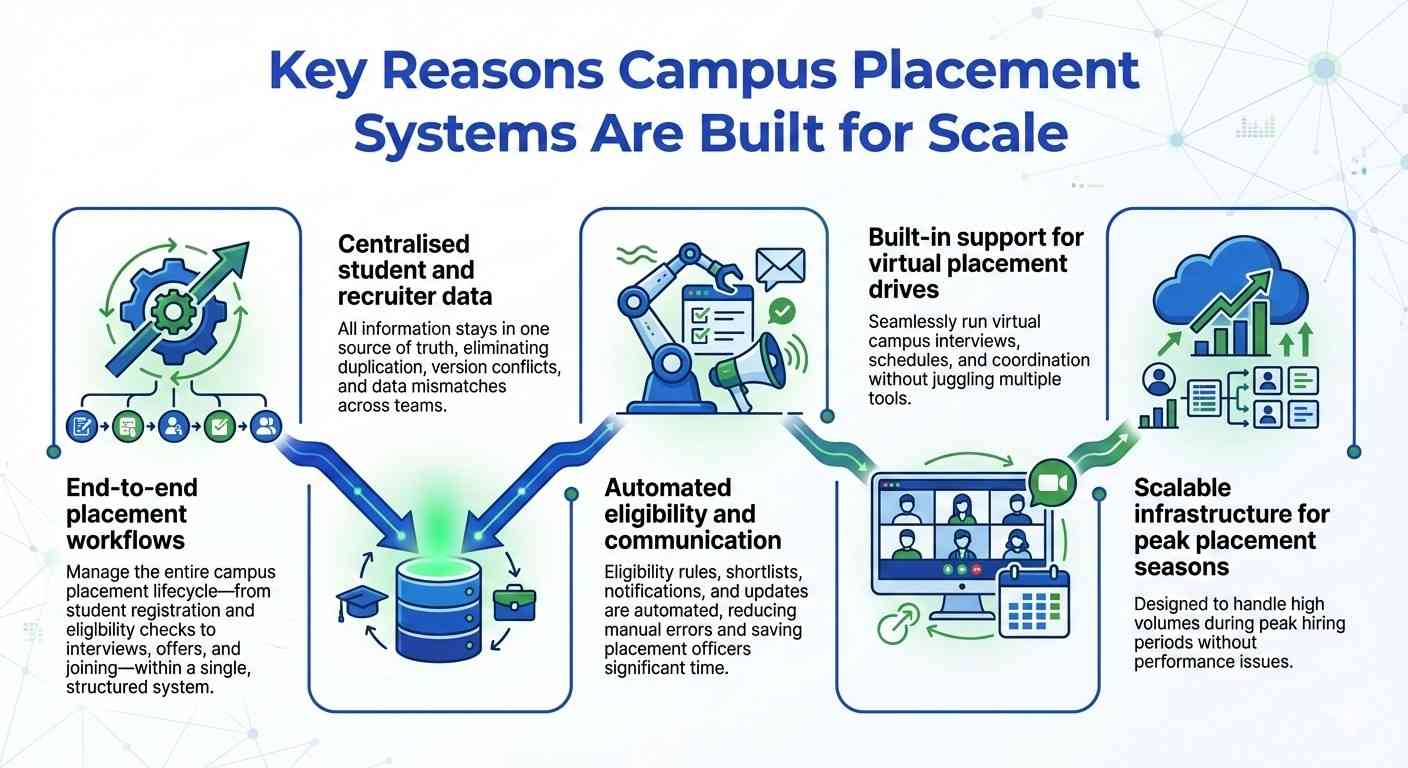
Superset is built specifically for Indian and global campus placement realities—supporting scale, diversity, and institutional workflows with minimal operational friction.
Superset’s Approach to Campus Placement Transformation
Superset goes beyond being a simple software tool—it functions as a complete campus placement ecosystem designed to handle the scale and complexity of modern campus placements. Instead of fragmented spreadsheets and manual coordination, Superset brings every placement activity onto a single, structured platform.
- Run large-scale campus placements from a single platform: Universities can manage thousands of students, multiple recruiters, and parallel drives centrally, eliminating data silos and operational confusion.
- Manage virtual campus interviews seamlessly: Superset supports end-to-end coordination of virtual campus interviews, including scheduling, communication, and real-time updates, reducing last-minute disruptions.
- Offer recruiters a professional, transparent experience: Recruiters gain clear visibility into candidate pipelines, eligibility, and interview progress, building trust and improving repeat participation.
- Empower placement officers with automation and insights: Automated workflows, real-time dashboards, and actionable reports help placement teams focus on strategy rather than manual tasks.
By replacing spreadsheets with a structured campus placement system, universities regain control, visibility, and long-term placement credibility.
The Real Question: What’s the Cost of Waiting?
Delaying the move from spreadsheets to a structured campus placement system comes with hidden but compounding costs. As campus placement volumes increase, operational cracks begin to show:
- Errors multiply: Manual data entry, duplicate sheets, and version mismatches lead to incorrect eligibility lists, missed interview updates, and offer tracking mistakes that directly impact students and recruiters.
- Trust erodes: Inconsistent information and last-minute corrections reduce confidence among students, recruiters, and internal stakeholders in the placement process.
- Teams burn out: Placement officers spend excessive time fixing errors, coordinating updates, and managing chaos instead of focusing on strategic outcomes.
- Recruiter satisfaction drops: Delays, miscommunication, and poor visibility discourage recruiters from returning for future campus placements.
Spreadsheets rarely fail all at once. Instead, they quietly create inefficiencies that escalate each placement season, eventually making large-scale campus placements difficult to manage and sustain.
Moving from Spreadsheets to a Scalable Campus Placement System
Transitioning from spreadsheets to a dedicated campus placement system is not about giving up flexibility—it’s about strengthening the entire placement process to handle scale and complexity. Here’s what universities gain:
- Reliability: Unlike spreadsheets that are prone to manual errors and version conflicts, a campus placement system ensures a single source of truth for student data, eligibility, offers, and outcomes. This reduces mistakes and builds trust with recruiters and students.
- Speed: Automated workflows replace manual data entry, filtering, and follow-ups. Placement officers can run shortlisting, scheduling, and communication faster—especially during high-volume or virtual placement drives.
- Transparency: Every action is tracked and visible to the right stakeholders. Clear audit trails, real-time dashboards, and structured communication reduce confusion and student grievances.
- Scalability: As campus placements grow in volume and complexity, systems like Superset scale effortlessly—handling multiple drives, recruiters, and virtual campus interviews without operational breakdowns.
By adopting platforms like Superset, universities not only streamline campus placements but also enhance credibility, professionalism, and long-term institutional reputation.
Conclusion
Spreadsheets may have supported campus placement in the past, but they cannot sustain today’s scale, complexity, or expectations. As campus placements expand to include virtual placement drives, virtual campus interviews, and multi-stakeholder coordination, operational cracks become unavoidable. A purpose-built campus placement system brings structure, transparency, and control where spreadsheets fall short. Platforms like Superset help universities move from reactive execution to strategic placement management. For placement teams aiming to improve outcomes, credibility, and efficiency, adopting a scalable campus placement portal is no longer optional—it’s essential.