



Choosing the right placement portal has become one of the most important technology decisions for universities today. As recruiter expectations evolve, student volumes grow, and campus hiring becomes increasingly digital, placement teams need more than a system to publish job opportunities. They need a platform that simplifies operations, improves recruiter collaboration, enhances the student experience, and scales with institutional growth.
For many universities, the placement office has transformed significantly over the past few years. What was once a department focused on coordinating a limited number of campus drives is now expected to manage relationships with hundreds of recruiters, support thousands of students, coordinate internships and full-time opportunities, automate communication, and provide real-time placement insights to institutional leadership.
This shift has exposed the limitations of traditional placement management processes.
Many institutions still depend on disconnected spreadsheets, emails, messaging groups, and multiple standalone tools to manage campus placements. While these methods may work for smaller institutions, they become increasingly difficult to sustain as recruiter participation and student numbers grow. Manual eligibility verification, repetitive communication, inconsistent student records, and fragmented reporting consume valuable time that placement teams could otherwise spend building stronger employer relationships.
A modern placement portal addresses these operational challenges by bringing students, recruiters, and placement teams onto a single connected platform. Instead of treating placement management as a collection of independent tasks, it creates a structured workflow that supports every stage of the campus recruitment process, from employer engagement and student registrations to assessments, interviews, offers, and placement analytics.
However, not every placement portal delivers the same value.
Many universities evaluate software based primarily on feature lists or pricing. Others choose a platform because it has been recommended by another institution without fully understanding whether it aligns with their own placement processes. In reality, selecting the right platform requires a broader evaluation of usability, automation, scalability, recruiter experience, and long-term institutional needs.
This guide provides a practical evaluation framework to help universities make that decision with confidence.
Rather than comparing products based on marketing claims, we’ll explore the operational capabilities that actually improve campus placement outcomes, strengthen recruiter engagement, and enable placement teams to work more efficiently.
Whether your institution is planning to replace an existing system or implementing a placement cell online for the first time, this framework will help identify what truly matters before making an investment.
Why Universities Are Rethinking Placement Portals
Campus recruitment has evolved far beyond organising placement drives and publishing notices.
Today’s placement offices operate at the intersection of multiple stakeholders. Students expect a seamless digital experience throughout their placement journey. Recruiters expect faster coordination, accurate candidate information, and simplified hiring workflows. University leadership expects better placement outcomes supported by meaningful data and reporting.
Meeting all these expectations simultaneously is challenging when placement activities continue to rely on manual coordination.
As universities expand academic programs and student intake increases, placement teams often experience similar operational issues.
Recruiters request candidate lists through email while student information resides across multiple spreadsheets. Eligibility verification becomes repetitive because criteria differ for every hiring drive. Interview schedules change frequently, requiring continuous communication between recruiters, students, and faculty coordinators. Preparing placement reports often involves compiling information from several disconnected sources.
These challenges are rarely caused by a lack of effort from placement officers.
Instead, they reflect systems that were never designed to support the scale and complexity of modern campus recruitment.
This is one of the reasons universities worldwide are increasingly investing in technology that centralises placement operations instead of managing each activity independently.
According to Superset’s brand positioning, modern campus recruitment requires connected infrastructure that brings together employers, universities, and students through a unified ecosystem rather than fragmented workflows. This focus on centralisation, visibility, automation, and scalability reflects how placement operations have evolved over the last decade.
The conversation has therefore shifted from “Do we need placement software?” to “Which placement portal can best support our institution’s long-term placement strategy?”
That distinction is significant because universities are no longer purchasing software simply to digitise existing processes. They are investing in platforms that can improve recruiter relationships, simplify administration, increase operational transparency, and ultimately strengthen campus placements.
What Makes a Modern Placement Portal Different?
Many software vendors describe their products as placement portals.
However, there is a considerable difference between a system that stores information and one that actively supports the complete placement lifecycle.
Traditionally, placement portals focused primarily on publishing opportunities and collecting student applications. While useful, these systems often required placement officers to manage the remaining workflow manually. Communication happened through email. Eligibility checks required spreadsheets. Recruiters coordinated interviews separately. Reports had to be created manually after every hiring cycle.
Modern placement platforms take a fundamentally different approach.
Rather than digitising isolated activities, they connect the complete placement ecosystem into a structured workflow.
For universities, this means placement teams can manage recruiter engagement, student registrations, eligibility rules, application tracking, interview scheduling, communication, reporting, and analytics from a central environment instead of switching between multiple tools.
Students benefit from greater transparency throughout their placement journey. They can maintain a single professional profile, discover relevant opportunities, monitor application progress, receive timely updates, and participate in recruitment activities through one platform.
Recruiters also experience significant improvements. Instead of relying on repeated email exchanges, they gain structured access to eligible candidates, coordinated hiring workflows, assessment management, interview scheduling, and consolidated hiring information.
This ecosystem approach aligns closely with Superset’s positioning as an end-to-end infrastructure for campus hiring and placement, connecting employers, universities, and students through a single platform rather than solving only one part of the recruitment process.
The distinction may appear subtle, but its operational impact is significant.
A traditional placement portal digitises administrative work.
A modern placement platform improves how campus recruitment itself operates.
Signs Your Current Placement Portal Is Holding Your University Back
Many universities continue using systems that were implemented several years ago. While these platforms may still perform basic functions, changing recruiter expectations and increasing placement complexity often expose operational limitations that become more noticeable over time.
If your placement team frequently spends more time coordinating information than engaging with recruiters and supporting students, it may indicate that the underlying system is no longer keeping pace with institutional requirements.
Some of the most common warning signs include:
- Placement officers spend hours verifying student eligibility manually.
- Recruiters repeatedly request information already available elsewhere.
- Students rely on emails or messaging groups to understand application status.
- Placement reports require significant manual compilation every semester.
- Different departments maintain separate placement records.
- Internship and campus placement workflows operate independently.
- Recruiter communication depends heavily on individual coordinators.
- Student data becomes inconsistent across multiple systems.
- There is limited visibility into placement performance throughout the academic year.
Individually, these issues may appear manageable.
Collectively, however, they increase administrative effort, reduce operational transparency, and create unnecessary friction for every stakeholder involved.
The objective of implementing a modern placement portal should not simply be replacing spreadsheets.
It should enable placement teams to spend less time managing processes and more time building stronger employer relationships, supporting students effectively, and continuously improving campus placement outcomes.
The 2026 Placement Portal Evaluation Framework
Choosing a placement portal shouldn’t come down to comparing feature lists or selecting the most affordable option. A placement platform becomes part of your university’s operational infrastructure, influencing how placement officers work, how recruiters engage with your institution, and how students experience campus recruitment.
The right platform doesn’t simply automate existing tasks. It creates a connected ecosystem where every stakeholder can collaborate more efficiently, reducing administrative effort while improving placement outcomes.
To help universities make an informed decision, we’ve created a practical evaluation framework built around the capabilities that matter most in modern campus recruitment.
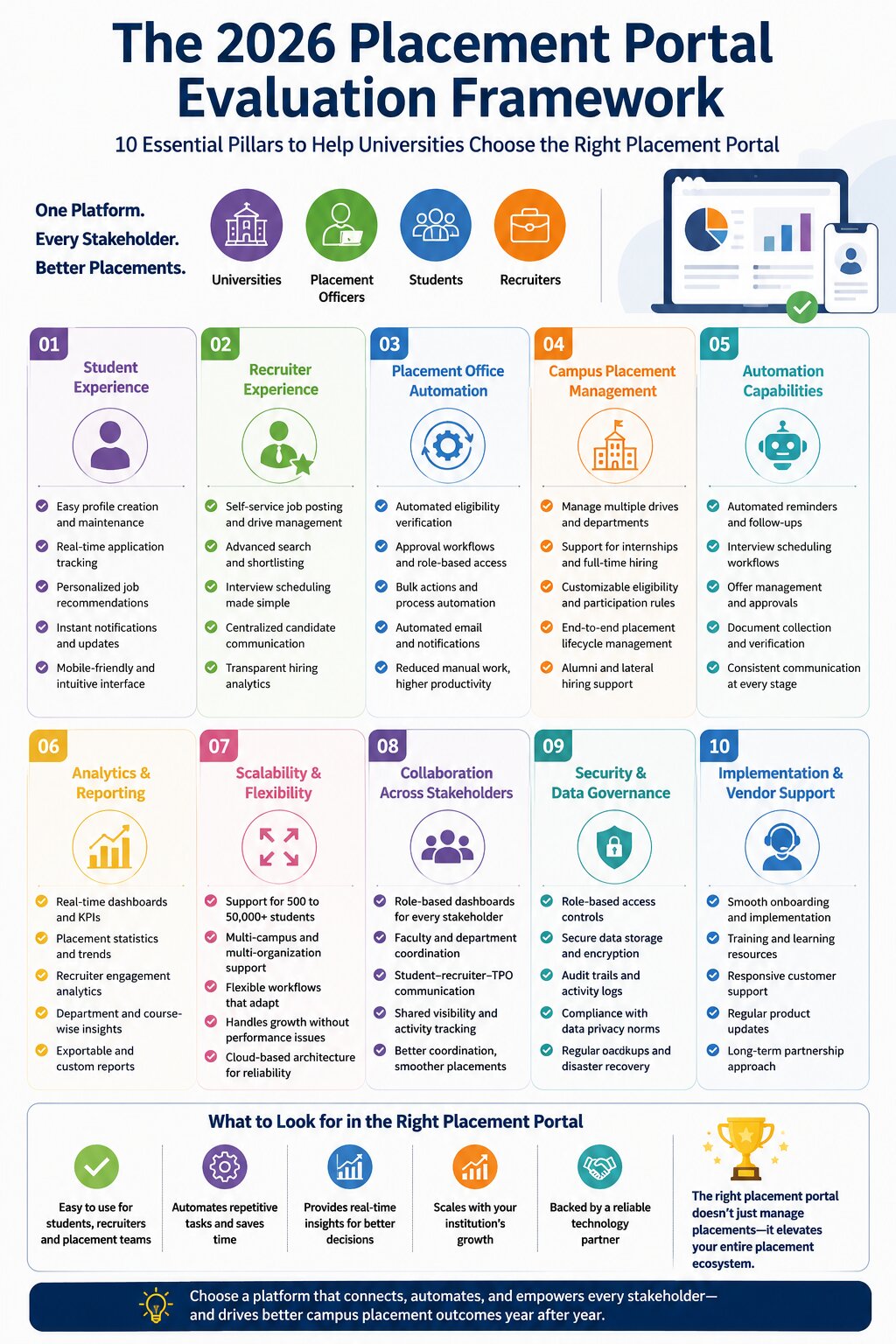
- Evaluate the Student Experience First
Every placement portal ultimately exists to improve student outcomes.
Yet many universities begin software evaluations by comparing administrative features rather than considering how students interact with the platform throughout their placement journey.
A modern placement portal should provide students with a seamless experience from profile creation through final offer acceptance.
Students should be able to:
- Build and maintain a professional profile.
- Upload resumes and supporting documents once.
- View personalised placement opportunities.
- Understand eligibility before applying.
- Track every application in real time.
- Receive timely notifications about assessments and interviews.
- Monitor offer status without contacting the placement office.
When students rely on emails, messaging groups or individual coordinators simply to understand where they stand, the technology is not reducing complexity—it is adding another layer to it.
A well-designed student experience also improves placement participation. Students engage more actively when the process is transparent, predictable and accessible from a single platform.
Questions to ask vendors
- Can students manage their entire placement journey through one portal?
- Is the experience mobile-friendly?
- Does the system automatically notify students about important updates?
- Can students track every application without contacting the placement office?
- Assess the Recruiter Experience
Universities often evaluate placement software from an internal administration perspective.
However, recruiters are equally important users of the platform.
A poor recruiter experience creates additional coordination effort for placement officers and can influence whether employers choose to return for future hiring cycles.
Recruiters expect hiring to be simple.
They should be able to:
- Publish opportunities.
- Define eligibility requirements.
- Review applications.
- Shortlist candidates.
- Schedule interviews.
- Access candidate information.
- Track hiring progress.
without repeatedly exchanging spreadsheets and emails with the placement office.
The easier it becomes for recruiters to hire through your institution, the stronger your long-term employer relationships become.
This is particularly important for universities conducting multiple campus placement drives throughout the academic year.
Questions to ask vendors
- How much recruiter activity is self-service?
- Can recruiters manage hiring independently?
- Does the platform simplify interview coordination?
- Can recruiters easily collaborate with placement officers?
- Evaluate Placement Office Automation
One of the primary reasons universities invest in a placement portal is to reduce manual administrative work.
Unfortunately, many systems digitise processes without actually automating them.
Placement officers continue to spend significant time:
- verifying eligibility
- sending reminders
- tracking documents
- maintaining spreadsheets
- updating application status
- creating reports
A modern placement portal should automate repetitive operational work so placement teams can focus on employer engagement and student success.
Look for automation across:
- eligibility verification
- approval workflows
- student communication
- interview scheduling
- recruiter notifications
- offer management
- document collection
- report generation
Automation doesn’t replace the placement office.
It enables placement officers to spend more time creating value rather than managing administration.
- Can the Platform Scale With Your University’s Growth?
Many universities purchase software that satisfies today’s requirements without considering future growth.
The question shouldn’t be:
“Can this placement portal manage our current placement season?”
It should be:
“Will this platform still support us five years from now?”
As placement activity grows, universities often need to manage:
- larger student cohorts
- multiple departments
- postgraduate programmes
- internship drives
- full-time recruitment
- international recruiters
- alumni hiring initiatives
A scalable placement portal should support increasing operational complexity without requiring universities to redesign existing workflows every year.
- Does It Support the Complete Campus Placement Lifecycle?
Many placement portals focus primarily on publishing opportunities.
Campus recruitment, however, extends far beyond applications.
Universities should evaluate whether the platform supports every stage of campus placements, including:
Employer Engagement
Managing recruiter relationships from initial outreach through repeat hiring.
Student Registration
Maintaining accurate student records and eligibility.
Opportunity Management
Publishing internships and placement opportunities.
Application Tracking
Managing student participation.
Assessments
Supporting online evaluations where applicable.
Interview Coordination
Scheduling interviews efficiently.
Offer Management
Tracking selections and offer acceptance.
Placement Reporting
Producing meaningful placement insights.
A platform that supports the complete lifecycle creates significantly less administrative effort than multiple disconnected systems.
- Reporting and Analytics Should Drive Better Decisions
Placement data is valuable only when universities can use it to improve future outcomes.
Many institutions continue producing reports manually after every placement season.
Modern placement portals should provide visibility throughout the recruitment cycle rather than only after it ends.
Placement officers should be able to answer questions like:
- Which companies hired the most students?
- Which departments achieved the highest placement rates?
- Which drives generated the highest participation?
- Where are students dropping off?
- Which recruiters returned this year?
- Which skills are employers hiring for?
Analytics should support continuous improvement rather than simply documenting historical activity.
- Consider Collaboration Across Stakeholders
Campus placements involve far more people than placement officers alone.
Faculty coordinators, department heads, recruiters, students and institutional leadership all contribute to placement success.
A placement portal should improve collaboration rather than creating additional communication layers.
Ask whether the platform supports:
- department-level visibility
- faculty coordination
- recruiter collaboration
- student communication
- leadership reporting
The more effectively stakeholders collaborate, the smoother placement operations become.
- Security, Privacy and Data Governance Matter
Placement portals manage significant volumes of student and recruiter information.
Universities should therefore evaluate:
- access controls
- permission management
- audit trails
- secure document storage
- user authentication
- data privacy practices
Technology should simplify operations without compromising institutional governance.
- Evaluate Vendor Partnership — Not Just Software
Selecting a placement portal is not simply purchasing software.
It is beginning a long-term operational partnership.
Implementation quality often influences success more than individual features.
Universities should understand:
- onboarding process
- implementation timelines
- training support
- customer success model
- product improvements
- technical support availability
A responsive technology partner helps placement teams adapt as institutional requirements evolve.
- Think Beyond Software — Evaluate the Ecosystem
Perhaps the most overlooked evaluation criterion is ecosystem strength.
A placement portal should not exist in isolation.
It should connect universities, recruiters and students through a structured hiring ecosystem.
According to Superset’s positioning, modern campus hiring benefits from connected infrastructure that centralises interactions across employers, universities and students while improving visibility, scalability and operational efficiency.
That ecosystem approach creates value beyond individual software features because every stakeholder benefits from working within a connected placement environment.
Placement Portal Evaluation Scorecard
| Evaluation Area | Why It Matters |
| Student Experience | Improves participation and transparency |
| Recruiter Experience | Strengthens employer engagement |
| Placement Office Automation | Reduces manual effort |
| Campus Placement Workflow | Connects the complete hiring lifecycle |
| Reporting & Analytics | Enables continuous improvement |
| Scalability | Supports institutional growth |
| Collaboration | Improves stakeholder coordination |
| Security | Protects institutional data |
| Implementation Support | Accelerates adoption |
| Ecosystem Strength | Builds long-term placement success |
Traditional Placement Portal vs Modern Placement Platform
The term placement portal is often used broadly, but not all platforms deliver the same level of operational value. Many universities continue using systems designed primarily to publish opportunities and collect applications. While these systems serve a basic purpose, today’s campus recruitment environment demands much more.
Modern placement platforms support the complete placement lifecycle by connecting placement officers, students, recruiters, and university leadership through one integrated ecosystem.
| Capability | Traditional Placement Portal | Modern Placement Platform |
| Student Registration | Basic profile collection | Centralised student profiles with application tracking |
| Recruiter Management | Manual communication | Self-service recruiter workflows |
| Eligibility Verification | Manual checks | Automated eligibility rules |
| Campus Drives | Individually managed | Multi-drive management across departments |
| Interview Scheduling | Email and spreadsheets | Integrated scheduling workflows |
| Communication | Manual emails and messaging | Automated notifications and updates |
| Placement Analytics | Manual reports | Real-time dashboards and insights |
| Internship Management | Often separate | Unified internship and placement workflows |
| Scalability | Limited | Supports institutional growth |
| Collaboration | Fragmented | Connected ecosystem for all stakeholders |
The objective is not simply to digitise placement activities but to create an environment where every stakeholder can work more efficiently while improving student outcomes.
15 Questions Every Placement Officer Should Ask Before Choosing a Placement Portal
Selecting a placement portal is a long-term decision. Beyond demonstrations and feature lists, placement officers should evaluate how well the platform supports day-to-day operations.
Consider asking vendors:
Student Experience
- Can students manage their complete placement journey from one platform?
- Does the portal provide real-time application tracking?
- Is the interface intuitive enough to minimise training?
Recruiter Experience
- Can recruiters independently manage hiring activities?
- Does the platform simplify candidate shortlisting?
- How are interviews coordinated?
Placement Operations
- Can eligibility rules be configured without manual intervention?
- Does the platform automate communication?
- Can internships and campus placements be managed together?
- How easily can multiple departments collaborate?
Reporting
- Are placement reports available in real time?
- Can placement officers generate customised reports?
- Does the platform provide historical placement insights?
Growth & Support
- Can the platform support future institutional growth?
- What onboarding and implementation support is provided?
- How frequently is the platform updated?
Universities that ask these questions early are better positioned to choose a platform that supports long-term success rather than solving only today’s operational challenges.
Common Mistakes Universities Make When Selecting Placement Software
Choosing technology solely based on price often leads to higher operational costs later.
Some of the most common evaluation mistakes include:
Focusing Only on Features
Feature lists rarely reflect day-to-day usability. The quality of workflows matters more than the number of features.
Ignoring Recruiter Experience
Recruiters are one of the primary users of the platform. If hiring becomes difficult for employers, recruiter engagement can decline over time.
Underestimating Student Adoption
Even the most advanced system delivers limited value if students struggle to use it effectively.
Overlooking Scalability
Today’s requirements may differ significantly from institutional needs three years from now.
Treating Implementation as an Afterthought
Technology adoption depends as much on onboarding, change management, and support as it does on software functionality.
How the Right Placement Portal Improves Campus Placements
Technology alone cannot improve placement outcomes.
However, the right placement platform removes operational barriers that often slow campus recruitment.
When repetitive administrative work is reduced, placement teams gain more time to:
- build stronger recruiter relationships
- organise additional hiring opportunities
- engage students more effectively
- analyse placement performance
- improve institutional planning
Students benefit from greater transparency throughout the placement process.
Recruiters experience faster coordination and better candidate visibility.
University leadership gains access to meaningful placement insights that support strategic decision-making.
Over time, these improvements contribute to a stronger campus placement ecosystem rather than simply a more efficient administrative process.
Why Connected Placement Platforms Create Long-Term Value
The most successful universities no longer evaluate placement software as an isolated technology purchase.
Instead, they view it as part of a broader digital ecosystem connecting students, recruiters, placement officers, faculty, and institutional leadership.
This connected approach reduces operational silos and creates a consistent experience throughout the placement lifecycle.
According to Superset’s positioning, connecting employers, universities, and students through an integrated ecosystem helps simplify campus hiring, improve collaboration, and support placement operations at scale.
Rather than replacing existing placement processes, connected platforms enable universities to modernise them while maintaining operational consistency.
How Superset Supports Modern Placement Operations
Universities evaluating placement technology often look beyond software features. They want a platform that supports long-term placement success while reducing administrative complexity.
Superset is designed as an end-to-end campus hiring and placement platform connecting universities, employers, and students through a shared ecosystem. Across its university and employer offerings, the platform supports placement operations through capabilities such as student engagement, employer collaboration, campus hiring workflows, assessments, interviews, communication, and analytics.
For placement teams, this means fewer disconnected systems, improved visibility across recruitment activities, and more structured placement operations.
Rather than functioning solely as a placement portal, Superset is positioned as a platform that helps institutions modernise the complete campus recruitment experience while strengthening collaboration with recruiters and improving student engagement.
Final Thoughts
Choosing the right placement portal is no longer simply an IT decision.
It is a strategic investment in how your university connects students with career opportunities, collaborates with recruiters, and manages campus recruitment over the long term.
As placement operations become more complex, universities need technology that supports the complete placement lifecycle—not just individual administrative tasks.
The most effective platforms simplify workflows, improve visibility, automate repetitive activities, and strengthen collaboration between every stakeholder involved in campus recruitment.
When evaluating placement portals, universities should therefore look beyond feature comparisons and consider how the platform will support institutional growth, recruiter relationships, operational efficiency, and student success over the coming years.
The right platform does more than digitise placement activities.
It creates the foundation for a more connected, scalable, and future-ready placement ecosystem.
Frequently Asked Questions
1. What is a placement portal?
A placement portal is a digital platform that helps universities manage campus recruitment by connecting students, recruiters, and placement teams through a structured hiring process.
2. How does a placement portal improve campus placements?
A placement portal improves campus placements by simplifying student registrations, employer engagement, application management, interview coordination, communication, and reporting while reducing manual administrative effort.
3. What features should universities look for in a placement portal?
Universities should evaluate student experience, recruiter workflows, automation, analytics, scalability, security, collaboration capabilities, implementation support, and long-term platform flexibility.
4. How is a modern placement platform different from a traditional placement portal?
Modern placement platforms support the complete placement lifecycle through connected workflows, automation, analytics, and collaboration instead of only publishing opportunities.
5. Can placement portals manage internships as well as campus placements?
Many modern placement platforms support both internship management and campus placement workflows through a unified system.
6. Why is automation important for placement offices?
Automation reduces repetitive administrative work such as eligibility verification, communication, scheduling, and reporting, allowing placement officers to focus more on employer engagement and student success.
7. How do placement portals improve recruiter experience?
Placement portals simplify recruiter interactions by providing structured hiring workflows, candidate visibility, scheduling support, and streamlined communication.
8. What should placement officers ask before selecting placement software?
Placement officers should evaluate usability, scalability, implementation support, reporting capabilities, recruiter experience, automation, and ecosystem strength before making a decision.
9. How does Superset help universities manage campus placements?
Superset supports universities through a connected campus hiring and placement ecosystem that brings together students, recruiters, and placement teams while supporting structured recruitment workflows.
10. Is a placement portal suitable for colleges of all sizes?
Yes. Modern placement platforms are designed to support institutions with varying student populations while providing the flexibility to scale as placement operations grow.