



Campus placement outcomes are no longer determined by student talent alone.
Universities today operate in a far more competitive placement environment than they did a few years ago.
Recruiters expect faster coordination. Students expect transparency and access. Hiring cycles have become increasingly digital. Companies evaluate institutions not only based on student quality, but also on placement readiness, process efficiency, and operational consistency.
This means placement success is no longer dependent on one factor.
It depends on how effectively universities manage the entire placement ecosystem.
Universities trying to improve placement outcomes must first understand how modern campus placement processes actually function operationally across universities and recruiters. Institutions that understand placement workflows structurally are usually better positioned to improve recruiter engagement, student participation, and placement scalability.
Institutions that consistently achieve strong placement outcomes usually have one thing in common:
they operate through structured placement systems instead of reactive placement processes.
This is where modern campus placement software and connected placement portals are increasingly becoming critical infrastructure for universities attempting to scale placement operations efficiently.
Improving placement rates today requires more than simply inviting additional recruiters.
It requires visibility, coordination, preparation, communication, and scalable execution.
Here are the most important strategies universities should focus on.
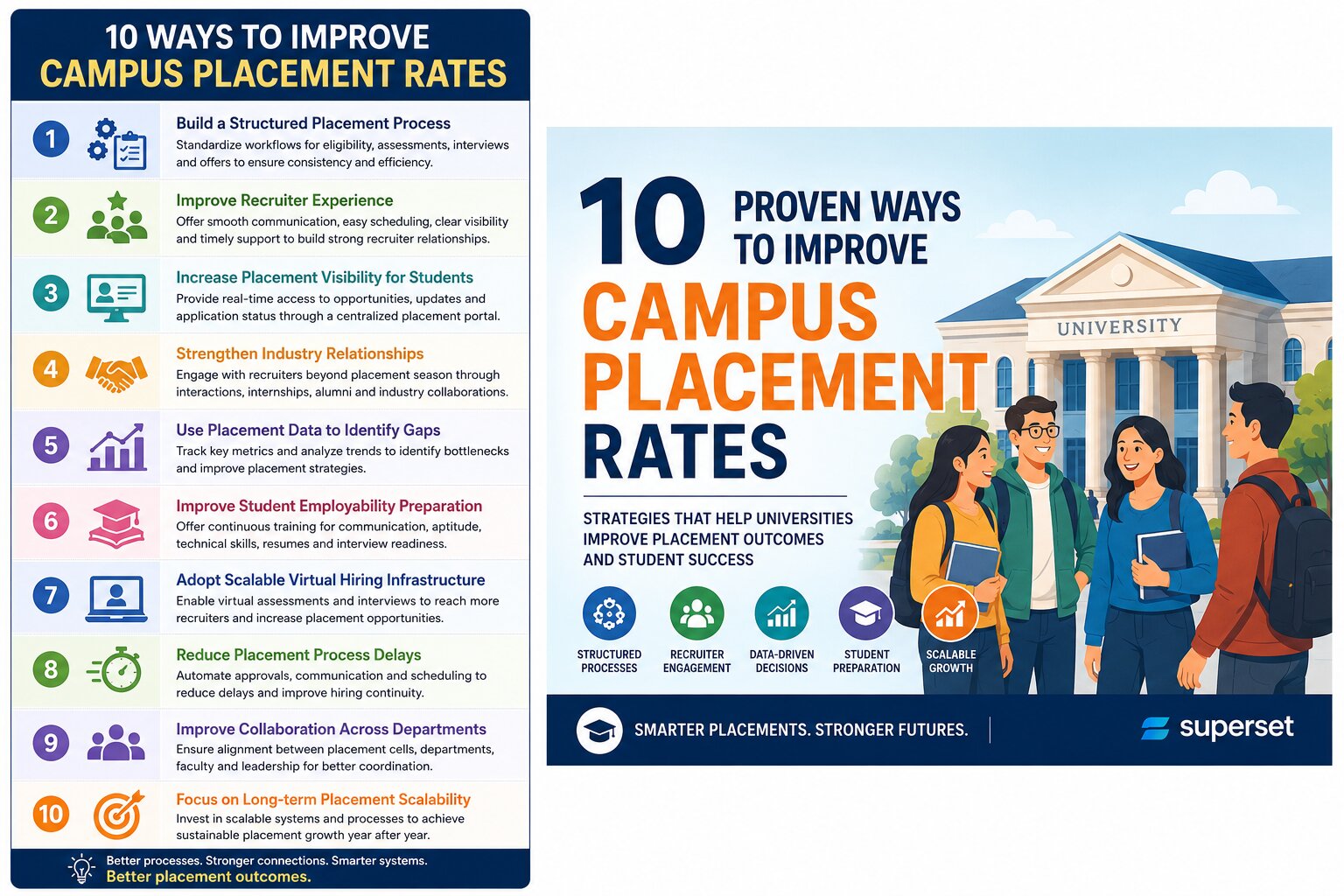
1. Build a structured placement process instead of relying on manual coordination
One of the biggest reasons placement rates stagnate is process inconsistency.
Many universities still manage placements through spreadsheets, fragmented communication, and manual tracking systems.
Initially, these approaches appear manageable.
But once placement activity scales across departments, recruiters, assessments, and hiring timelines, operational gaps begin affecting placement outcomes directly.
Students miss updates. Eligibility tracking becomes inconsistent. Recruiters face delays. Placement teams spend more time coordinating workflows manually instead of focusing on strategic engagement.
Universities that already understand the broader campus placement ecosystem are usually better positioned to improve execution quality because they focus on workflow continuity instead of isolated placement activities.
Universities that improve placement performance usually transition toward centralised systems that standardise workflows across the placement lifecycle.
Structured campus placement software helps institutions centralise:
- student eligibility management
- recruiter coordination
- assessment workflows
- interview scheduling
- reporting and analytics
- placement communication
The goal is not simply digitisation.
It is operational consistency.
2. Improve recruiter experience during campus hiring
Universities often focus heavily on student readiness while overlooking recruiter experience.
But recruiters evaluate institutions based on operational efficiency as much as candidate quality.
When hiring teams encounter:
- delayed communication
- fragmented coordination
- unclear schedules
- inconsistent candidate pipelines
- limited visibility
their engagement quality decreases.
This directly affects future hiring relationships.
Strong placement institutions create predictable recruiter experiences.
Recruiters should be able to:
- Access candidate data easily
- Coordinate assessments smoothly
- Track hiring progress clearly
- Communicate through centralised systems
- Schedule interviews efficiently
Modern campus recruitment platforms help universities reduce friction across recruiter workflows while improving hiring continuity.
This becomes increasingly important as organisations scale fresher hiring operations across multiple campuses.
3. Increase placement visibility for students
Students perform better when they clearly understand placement opportunities, timelines, and expectations.
One of the most common placement challenges inside universities is information fragmentation.
Students often struggle with:
- Unclear application timelines
- Missed recruiter updates
- Inconsistent eligibility visibility
- Delayed communication
- Confusion around placement stages
These gaps reduce participation quality and create unnecessary anxiety.
A centralised placement portal improves transparency by giving students real-time visibility into:
- Job opportunities
- Application status
- Placement schedules
- Recruiter communication
- Assessment updates
This creates a more structured placement experience while improving overall engagement levels.
And higher engagement typically leads to better placement participation and outcomes.
4. Strengthen industry relationships beyond placement season
Many universities approach recruiter engagement transactionally.
Companies are contacted primarily during placement cycles and communication reduces significantly afterward.
This weakens long-term hiring relationships.
Institutions that consistently improve placement rates usually maintain ongoing recruiter engagement throughout the year.
This includes:
- Industry interaction sessions
- Hiring trend discussions
- Internship collaborations
- Curriculum alignment conversations
- Alumni engagement
- Virtual networking initiatives
The stronger the industry relationship ecosystem becomes, the stronger placement continuity becomes over time.
Placement success is rarely built during recruitment season alone.
It is built through continuous institutional credibility.
Industry hiring trends shared by LinkedIn Talent Solutions also show that long-term recruiter engagement improves hiring consistency significantly.
5. Use placement data to identify operational gaps
Many placement teams collect data.
Far fewer use it strategically.
Modern placement systems allow universities to track:
- Placement participation rates
- Recruiter conversion ratios
- Department-level performance
- Assessment progression
- Hiring timelines
- Offer acceptance trends
This visibility helps placement teams identify operational bottlenecks early.
For example:
- Are students dropping off after assessments?
- Are certain departments underperforming?
- Are interview scheduling delays affecting recruiter experience?
- Are communication gaps reducing participation?
Without structured analytics, these patterns remain invisible.
Data visibility transforms placements from reactive coordination into measurable operational management.
This is one of the major reasons institutions are increasingly adopting centralised online campus placement software infrastructure.
6. Improve student employability preparation continuously
Placement preparation should not begin during the final-year recruitment season.
Universities with strong placement outcomes typically build employability development into the student lifecycle itself.
This includes:
- Communication skills training
- Aptitude preparation
- Interview readiness
- Resume development
- Mock assessments
- Technical skill alignment
The objective is not simply to help students clear interviews.
It is preparing students for evolving industry expectations.
Placement readiness becomes significantly stronger when universities align preparation efforts continuously rather than reactively.
This is also where structured fresher hiring frameworks become valuable for understanding recruiter expectations at scale.
7. Adopt a scalable virtual hiring infrastructure
Campus hiring has evolved significantly beyond physical placement drives.
Today, companies increasingly operate through:
- Virtual assessments
- Remote interviews
- Hybrid hiring models
- Digital onboarding workflows
Universities relying entirely on offline coordination often struggle to support these workflows efficiently.
Scalable virtual campus hiring infrastructure allows institutions to:
- Support remote recruitment
- Coordinate assessments centrally
- Reduce scheduling delays
- Improve recruiter accessibility
- Expand hiring participation
Virtual hiring infrastructure also increases placement reach because recruiters can engage with universities without geographical limitations.
This becomes especially important for institutions attempting to improve placement opportunities across diverse recruiter categories.
8. Reduce placement process delays
Delays are one of the most underestimated factors affecting placement outcomes.
When placement workflows slow down:
- Recruiters lose momentum
- Students disengage
- Coordination complexity increases
- Scheduling conflicts rise
- Hiring continuity weakens
Universities that improve placement rates usually focus heavily on reducing operational lag across:
- Approvals
- Communication
- Assessments
- Interview coordination
- Reporting
- Offer management
Automation plays a major role here.
Modern placement automation software reduces dependency on continuous manual coordination while improving process continuity across hiring stages.
The faster and more structured the process becomes, the stronger recruiter’s confidence becomes.
9. Improve collaboration between departments and placement teams
Placement performance is rarely driven by placement cells alone.
Academic departments, faculty members, student coordinators, and institutional leadership all influence placement outcomes.
However, many universities operate through disconnected internal coordination systems.
This creates:
- Inconsistent communication
- Delayed approvals
- Fragmented student tracking
- Operational duplication
Strong placement institutions create collaborative ecosystems where departments and placement teams operate through shared visibility.
This improves:
- Eligibility management
- Student preparation
- Recruiter coordination
- Placement communication
- Reporting accuracy
Connected placement infrastructure helps institutions reduce fragmentation while improving institution-wide placement alignment.
Research published by NASSCOM also highlights how connected digital infrastructure is becoming central to scalable talent ecosystems.
10. Focus on long-term placement scalability, not short-term placement numbers
Some universities focus heavily on maximising placement numbers during a single cycle.
But sustainable placement growth requires long-term infrastructure thinking.
Institutions that consistently improve placement outcomes invest in:
- Scalable systems
- Recruiter ecosystems
- Placement analytics
- Workflow automation
- Student engagement infrastructure
- Digital hiring readiness
This creates operational stability across placement cycles instead of temporary improvements.
Platforms like Superset support this transition by helping universities manage placements through connected workflows rather than fragmented administrative systems.
Universities that invest in scalable placement infrastructure often see stronger long-term outcomes because they treat campus placement as a connected operational ecosystem rather than a seasonal activity.
The future of campus hiring will increasingly depend on how effectively institutions build scalable placement ecosystems.
Not just how many companies they invite during placement season.
Final Thought
Improving campus placement rates requires much more than increasing recruiter participation.
Universities today must manage placements as connected operational ecosystems involving students, recruiters, workflows, communication, analytics, and hiring infrastructure.
Institutions that continue operating through fragmented systems will increasingly struggle as campus hiring complexity grows.
Institutions that adopt structured placement strategies, centralised workflows, and scalable digital infrastructure will be better positioned to improve placement outcomes consistently over time.
Because modern placements are no longer driven only by opportunity availability.
They are driven by operational execution quality.