



India produces one of the largest pools of graduates in the world every year. For organisations looking to build a strong workforce pipeline, campus hiring has become a critical recruitment strategy. Companies across industries, including technology, consulting, banking, manufacturing, and startups, rely on campus recruitment to identify and hire young talent early.
However, campus recruitment today is far more complex than traditional campus visits and interview sessions. Recruiters must manage thousands of applications, coordinate with multiple universities, evaluate candidates through assessments, and maintain strong candidate engagement throughout the hiring cycle.
To address these challenges, organisations are increasingly adopting campus hiring platform, campus hiring automation tools, and online campus hiring platforms that allow recruiters to scale hiring efficiently while improving candidate experience.
For HR heads, HR managers, CEOs, and founders, mastering campus recruitment is no longer optional. It is a strategic initiative that supports long-term workforce planning and business growth.
This guide explores how campus hiring in India has evolved, the challenges recruiters face, and how modern technology is transforming campus recruitment into a scalable and data-driven process.
What is Campus Hiring and Why It Matters in India
Campus hiring refers to the process through which organisations recruit students directly from universities and colleges before or immediately after graduation. Companies typically collaborate with university placement cells to identify talented students and offer them roles such as graduate trainees, entry-level engineers, analysts, or interns.
India has one of the largest higher education systems globally. According to the All India Survey on Higher Education (AISHE), India has over 1,000 universities and more than 40,000 colleges, producing millions of graduates every year. This vast academic ecosystem creates an enormous opportunity for companies seeking early-career talent.
Why Campus Hiring Is Important for Organizations
Access to Emerging Talent
Universities are home to young professionals who are entering the workforce with updated academic knowledge and new perspectives. Hiring from campuses allows companies to bring in innovative thinking and fresh skills.
Workforce Pipeline Development
Campus hiring helps organisations build a long-term talent pipeline. Many companies hire graduates into structured training programs and develop them into future leaders within the organisation.
Cost Efficiency
Recruiting multiple candidates during campus drives often reduces the cost per hire compared to sourcing experienced professionals individually.
Cultural Alignment
Early-career employees can adapt more easily to company culture and internal processes, making them valuable long-term assets for organisations.
Because of these benefits, campus hiring continues to remain a key recruitment channel for many organisations in India.
Evolution of Campus Hiring (Offline → Virtual → Automated)
Campus hiring in India has evolved significantly over the past decade. Advancements in recruitment technology and changing workforce expectations have reshaped how companies interact with universities and students.
Traditional Campus Hiring
In the past, campus recruitment relied heavily on physical interactions. Recruiters would visit universities to conduct pre-placement presentations, distribute application forms, conduct written tests, and hold in-person interviews.
Although effective, this model had several limitations:
- High travel and logistics costs
- Limited access to campuses outside major cities
- Slow evaluation processes
- Manual data handling
As organisations expanded their hiring needs, this approach became increasingly difficult to scale.
Virtual Campus Hiring
The rise of digital recruitment tools introduced the concept of online campus hiring. Companies began conducting assessments and interviews remotely through online platforms.
Virtual hiring helped organisations:
- Reach candidates from multiple universities simultaneously
- Reduce recruitment timelines
- Eliminate travel costs
- Improve candidate accessibility
The adoption of virtual hiring accelerated rapidly during the pandemic, leading to widespread acceptance of digital recruitment models.
Automated Campus Hiring
Today, the latest evolution in campus recruitment involves campus hiring automation. Modern campus hiring platforms allow companies to automate many aspects of the hiring process, including candidate screening, interview scheduling, and communication.
Automation enables HR teams to:
- Process thousands of applications efficiently
- Identify top candidates faster
- Improve coordination across hiring teams
- Track recruitment performance using analytics
This shift toward automation is transforming campus hiring into a scalable and technology-driven recruitment strategy.
Campus Hiring Challenges for HR Leaders
Despite its advantages, campus hiring presents several operational challenges for HR teams and recruitment leaders.
High Application Volumes
Popular campus drives often attract thousands of applications for a limited number of roles. Screening such large volumes of candidates manually can slow down the recruitment process and overwhelm HR teams if the process is not completely automated.
Limited Campus Reach
Many organisations focus only on a few well-known universities. While these institutions produce strong talent, this approach may cause recruiters to overlook skilled candidates from other colleges.
Expanding campus outreach requires significant coordination and resource allocation.
Coordination with Multiple Stakeholders
Campus hiring requires collaboration between several parties, including recruiters, university placement officers, hiring managers, and candidates. Coordinating schedules, interviews, and assessments across multiple campuses can be complex.
Offer Dropouts
Offer acceptance and joining ratios remain a major concern in campus recruitment. Students often participate in multiple hiring processes simultaneously and may decline offers if better opportunities arise.
Lack of Data Visibility
Traditional hiring processes often provide limited insights into recruitment performance. Without accurate data, HR leaders may struggle to optimise their campus hiring strategy.
These challenges highlight the growing need for technology-enabled campus recruitment systems.
How Technology is Transforming Campus Recruitment
Technology is playing a critical role in modernising campus recruitment processes. Digital platforms now help organisations streamline hiring operations and improve recruitment efficiency.
Centralised Candidate Management
Modern campus hiring platform enables recruiters to manage candidate applications, resumes, and communications through a centralised dashboard.
This eliminates the need for multiple spreadsheets and manual tracking systems.
Automated Candidate Screening
Automated filters allow recruiters to shortlist candidates based on predefined criteria such as academic scores, course specialisation, or assessment results.
This significantly reduces the time spent on manual resume screening.
Online Assessments
Recruiters can conduct aptitude tests, coding assessments, and skill evaluations through integrated online assessment tools.
These assessments help organisations identify candidates with the required competencies before conducting interviews.
Virtual Interviewing
Video interview platforms allow recruiters and hiring managers to interact with candidates remotely, eliminating the need for physical campus visits.
Recruitment Analytics
Modern recruitment systems provide data-driven insights into hiring performance. HR teams can track important metrics such as application conversions, assessment performance, and offer acceptance rates.
By using technology effectively, organisations can scale their online campus hiring platforms while maintaining high recruitment standards.
Step-by-Step Campus Hiring Process
A structured recruitment process is essential for successful campus hiring. While the exact process may vary across organisations, most campus recruitment programs follow a similar framework.
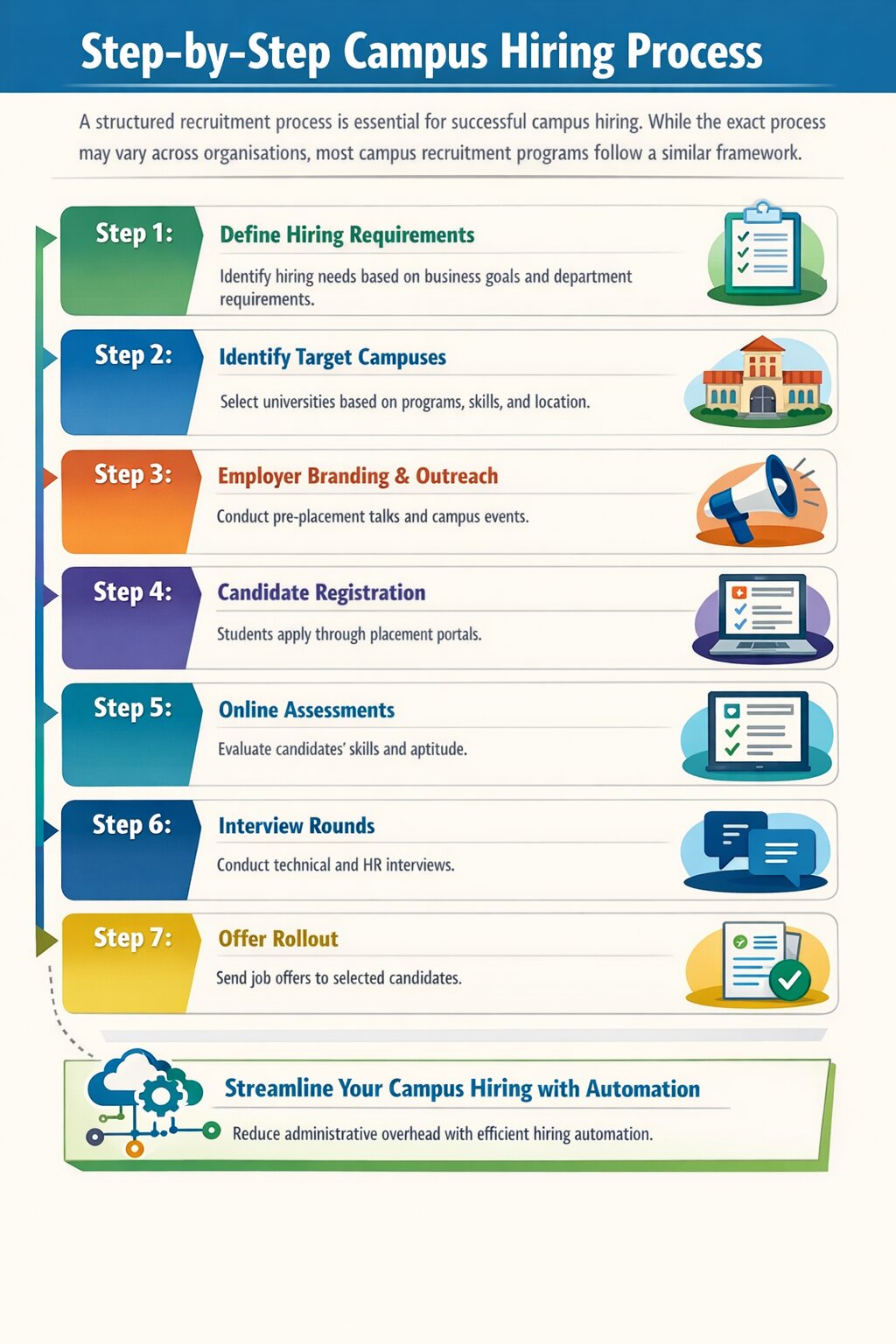
Step 1: Define Hiring Requirements
The first step involves identifying hiring needs based on business goals, workforce planning, and department requirements.
Step 2: Identify Target Campuses
Organisations select universities that align with their hiring needs based on factors such as academic programs, student skill sets, and geographic location.
Step 3: Employer Branding and Outreach
Companies often conduct employer branding activities such as pre-placement talks, webinars, and campus events to introduce students to their organisation.
Step 4: Candidate Registration
Students apply for roles through placement portals or recruitment platforms.
Step 5: Online Assessments
Organisations conduct assessments to evaluate candidates’ aptitude, technical skills, or domain knowledge.
Step 6: Interview Rounds
Shortlisted candidates undergo one or more interview rounds, including technical interviews, problem-solving assessments, and HR discussions.
Step 7: Offer Rollout
Candidates who successfully clear the selection process receive job offers and onboarding instructions.
Using campus hiring automation, companies can streamline each step and reduce administrative overhead.
Scaling Campus Hiring Across Multiple Universities
Large organisations often recruit from dozens or even hundreds of universities every year. Scaling such operations requires a well-defined strategy and technology support.
Expanding Campus Networks
Companies are increasingly expanding their campus hiring programs beyond traditional institutions. This approach allows recruiters to discover talented candidates from emerging universities.
Standardised Recruitment Workflows
Creating standardised recruitment processes helps organisations maintain consistency across multiple campuses.
Centralised Recruitment Platforms
Centralised recruitment systems allow HR teams to manage campus drives across multiple universities through a single interface.
These platforms improve coordination, streamline candidate management, and simplify communication between recruiters and universities.
Virtual Campus Hiring and Remote Assessments
Virtual hiring has become a central component of modern campus recruitment strategies.
Advantages of Virtual Campus Hiring
Wider Geographic Reach
Companies can access students from universities across different regions without physical travel.
Faster Recruitment Cycles
Online assessments and virtual interviews reduce hiring timelines and accelerate decision-making.
Reduced Operational Costs
Virtual hiring eliminates travel expenses and logistical challenges associated with traditional campus drives.
Improved Candidate Convenience
Students can participate in recruitment processes from any location, making the experience more accessible.
As a result, many organisations now use hybrid recruitment models that combine virtual and in-person hiring activities.
Data-Driven Campus Hiring Strategies
Recruitment analytics are becoming increasingly important in campus hiring. Data-driven insights help HR leaders refine their hiring strategies and improve recruitment outcomes.
Key Campus Hiring Metrics
Application-to-Selection Ratio
This metric measures how many applicants are required to make a successful hire. A lower ratio indicates a more efficient screening process.
Offer Acceptance Rate
This metric tracks the percentage of candidates who accept job offers.
Offer-to-Joining Ratio
This metric measures how many candidates who accept offers eventually join the organisation.
Time-to-Hire
Time-to-hire evaluates the total duration of the recruitment process from candidate application to offer acceptance.
Monitoring these metrics helps organisations identify bottlenecks and optimise their campus hiring strategy.
Best Tools for Campus Recruitment Automation
To manage large-scale hiring programs, organisations increasingly rely on specialised recruitment technologies.
Applicant Tracking Systems
Applicant tracking systems help recruiters manage candidate applications, track recruitment stages, and maintain organised candidate databases.
Online Assessment Platforms
Assessment platforms allow companies to evaluate candidate skills through structured tests and coding challenges.
Interview Scheduling Tools
Automated scheduling tools simplify interview coordination between recruiters, hiring managers, and candidates.
Campus Hiring Platforms
Comprehensive campus hiring software platforms combine multiple recruitment functions into a single system. These platforms support:
- Campus outreach
- Candidate registration
- Online assessments
- Interview management
- Offer tracking
- Recruitment analytics
Using integrated platforms allows organisations to streamline their online campus hiring initiatives and improve operational efficiency.
Future of Campus Hiring in India
The future of campus recruitment will be shaped by emerging technologies and changing workforce expectations.
AI-Powered Recruitment
Artificial intelligence will play a greater role in candidate screening, skill matching, and predictive hiring analytics.
Skill-Based Hiring
Organisations are increasingly focusing on practical skills and problem-solving abilities rather than relying solely on academic scores.
Hybrid Recruitment Models
Many companies are expected to adopt hybrid campus recruitment strategies that combine online assessments with selective in-person engagement.
Expanded Campus Outreach
Recruiters are gradually expanding their hiring programs to include universities beyond traditional Tier-1 institutions.
Advanced Recruitment Analytics
Data-driven insights will help HR leaders predict hiring outcomes and continuously improve their campus recruitment strategies.
Organisations that embrace these technological advancements will be better positioned to attract and hire top talent from universities across India.
Conclusion
Campus hiring remains one of the most effective ways for organisations to build a strong early-career talent pipeline. However, managing large-scale recruitment across multiple universities requires strategic planning, efficient processes, and modern technology.
By leveraging campus hiring platform, organisations can streamline recruitment workflows, improve hiring efficiency, and enhance candidate experience.
For HR leaders, CEOs, and founders, investing in a structured and technology-enabled campus hiring strategy is essential for building the workforce that will drive business growth in the years ahead.