



For organisations looking to build a strong talent pipeline, campus hiring remains one of the most effective recruitment strategies in India. Every year, millions of students graduate from universities across the country, creating an enormous opportunity for companies to identify and nurture future talent.
However, hiring from campuses is no longer as simple as visiting a few colleges and conducting interviews. Today’s recruitment landscape requires organisations to design a structured campus hiring strategy that aligns with their workforce planning, growth goals, and talent requirements.
Startups, mid-sized companies, and large enterprises all approach campus hiring differently. While startups often look for agile problem-solvers who can adapt quickly, large organisations typically focus on building long-term talent pipelines through structured graduate hiring programs.
To manage this process effectively, many organisations now rely on campus hiring software, campus hiring automation tools, and online campus hiring platforms that simplify recruitment operations and enable companies to hire from multiple universities at scale.
In this guide, we explore how organisations can build an effective campus hiring strategy, the key steps involved, and how modern campus hiring solutions are transforming graduate recruitment in India.
For a deeper understanding of how campus recruitment works and the technologies shaping modern hiring practices, you can explore our detailed guide on campus hiring in India.
Why Campus Hiring Strategy Matters More Than Ever
Campus recruitment has become increasingly competitive. Top students often receive multiple job offers, and organisations must move quickly to identify and engage talented candidates.
Without a clear strategy, companies may face several challenges:
- Hiring from the wrong campuses
- Attracting low-quality applications
- Slow recruitment cycles
- High offer dropouts
- Poor candidate engagement
A well-defined campus hiring strategy helps organisations overcome these challenges and build a scalable recruitment framework.
When supported by campus hiring platforms and automation tools, companies can manage large hiring volumes while maintaining strong candidate experiences.
Key Elements of an Effective Campus Hiring Strategy
Designing a successful campus hiring program requires more than just conducting interviews. Organisations must create a comprehensive strategy that covers planning, outreach, candidate evaluation, and engagement.
Below are the core elements of an effective campus recruitment strategy.
1. Align Campus Hiring With Workforce Planning
A successful campus hiring strategy begins with understanding future workforce requirements.
Recruitment teams should work closely with business leaders and department heads to determine:
- How many graduates need to be hired
- Which roles require entry-level talent
- Which technical or functional skills are required
- Where new hires will be located
This alignment ensures that campus hiring efforts support broader organisational growth plans.
Companies that recruit large numbers of graduates often establish structured hiring programs such as graduate trainee programs or management trainee programs.
2. Identify the Right Universities
Selecting the right universities is one of the most important aspects of campus hiring.
While Tier-1 institutions often attract significant attention, many organisations are now expanding their recruitment efforts to include Tier-2 and Tier-3 colleges as well.
This approach helps companies access a broader and more diverse talent pool.
When selecting campuses, organisations typically evaluate:
- Academic reputation of the university
- Availability of relevant courses
- Past hiring success from the campus
- Geographic diversity
- Student skill levels and employability
Using a campus hiring platform allows recruiters to manage relationships with multiple universities and discover new hiring opportunities.
3. Strengthen Employer Branding on Campuses
Students today are more informed than ever before. Before applying to companies, they research potential employers to understand career growth opportunities, company culture, and learning experiences.
Organisations that invest in employer branding tend to attract stronger candidates during campus hiring drives.
Common campus engagement activities include:
- Pre-placement talks
- Career webinars
- Hackathons and competitions
- Internship programs
- Industry workshops
These initiatives help companies build visibility and credibility among students, improving application quality.
Strong branding also helps organisations differentiate themselves in competitive hiring environments.
4. Use Online Campus Hiring to Expand Reach
Traditional campus hiring relied heavily on physical visits to universities. While this approach worked well for a limited number of campuses, it restricted the reach of recruitment programs.
Today, many companies are adopting online campus hiring strategies to expand their reach across multiple universities simultaneously.
Digital recruitment platforms enable companies to:
- Host virtual campus drives
- Conduct online assessments
- Manage candidate applications
- Schedule remote interviews
By leveraging virtual campus hiring software, recruiters can engage with students from universities across the country without the need for travel.
5. Implement Campus Hiring Automation
Managing thousands of student applications manually can overwhelm recruitment teams.
This is why many organisations are adopting campus hiring automation software to streamline hiring workflows.
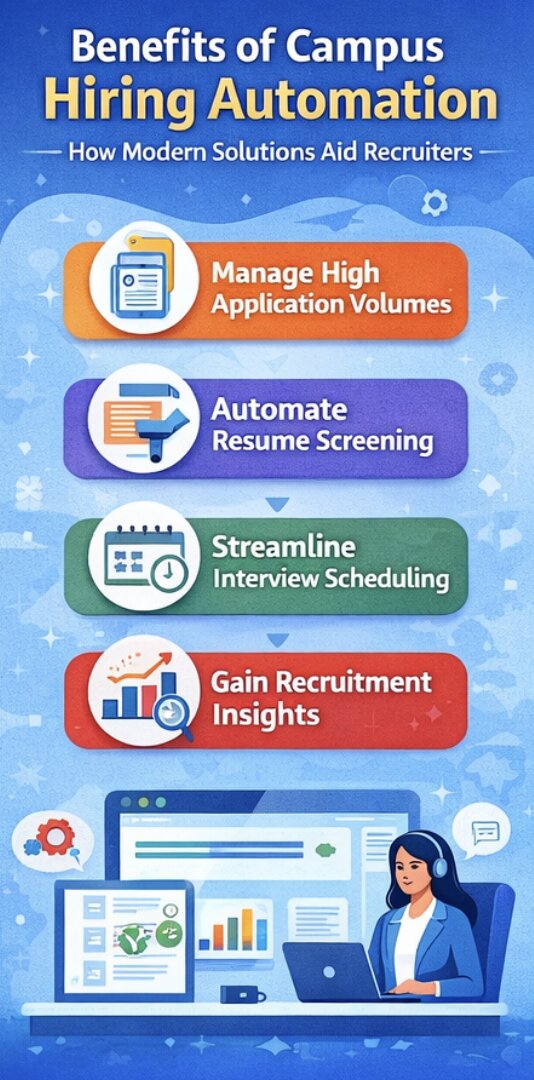
Automation helps recruiters:
- Screen candidate applications automatically
- Manage candidate pipelines
- Schedule interviews efficiently
- Track recruitment progress
- Maintain centralised hiring records
By integrating automation into their recruitment processes, companies can run scalable online campus hiring programs while reducing administrative workload.
6. Design Structured Candidate Evaluation Methods
Evaluating large numbers of candidates requires standardised assessment methods.
Companies often combine multiple evaluation techniques during campus hiring.
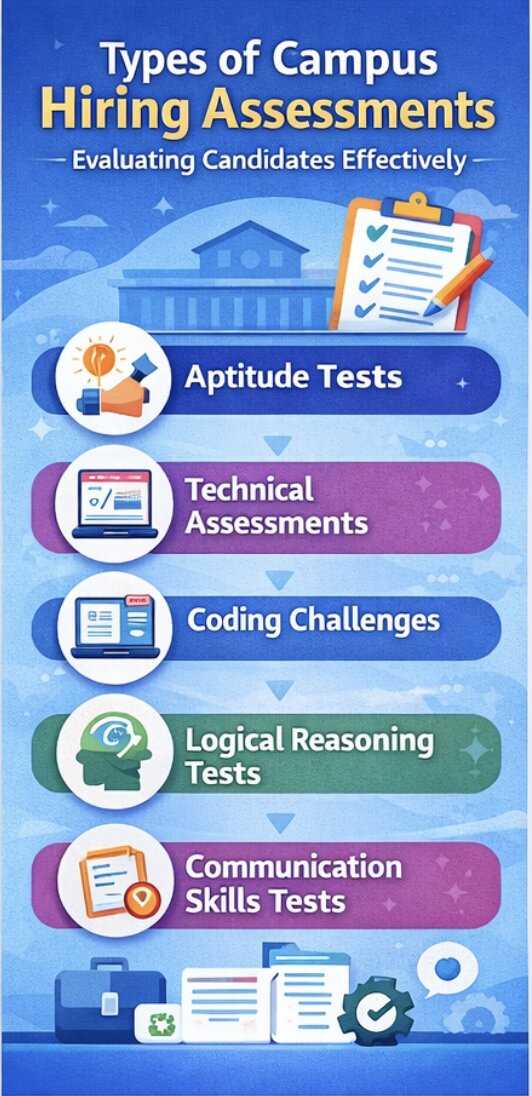
Common evaluation methods include:
- Aptitude tests
- Coding challenges
- Technical assessments
- Problem-solving exercises
- Behavioral interviews
Using virtual campus hiring platforms, organisations can conduct these assessments online and evaluate candidates objectively.
Structured evaluation processes help ensure that recruiters identify candidates with the right skills and potential.
7. Improve Candidate Engagement and Experience
Candidate experience plays a crucial role in campus recruitment success.
Students often participate in multiple recruitment processes simultaneously. Organisations that provide clear communication and smooth hiring experiences are more likely to secure top talent.
Best practices for improving candidate engagement include:
- Providing timely application updates
- Offering transparent hiring timelines
- Conducting structured interview processes
- Hosting pre-joining engagement sessions
Maintaining strong engagement helps organisations improve offer acceptance and joining ratios.
Common Campus Hiring Strategy Mistakes to Avoid
Even experienced recruitment teams can face challenges during campus hiring.
Some common mistakes include:
Recruiting from Too Few Campuses
Focusing on only a small number of universities limits access to diverse talent pools.
Lack of Recruitment Data
Without tracking recruitment metrics, organisations struggle to optimise their hiring strategy.
Manual Hiring Processes
Manual workflows slow down recruitment operations and reduce efficiency.
Weak Employer Branding
Companies that do not invest in campus engagement may struggle to attract strong applicants.
Avoiding these mistakes helps organisations build more effective campus recruitment programs.
Role of Campus Hiring Platforms in Modern Recruitment
Technology has become a central component of successful campus hiring programs.
Modern campus hiring platforms combine multiple recruitment functions into a single system.
These platforms help organisations:
- Connect with universities across the country
- Manage candidate registrations
- Conduct online assessments
- Schedule interviews
- Track hiring analytics
Using integrated campus hiring solutions, recruiters can manage large-scale recruitment operations efficiently while improving candidate experience.
Future of Campus Hiring Strategy in India
Campus hiring will continue to evolve as organisations adopt new technologies and hiring approaches.
Several trends are expected to shape the future of campus recruitment.
AI-Driven Candidate Screening
Artificial intelligence will help recruiters identify top candidates faster by analysing application data and assessment results.
Skill-Based Hiring
Companies are increasingly focusing on evaluating practical skills rather than relying solely on academic performance.
Hybrid Campus Hiring Models
Future hiring programs will combine virtual recruitment processes with selective in-person campus engagement.
Data-Driven Recruitment Strategies
Recruitment analytics will help HR leaders refine hiring strategies and improve talent acquisition outcomes.
Organisations that embrace these trends will gain a competitive advantage in attracting top graduate talent.
Conclusion
Campus recruitment remains one of the most powerful ways for organisations to build strong early-career talent pipelines. However, successful hiring programs require more than simply visiting universities and conducting interviews.
By developing a structured campus hiring strategy and leveraging modern campus hiring software, companies can scale recruitment operations, improve candidate experience, and hire top graduates more efficiently.
As the hiring landscape continues to evolve, organisations that invest in technology-driven campus recruitment strategies will be better positioned to attract the next generation of talent.