



Introduction
If you speak to any placement officer today, one thing is clear campus placements are no longer just about inviting a few companies and coordinating interviews.
They’ve become one of the most visible indicators of a university’s success.
Students evaluate colleges based on placement outcomes. Recruiters decide whether to return based on their hiring experience. And internally, placement teams are under constant pressure to deliver better results with limited bandwidth.
What’s changed over the last few years is not just scale but expectations.
In this guide, we’ll break down what campus placements really look like today, where most universities struggle, and how a more structured, technology-led approach is quietly changing the game.
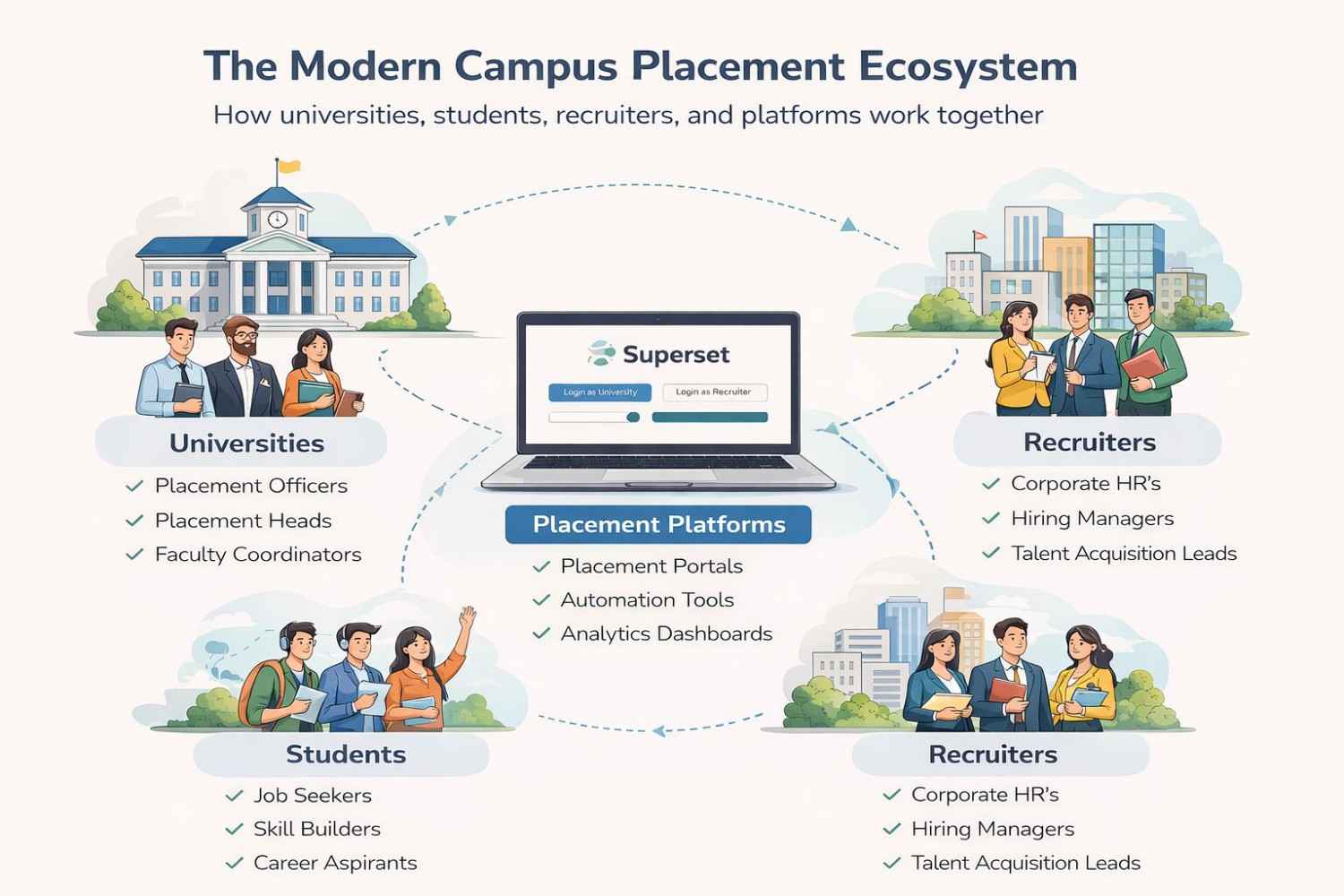
So, what exactly are campus placements today?
At its core, campus placement is still the process of helping students transition from education to employment by connecting them with recruiters.
But that definition feels incomplete in 2026.
Today, campus placements are closer to an ecosystem than a process. It involves managing thousands of students, coordinating with multiple recruiters, handling assessments, interviews, shortlisting, offers, and doing all of this without delays or confusion.
What used to happen in classrooms and auditoriums now happens across dashboards, emails, platforms, and virtual tools.
And that’s where things start getting complicated.
Why placements have become harder to manage
On paper, the placement process hasn’t changed much. But in reality, the scale and complexity have increased significantly.
A typical placement cycle now involves:
- Hundreds (sometimes thousands) of students
- Dozens of companies hiring at the same time
- Multiple rounds of evaluations
- Tight timelines from recruiters
Trying to manage all of this manually or through disconnected tools almost always leads to:
- Missed communications
- Scheduling conflicts
- Data inconsistencies
- Frustrated students and recruiters
Most placement teams aren’t inefficient, they’re just overloaded.
How the placement process actually plays out
Every university has its own variation, but most placement cycles follow a similar flow.
It usually starts months in advance, when the placement team begins reaching out to companies and confirming participation. At the same time, students are registered, resumes are collected, and eligibility criteria are defined.
Once companies are onboarded, things start moving quickly. Pre-placement talks are scheduled, assessments are conducted, and shortlists are generated.
This is where the pressure peaks.
Interviews need to be coordinated, students need to be informed in real time, and recruiters expect everything to run smoothly. A single delay can create a ripple effect across the entire process.
Finally, offers are rolled out, accepted, or sometimes declined and the cycle continues.
It sounds straightforward. But in practice, this is where most placement teams feel the strain.
The shift from “offline coordination” to “online placement”
One of the biggest changes we’ve seen is the move toward online placement systems.
Not because it’s trendy but because it’s necessary.
When everything is handled across spreadsheets, WhatsApp groups, and emails, there’s no single source of truth. Teams spend more time coordinating than actually managing placements.
Online placement systems solve this by bringing everything into one place:
- Student data
- Job postings
- Communication
- Interview schedules
- Offer tracking
More importantly, they reduce the back-and-forth that slows everything down.
Where most universities still struggle
Even today, many universities are somewhere in between partly digital, partly manual.
And that’s where inefficiencies creep in.
For example, student data might be stored in one system, but shortlisting happens elsewhere. Communication might happen on email, but updates are shared through messaging apps.
This fragmentation creates problems that are easy to overlook:
- Students missing important updates
- Recruiters not getting timely responses
- Placement teams duplicating effort
Over time, this doesn’t just affect efficiency it affects placement outcomes.
What a modern placement platform actually changes
A lot of people assume a placement platform is just another tool. In reality, it changes how the entire process is managed.
Instead of stitching together multiple systems, everything runs through a single, structured workflow.
Student profiles, company interactions, assessments, interview scheduling, and offers all of it is connected.
The real impact shows up in small but important ways:
- Shortlisting happens faster
- Communication becomes clearer
- Fewer manual errors
- Better coordination during peak placement season
And perhaps most importantly, placement teams get visibility they can actually see what’s happening at every stage.
Where Superset fits into this shift
This is exactly where platforms like Superset come in.
Instead of being just a listing portal, Superset is built to support end-to-end campus hiring workflows for both universities and recruiters.
From a university’s perspective, it helps simplify what is otherwise a very fragmented process.
You’re not switching between tools or chasing updates. Everything from student onboarding to final offers happens in one system.
For recruiters, it creates a more structured hiring experience, which is why many of them prefer coming back to campuses that use a platform like this.
And for placement teams, the biggest benefit is simple: less manual work, fewer errors, and better control over the entire process.
Why virtual placement drives are now standard
A few years ago, virtual placement drives were seen as an alternative. Today, they’re a core part of the process.
Not just because they’re convenient but because they’re scalable.
Companies can evaluate more students in less time. Universities can host more recruiters without logistical constraints. And students can participate without being limited by physical infrastructure.
But running a virtual drive smoothly requires coordination and without the right system in place, it can quickly become chaotic.
That’s why most successful virtual placement drives today are backed by structured platforms rather than ad-hoc tools.
The growing role of automation in placements
If there’s one shift that’s quietly transforming placements, it’s automation.
Not in a complicated, AI-heavy way but in simple, practical ways:
- Automatically filtering eligible students
- Scheduling interviews without manual coordination
- Sending real-time updates
- Tracking offers and responses
These small improvements add up quickly.
What used to take hours can now be handled in minutes. And that gives placement teams something they rarely have time to focus on strategy instead of operations.
What universities should focus on going forward
Looking ahead, the universities that will stand out aren’t necessarily the ones with the most recruiters but the ones with the most efficient placement systems.
That means:
- Moving away from fragmented tools
- Creating a more structured placement workflow
- Using data to understand what’s working (and what isn’t)
- Making it easier for recruiters to hire from campus
Because at the end of the day, placements aren’t just about outcomes they’re about experience.
For students. For recruiters. And for the placement team itself.
Closing thoughts
Campus placements haven’t become more complicated by design they’ve become more complex because of scale.
And trying to manage that complexity with outdated methods is what creates most of the friction.
The shift we’re seeing now is simple: universities are moving toward more organized, platform-led placement systems that can handle scale without breaking down.
That’s not just a trend it’s becoming the standard.
And the sooner placement teams adapt to that shift, the easier everything else becomes.