

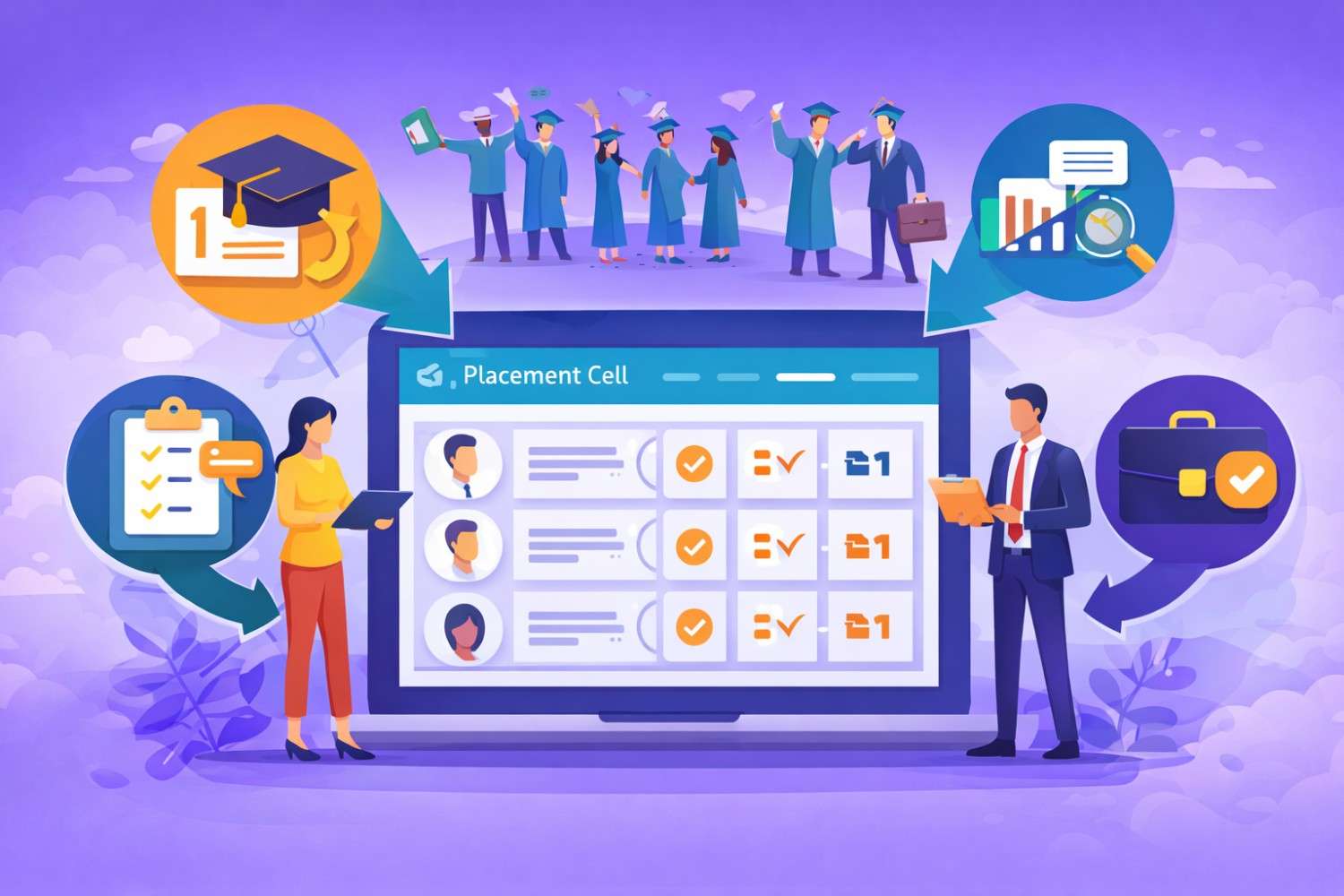

Online placement is no longer a supporting function of campus hiring—it has become the primary way universities connect graduating students with employers. However, many placement teams still approach online placement as a series of disconnected digital events rather than an institutional system. In reality, effective online placement begins well before applications open and continues beyond job confirmation. For universities and placement officers, understanding this internal lifecycle is critical to running scalable, credible online campus placement programs. This blog explores how online placement truly functions inside universities and why platforms like Superset are essential for managing it effectively at scale.
Why Online Placement Is No Longer Just a Digital Process
Online placement today goes far beyond simply moving placement activities to digital tools—it requires universities to run placement as a coordinated institutional system.
- Managing thousands of students with varied eligibility rules: Placement cells must handle different academic criteria, backlogs, attendance requirements, and employer-specific conditions at scale. Without system-driven eligibility controls, errors and manual interventions become unavoidable.
- Coordinating hundreds of employers with unique hiring workflows: each employer follows a different online campus hiring process, including assessments, interviews, and offer policies. Placement teams need structured workflows to manage this complexity consistently.
- Supporting continuous online campus hiring, not seasonal drives: Online campus placement now runs year-round, requiring placement cells to manage overlapping online campus drives without operational fatigue.
- Ensuring compliance, auditability, and institutional reporting: Universities must maintain accurate records for accreditation, governance, and leadership reporting, which manual tools cannot reliably support.
Without a unified platform, placement cell online operations become fragmented and inefficient. True online placement is about institutionalising placement operations, not just digitising tasks.
Inside the Online Placement Lifecycle: How Universities Move from Readiness to Results
Online placement inside universities functions as a connected lifecycle, linking student readiness, employer preparation, hiring execution, and post-placement learning into one coordinated system. When placement cells fail to manage this flow with accuracy, structure, and governance, even a single gap can make the entire online campus placement process inefficient and unreliable.
The following stages reveal how online placement actually functions inside universities—and why platforms like Superset are essential to running placement cell online operations as a unified, institutional system rather than a series of disconnected activities.
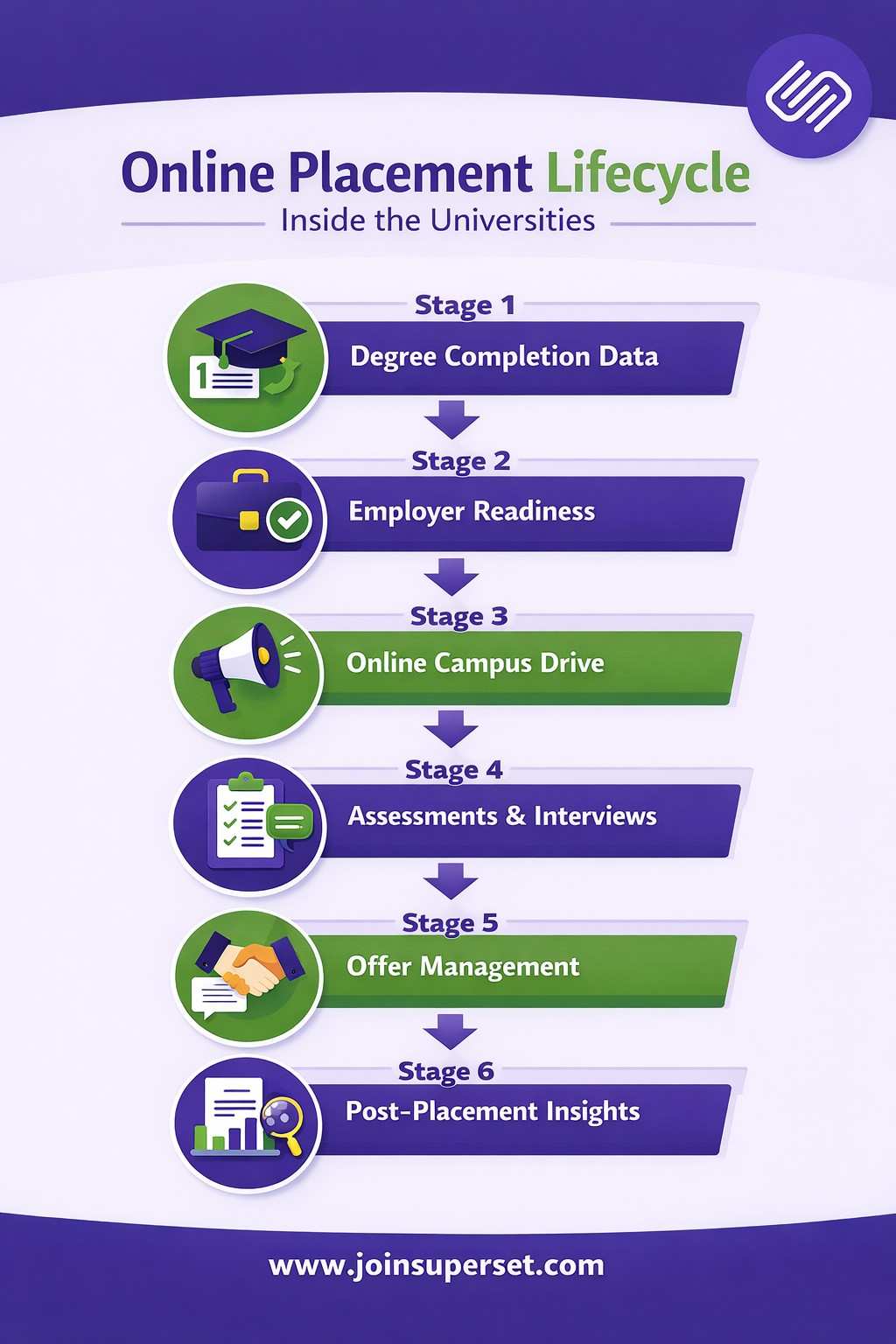
Stage 1: Degree Completion Data as the Foundation of Online Placement
The online placement journey starts earlier than most universities realise—at degree-completion readiness.
Before a single online campus drive is announced, placement teams must answer critical questions:
- Who is eligible to participate in online campus hiring?
- Which students meet academic, attendance, and compliance criteria?
- How do eligibility rules vary by department, program, or employer?
In a placement cell online environment, this data must be:
- Centralized
- Continuously updated
- Easily auditable
Superset enables universities to connect student academic data with placement workflows, ensuring that only eligible students appear in relevant online campus placement opportunities—without manual verification at every step.
Stage 2: Employer Readiness in an Online Campus Placement Model
While students are preparing, universities are simultaneously preparing employers—often invisibly.
For online campus hiring to function smoothly, placement cells must manage:
- Employer onboarding and verification
- Role approval workflows
- Eligibility mapping between roles and student profiles
- Hiring timeline coordination
In traditional models, this information lives across emails and documents. In modern online placement systems, it lives inside a structured platform.
Superset allows placement officers to standardise employer participation across online campus drives, ensuring consistency while still supporting employer-specific hiring processes.
Stage 3: Launching an Online Campus Drive (What Really Happens Internally)
From the outside, an online campus drive looks simple: a job is posted, students apply, and assessments begin.
Internally, placement cells are managing:
- Eligibility enforcement at scale
- Application caps and prioritisation
- Duplicate application prevention
- Real-time visibility into student participation
Without a unified online placement platform, these controls are either missing or manually enforced—leading to errors that damage employer trust.
Superset brings structure to online campus drives by embedding rules, workflows, and visibility directly into the system, reducing operational load on placement teams.
Stage 4: Assessments, Interviews, and Multi-Stage Online Campus Hiring
Modern online campus hiring rarely follows a single-step process. Instead, it includes:
- Online assessments
- Shortlisting rounds
- Technical interviews
- HR discussions
- Offer approvals
For placement cells online, the challenge is not running these steps—but tracking and governing them across hundreds of parallel hiring pipelines.
Superset provides placement officers with:
- Centralised pipeline visibility
- Stage-wise tracking across employers
- Real-time student status updates
- Historical records for audits and reporting
This transforms online placement from reactive coordination to proactive governance.
Stage 5: Offer Management and Job Confirmation
Job confirmation is often treated as the end of the online placement journey. In reality, it introduces new institutional responsibilities.
Placement teams must:
- Validate offers
- Track acceptances and rejections
- Enforce offer policies (single-offer, dream-company rules, etc.).
- Maintain records for accreditation and reporting
In a fragmented setup, this stage becomes chaotic. Superset centralises offer management within the online campus placement workflow, ensuring clarity for students, employers, and the placement cell alike.
Stage 6: Post-Placement Intelligence and Institutional Learning
The most overlooked aspect of online placement is what happens after job confirmation.
Universities that treat online campus placement as a system—not an event—use placement data to:
- Improve employer relationships
- Refine eligibility policies
- Identify skill gaps
- Strengthen future online campus hiring outcomes
Superset converts placement activity into actionable insights, helping universities continuously improve placement outcomes—not just complete them.
Why Placement Cells Struggle Without a Unified Online Placement Platform
When online placement is managed through disconnected tools and manual processes, placement cells face structural challenges that grow worse as scale increases.
- Data silos across departments: Student records, eligibility criteria, and employer details often sit in separate systems or spreadsheets, making it difficult for the placement cell online team to access a single, reliable source of truth.
- Manual enforcement of eligibility rules: Without automation, placement officers must manually check academic criteria, backlogs, or offer policies for every online campus placement, increasing errors and operational burden.
- Limited visibility during online campus drives: Tracking student participation, shortlists, and hiring stages in real time becomes nearly impossible during high-volume online campus hiring.
- Poor reporting for leadership and accreditation: Disconnected data leads to incomplete or delayed reports, weakening institutional credibility.
As online campus drives scale, these issues multiply. Superset addresses these realities by unifying data, workflows, and reporting into a single institutional platform.
Online Placement as an Institutional Capability (Not a Seasonal Activity)
Online placement today must be treated as an institutional capability, not a once-a-year placement season. Universities that succeed in long-term outcomes build systems that operate continuously, scale confidently, and earn employer trust.
- Institutional maturity defines the future of online placement: Mature universities embed online placement into their academic and administrative structure, ensuring consistency, accountability, and data-driven decision-making rather than ad-hoc execution.
- Running placement cell online operations year-round: Placement activity no longer ends with graduation. Universities manage internships, lateral hiring, alumni roles, and deferred offers through a continuously active placement cell online.
- Supporting multiple online campus drives simultaneously: Leading institutions handle parallel online campus drives across departments, programs, and recruiters without operational conflicts or data silos.
- Offering predictable, professional hiring experiences to employers: Structured workflows, clear timelines, and standardised communication improve employer confidence in online campus hiring.
- Why platforms matter: This shift requires governance-ready platforms—not fragmented tools. Superset enables universities to move from operational firefighting to strategic placement leadership.
Why Universities Choose Superset for Online Campus Placement
Universities adopt Superset because it transforms online campus placement from a fragmented activity into a unified, outcome-driven institutional system.
- Centralises the entire online placement lifecycle: Superset brings student eligibility, employer onboarding, online campus drives, assessments, offers, and reporting into a single platform, eliminating data silos and disconnected tools.
- Scales across departments, programs, and employers: Whether managing multiple courses, campuses, or parallel online campus hiring processes, Superset supports high-volume placement operations without increasing complexity.
- Reduces manual effort for placement officers: Automated eligibility checks, workflows, and real-time tracking significantly cut down repetitive coordination, freeing placement teams from spreadsheets and follow-ups.
- Improves employer confidence in online campus hiring: Structured processes, accurate data, and transparent tracking create a professional hiring experience that employers trust and return to.
- Enables focus on outcomes, not administration: With operations handled by the platform, placement teams can prioritise employer relationships, placement quality, and long-term success metrics.
Conclusion
Online placement has evolved into a critical institutional capability that directly reflects a university’s credibility, efficiency, and readiness for the future of hiring. When managed as a connected system rather than a series of isolated activities, online campus placement delivers better outcomes for students, employers, and placement teams alike. Platforms like Superset enable universities to move beyond manual coordination and reactive processes, replacing them with structured, scalable, and transparent operations. By focusing on governance, data integrity, and employer trust, universities can ensure that online placement consistently delivers meaningful job confirmations—not just completed campus drives.