


Hiring has never lacked metrics—time-to-hire, cost-per-hire, and offer acceptance rates fill HR dashboards. Yet even after adopting automated recruiting software, most companies still measure success using metrics built for manual hiring. That’s where the gap begins. Modern automated recruiting software doesn’t just accelerate tasks—it reshapes decision flow, exposes hidden delays, and redefines efficiency. But when HR teams fail to update what they track, they underuse their automated recruiting platform and miss real ROI. This blog explores what recruiting automation truly optimises—and what HR teams should start measuring now.
Why Traditional Hiring Metrics Don’t Work in Automated Hiring
Traditional hiring metrics break down in automated environments because they were built to measure human effort, not system performance. Once automation enters the process, the way hiring fundamentally changes.
- Resume screening speed: Earlier, recruiter screening time indicated efficiency. In an automated hiring system, resumes are parsed and shortlisted instantly, making this metric irrelevant for identifying delays.
- Number of interviews scheduled: Scheduling volume once reflects recruiter productivity. With automated scheduling, interviews scale easily—but this metric reveals nothing about decision quality or progression.
- Time to close a role: This summarises outcomes but hides where momentum was lost. It doesn’t show whether delays came from approvals, feedback loops, or workflow gaps.
When companies automate recruiting, bottlenecks shift from people to workflow design, decision latency, and data handoffs. Yet many HR teams still ask how long hiring took rather than where decisions slowed. Measuring decision flow—not just timelines—is what makes automated recruiting software truly effective.
The Metrics Automated Recruiting Software Improves—but Most HR Teams Don’t Track
Automated recruiting software changes how hiring operates beneath the surface. While traditional metrics focus on outputs like time-to-hire or cost-per-hire, automation shifts performance drivers to decision flow, workflow stability, data quality, and scalability. The following metrics highlight the areas where automated hiring systems deliver real optimisation—areas that are often overlooked because they don’t fit into legacy HR reporting models. Tracking these dimensions allows organisations to better evaluate the effectiveness of their recruiting automation beyond speed and volume.
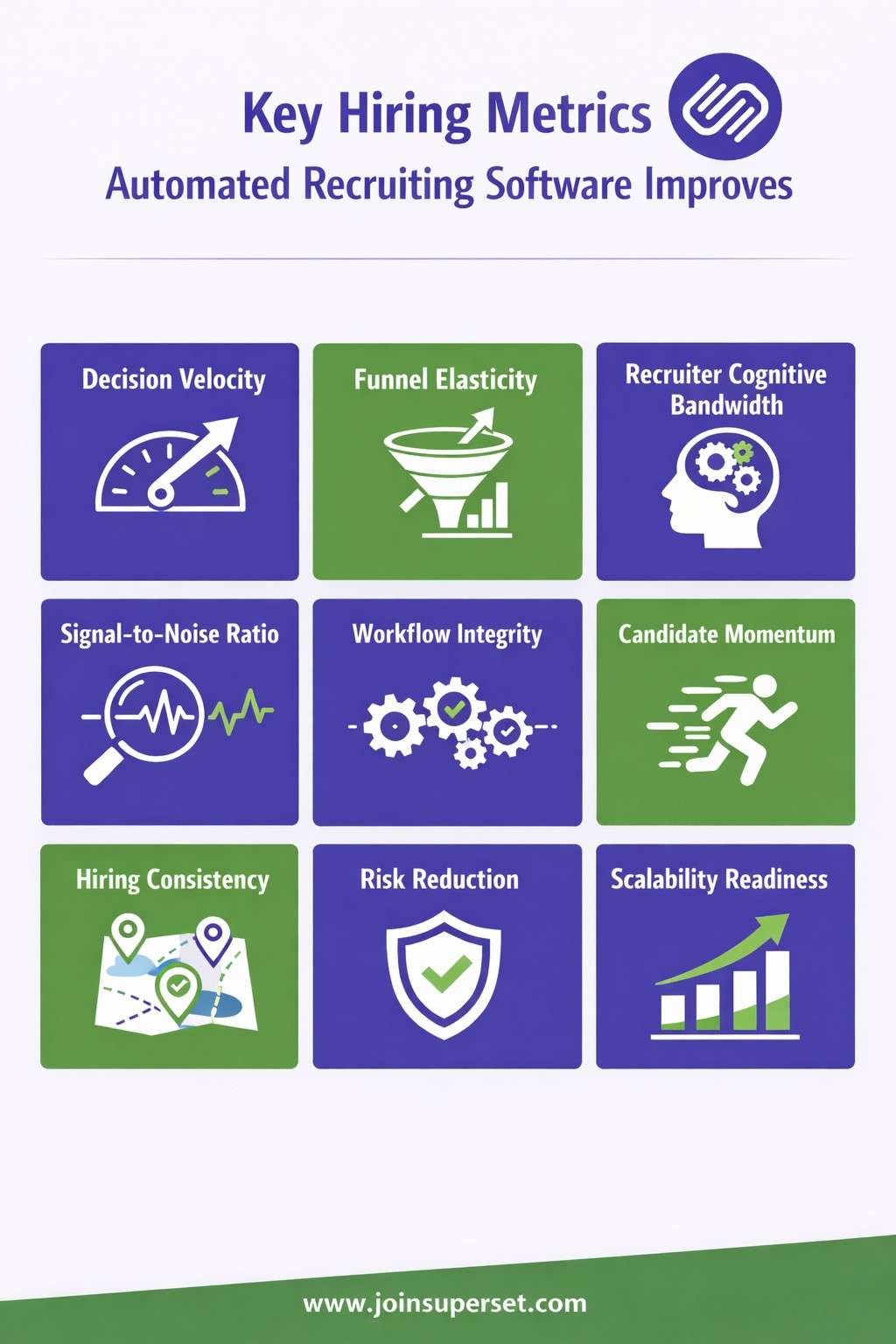
1. Decision Velocity: The Metric That Defines Modern Hiring Success
Hiring speed isn’t about how fast resumes are screened. It’s about how quickly decisions propagate through the system. Decision velocity measures the time it takes for hiring intent to move forward after new information enters the system:
- Assessment completed → shortlist decision
- Interview finished → next-round confirmation
- Offer approved → offer released
Automated recruiting software dramatically reduces input delays—but decision delays often remain untouched.
Why HR Teams Miss This
Because traditional metrics stop at “time-to-hire.”
Superset’s automated recruiting platform makes decision velocity visible by:
- Centralising real-time feedback
- Eliminating fragmented approvals
- Triggering automated next steps the moment decisions are made
Teams that track decision velocity don’t just hire faster—they control momentum.
2. Funnel Elasticity: How Well Your Hiring Process Absorbs Volume Spikes
Most hiring funnels look fine—until volume increases. Funnel elasticity measures how well your hiring process maintains conversion quality when applicant volume surges.
Automated recruiting software optimises for elasticity by:
- Auto-scaling screening
- Parallelizing evaluations
- Preventing recruiter overload
But HR teams usually track:
- Total applicants
- Total hires
What they should track:
- Conversion stability across volume changes
- Drop-off spikes at automated stages
- Assessment fatigue indicators
Superset is built for high-volume, campus, and early-career hiring, where elasticity isn’t optional—it’s mission-critical.
3. Recruiter Cognitive Bandwidth: The Hidden Cost Automation Can Either Reduce—or Worsen
Automation doesn’t automatically reduce recruiter workload. Poor automation increases mental fragmentation.
Recruiter cognitive bandwidth refers to:
- Number of tools used per hire
- Frequency of manual overrides
- Context switching across systems
Many companies adopt multiple recruiting automation software tools—creating automation chaos instead of efficiency. Superset avoids this by functioning as a unified automated recruiting platform, not a patchwork of point solutions.
What HR leaders should measure:
- Manual interventions per hire
- Workflow exceptions triggered
- Time spent coordinating vs evaluating
When cognitive bandwidth improves, hiring quality follows.
4. Signal-to-Noise Ratio: Why More Data Often Leads to Worse Decisions
Automated recruiting software generates data at scale—but not all data is signal.
Most HR teams celebrate:
- More applications
- More assessments
- More interviews
But automated hiring systems are most valuable when they improve signal clarity, not volume.
High-signal hiring tracks:
- Assessment-to-performance correlation
- Interview score consistency
- Drop-off reasons linked to role fit
Superset enables hiring teams to analyse which signals actually predict success, allowing companies to:
- Remove low-value steps
- Strengthen predictive stages
- Reduce unnecessary candidate fatigue
Better signal = fewer regrets.
5. Workflow Integrity: Where Hiring Breaks Even When Tools “Work”
When candidates stall or recruiters intervene manually, most teams blame people. The real issue is workflow integrity—how consistently hiring flows without human correction.
Automated recruiting software optimises workflow integrity by:
- Standardizing transitions
- Enforcing evaluation logic
- Maintaining hiring rhythm
But HR teams rarely track:
- Repeated process breaks
- Manual escalations
- Workflow bypasses
Superset’s configurable workflows help companies identify and fix weak links, not just automate broken processes.
6. Candidate Momentum: The Difference Between Experience and Engagement
Candidate experience is subjective. Candidate momentum is measurable.
Momentum tracks:
- Time between stages
- Responsiveness to automated communication
- Drop-off probability after each interaction
Automated recruiting platforms like Superset maintain momentum through:
- Automated nudges
- Predictable timelines
- Transparent status updates
HR teams that track momentum reduce:
- Ghosting
- Offer drop-offs
- Late-stage disengagement
Momentum, not branding, wins competitive hiring markets.
7. Hiring Consistency Across Teams and Locations
Automation doesn’t just speed up hiring—it standardises decision-making. But consistency isn’t guaranteed unless it’s measured.
HR leaders should track:
- Variance in hiring outcomes across teams
- Evaluation alignment between interviewers
- Offer ratios by department
Superset’s automated hiring system allows organisations to:
- Enforce structured hiring
- Maintain flexibility where needed
- Scale without quality erosion
Consistency is how companies grow without breaking their talent bar.
8. Risk Reduction: The Quiet ROI of Automated Recruiting Software
Most ROI calculations focus on cost and speed. The real long-term value of recruiting automation software is risk reduction.
Automation reduces:
- Bias through structured evaluation
- Compliance gaps via audit trails
- Decision opacity through documentation
Yet few HR teams measure:
- Audit readiness
- Decision traceability
- Compliance exposure per hire
Superset captures every hiring action—making compliance a byproduct, not a burden.
9. Scalability Readiness: Can Your Hiring System Handle Tomorrow
Hiring systems don’t fail slowly—they fail suddenly during growth. Scalability readiness measures whether your hiring process can:
- Absorb hiring spikes
- Replicate success across roles
- Maintain decision quality at scale
Automated recruiting platforms like Superset are designed for:
- Multi-location hiring
- Campus-to-enterprise transitions
- Rapid workforce expansion
HR teams that track readiness avoid rebuilding hiring systems mid-growth.
Why Superset Aligns Automation With What Actually Matters
Superset is designed to ensure recruiting automation delivers measurable hiring outcomes—not just operational speed.
- Measures what legacy metrics ignore: Traditional hiring metrics focus on speed and volume. Superset tracks deeper performance indicators such as decision delays, funnel drop-offs, and workflow bottlenecks—helping HR teams understand why hiring slows down, not just where it happens.
- Design workflows that scale with hiring demand: Superset enables configurable, role-based workflows that adapt to high-volume and multi-location hiring. This ensures consistency and control as hiring scales, without forcing teams into rigid, one-size-fits-all processes.
- Converts hiring data into hiring intelligence: Instead of isolated reports, Superset turns recruiting data into actionable insights—highlighting patterns in candidate quality, process efficiency, and hiring outcomes to support better decision-making.
Whether hiring graduates at scale or growing enterprise teams, Superset aligns automation with business strategy, ensuring technology strengthens hiring outcomes rather than complicating them.
The Shift HR Leaders Must Make Now in Automation
To unlock real value from automation, HR leaders must shift focus from adopting tools to measuring what actually drives hiring outcomes.
- Move beyond activity metrics: Tracking applications, interviews, or time-to-hire only shows effort. HR teams must measure how efficiently decisions move through the system once recruiting is automated.
- Focus on decision velocity: Automated recruiting software speeds up inputs, but delays often occur in approvals and evaluations. Measuring decision velocity reveals where hiring momentum slows—and why.
- Improve signal quality, not volume: Automation increases data, but not all data improves hiring. HR leaders should track which assessments and evaluations actually predict candidate success.
- Monitor workflow integrity: Repeated manual interventions and process overrides signal broken workflows. Measuring these gaps helps teams fix processes instead of blaming people.
- Turn hiring into an advantage: When these metrics are tracked consistently, automated recruiting software transforms hiring from an operational task into a scalable, strategic capability.
Conclusion
Automated recruiting software doesn’t deliver its real value by simply moving faster—it delivers value by making hiring measurable in smarter ways. When HR teams shift focus from surface-level metrics to decision velocity, signal quality, workflow integrity, and scalability readiness, recruiting becomes a strategic growth lever rather than an operational task. Platforms like Superset enable this shift by turning automation into insight, consistency, and control. The companies that win tomorrow won’t just automate recruiting—they’ll measure what automation truly optimises and act on it.