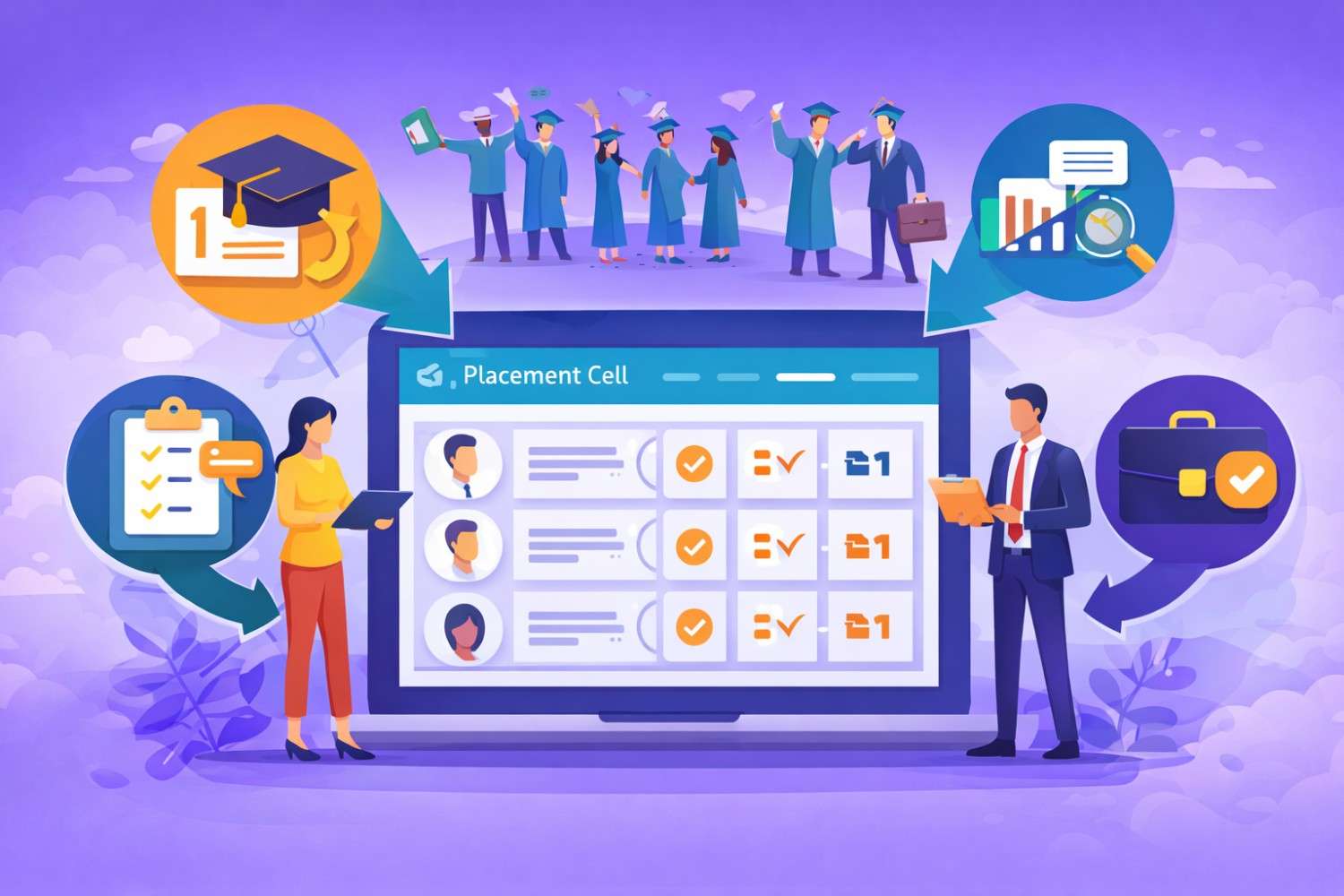



The campus recruitment process is often explained as a neat sequence of steps—planning, sourcing, screening, interviewing, and onboarding. But inside real companies, especially those hiring at scale, it rarely works that way. Most “complete guides” describe what should happen. This blog focuses on what actually happens inside HR and talent acquisition teams—and why many campus hiring efforts struggle despite best intentions. For companies hiring hundreds or thousands of fresh graduates every year, the campus recruitment process is no longer a seasonal activity. It is a complex, high-stakes operating system that directly impacts workforce planning, business continuity, employer brand, and cost efficiency.
How the Campus Recruitment Process Actually Starts Inside Companies
The campus recruitment process begins long before companies engage with campuses—it is shaped internally by planning, assumptions, and alignment of leadership. When these foundations are weak, execution challenges surface later in the hiring cycle.
- Starts with internal alignment: HR, talent acquisition, and business teams must agree on hiring goals and timelines; misalignment leads to downstream confusion.
- Workforce planning comes first: Initial hiring numbers are often based on assumptions rather than validated demand.
- Business realities shift mid-cycle: Headcount approvals, role clarity, and priorities frequently change during hiring seasons.
- Impact on campus hiring: Recruiters face pressure, causing over-hiring, under-hiring, and constant revisions.
Designing a Campus Recruitment Plan That Can Survive Change
A resilient campus recruitment plan must be built to adapt to shifting hiring needs, not locked into static assumptions or seasonal estimates.
- Campus prioritisation logic: High-performing companies evaluate campuses based on historical conversion rates, role fit, and hiring outcomes—not just long-standing relationships—ensuring effort is invested where results are most predictable.
- Role-wise intake flexibility: Instead of fixed numbers, intake targets are kept adjustable by role, allowing HR teams to respond quickly to changing business demands or headcount approvals.
- Contingency buffers for drop-offs: Smart plans account for offer rejections and no-shows by building buffers, reducing last-minute hiring gaps that disrupt workforce planning.
- Clear ownership across teams: Responsibilities are clearly defined across HR, recruiters, and hiring managers, preventing delays caused by handoffs or accountability gaps.
When these elements are managed through spreadsheets and emails, real-time decision-making becomes impossible—making centralised campus recruitment platforms essential for visibility, agility, and control.
What Really Happens During the On Campus Recruitment Process
On the surface, the on campus recruitment process seems simple—job postings, assessments, interviews, and offers. In practice, each stage hides operational challenges that intensify at scale and directly impact hiring outcomes.
1. Job Posting: Where Confusion Begins
- Different campuses require different job formats and documentation.
- Eligibility criteria often change mid-cycle, causing inconsistency.
- Job descriptions are reused without updates, weakening role clarity.
Result: Confused candidates, misaligned expectations, and inconsistent employer branding.
2. Screening and Shortlisting: Scale Becomes the Bottleneck
- The campus selection process attracts massive application volumes.
- Resume overload occurs without intelligent filtering mechanisms.
- Manual shortlisting consumes recruiter bandwidth and slows progress.
- Screening criteria vary across campuses, reducing fairness and consistency.
Result: Delays in the overall campus recruitment process.
3. Interviews: The Weakest Link in the Campus Hiring Process
- Interviewer availability conflicts cause delays and rescheduling.
- Last-minute panel changes lead to uneven assessments.
- Feedback is delayed or missing, slowing decision-making.
- Lack of standardised evaluation frameworks increases subjectivity.
Result: Lower interview quality and higher post-joining attrition risk.
4. Offer Management: The Most Underestimated Risk Area
- Offers are released in stages, limiting visibility into hiring progress.
- Candidates hold multiple offers, increasing drop-off risk.
- Communication gaps lead to candidate disengagement or ghosting.
- Joining ratios remain unpredictable without centralised tracking.
Result: Poor workforce forecasting and reduced business readiness.
Why Traditional Tools Fail the Campus Recruitment Process
Traditional hiring tools were never designed for the scale and complexity of campus hiring, which is why they consistently break down during high-volume recruitment cycles.
- ATS built for lateral hiring: Most ATS platforms are optimised for low-volume, role-specific hiring. They struggle to handle bulk applications, multi-campus workflows, and standardised assessments required in the campus recruitment process.
- Spreadsheets for campus tracking: Spreadsheets quickly become outdated and error-prone when multiple recruiters update data simultaneously, making real-time tracking of candidates and campuses unreliable.
- Emails and WhatsApp for coordination: Informal communication channels create dependency on individuals, lack audit trails, and make it hard to maintain consistent candidate communication.
This fragmented setup results in:
- Data silos, where information is scattered across tools
- No single source of truth, limiting leadership visibility
- Delayed decision-making, due to manual consolidation
- Poor candidate experience, caused by delays and miscommunication
Campus hiring requires a purpose-built system, not repurposed tools.
What High-Growth Companies Do Differently
High-growth companies treat the campus recruitment process as a scalable system rather than a seasonal task, enabling them to hire efficiently even at large volumes.
- Centralisation: All campuses, roles, candidates, and stages are managed on one platform, eliminating data silos and ensuring consistency across the campus hiring process.
- Automation: Tasks like assessments, shortlisting, scheduling, and communication are automated, reducing manual effort and errors while improving speed.
- Visibility: Real-time dashboards provide insights into funnel performance, drop-offs, and offer conversions for faster decision-making.
- Accountability: Clear ownership across HR, TA, and hiring managers ensures timelines are met and execution gaps are avoided.
Together, these principles transform the campus recruitment process from reactive chaos into a structured, predictable, and scalable hiring system.
The Role of Technology in Modern Campus Recruitment
Technology plays a critical role in modern campus recruitment, especially for companies hiring at scale, where manual coordination and disconnected tools quickly become bottlenecks. A purpose-built platform transforms campus hiring from a reactive process into a structured, data-driven system.
- Design a scalable campus recruitment plan: Technology helps HR teams plan hiring volumes across multiple campuses, roles, and timelines while staying flexible to business changes.
- Standardise the on campus recruitment process: A centralised platform ensures consistent workflows, evaluation criteria, and communication across all campuses, reducing process variability.
- Automate repetitive tasks: Activities like assessments, shortlisting, interview scheduling, and candidate communication are automated, freeing recruiters to focus on decision-making.
- Improve candidate experience: Timely updates, transparent timelines, and smooth digital workflows create a professional and engaging experience for students.
- Reduce time-to-hire: Automation and real-time visibility eliminate delays, helping companies close campus roles faster.
This is where platforms like Superset fit seamlessly into the campus recruitment ecosystem.
How Superset Helps Companies Reimagine the Campus Recruitment Process
Superset enables companies to modernise and take full control of the campus recruitment process by replacing fragmented, manual workflows with a single, scalable system built specifically for high-volume campus hiring.
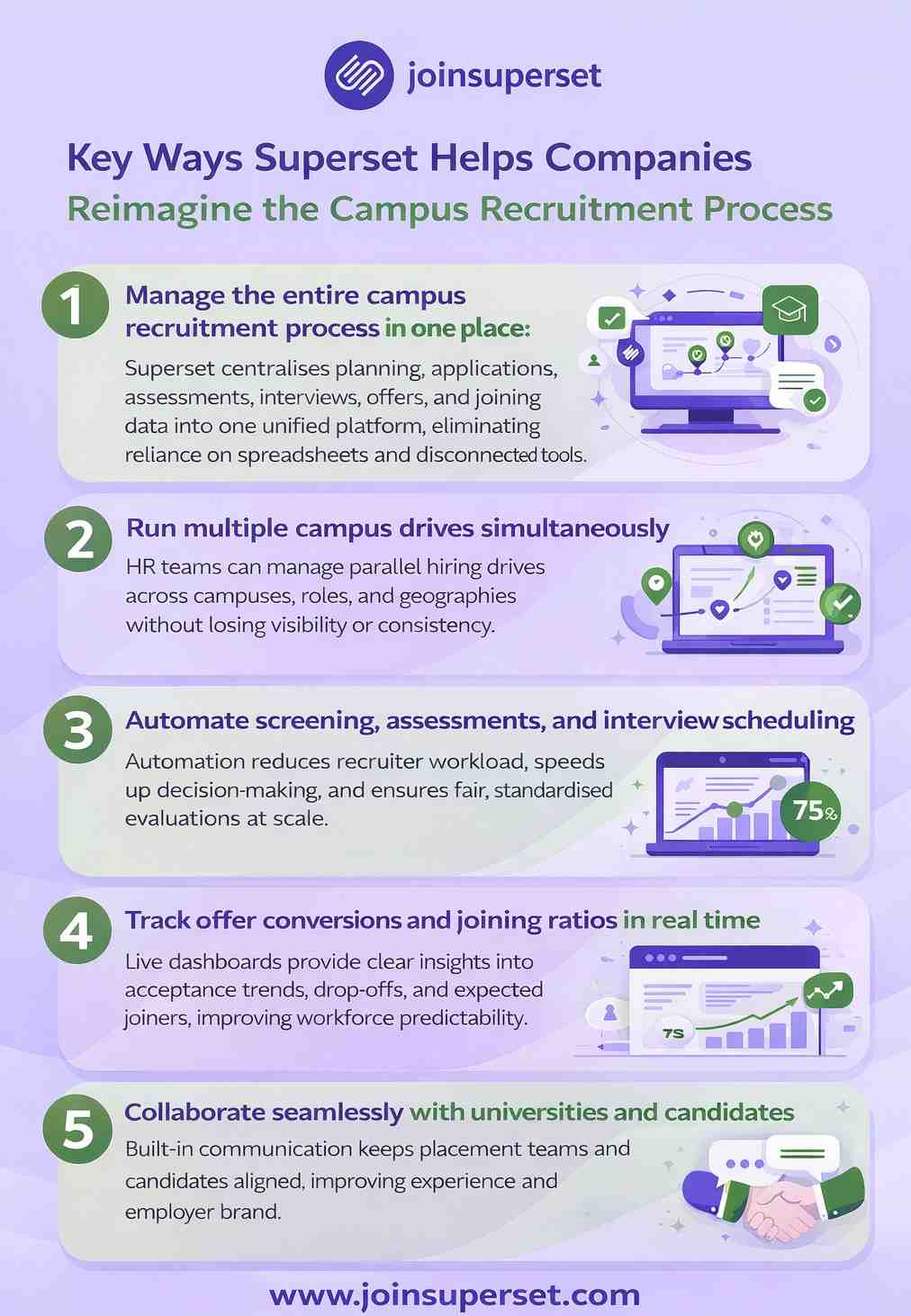
Together, these capabilities replace operational chaos with speed, structure, and data-driven control.
From Seasonal Hiring to a Repeatable System
A successful campus recruitment strategy goes beyond seasonal hiring, transforming into a repeatable, scalable system that delivers consistent results.
- Operates year-round: Hiring is planned continuously, not just during peak placement seasons, ensuring smoother execution.
- Builds long-term campus relationships: Strong partnerships with universities improve talent pipelines and brand recognition over time.
- Uses historical data to improve outcomes: Past performance insights guide better shortlisting, interview scheduling, and offer strategies.
- Continuously refines the campus selection process: Feedback loops and analytics help optimise assessments and candidate experience.
- Digitised and centralised: Automation and a unified platform make all of this achievable efficiently.
Metrics That Actually Matter in the Campus Recruitment Process
Measuring the right metrics is key to an effective campus recruitment process. Leading HR teams go beyond basic headcounts and focus on actionable insights that drive better hiring outcomes:
- Campus-wise conversion rates: Track how many applicants from each campus progress through the selection stages to identify high-performing talent pools.
- Assessment-to-interview ratios: Measure the efficiency of your screening process to ensure assessments are effectively predicting candidate suitability.
- Offer acceptance trends: Monitor which offers are being accepted or declined to optimise compensation, timelines, and communication.
- Joining predictability: Analyse actual joiners versus offers made to improve planning and reduce attrition.
These metrics guide smarter, data-driven recruitment decisions.
Why Candidate Experience Is a Business Metric
In campus hiring, candidate experience directly impacts your employer brand and future recruitment success.
- Students talk, campuses remember: Negative experiences spread quickly, affecting your reputation among students and placement officers.
- Broken processes hurt the brand: Delays, unclear timelines, and manual errors create frustration and reflect poorly on the company.
- Impact on future cycles: Poor candidate experience leads to lower acceptance rates and fewer top candidates in subsequent hiring drives.
- Automation and transparency are key: Streamlined communication, clear schedules, and real-time updates enhance the experience and protect your campus reputation.
The Future of the Campus Recruitment Process
The future of the campus recruitment process is evolving rapidly, driven by technology, data, and strategic alignment. Companies that adapt will gain efficiency and improve talent outcomes, while those that don’t risk operational and brand challenges.
- More data-driven: Decisions will rely on real-time insights from candidate pipelines, assessment results, and campus trends to improve hiring accuracy.
- Less manual: Automation will reduce repetitive tasks like scheduling, shortlisting, and communication, freeing HR teams for strategic work.
- Highly collaborative: Cross-functional coordination between HR, TA, and business leaders will ensure smoother execution.
- Tightly aligned with business planning: Campus hiring will reflect changing business priorities, minimising mismatches and inefficiencies.
Conclusion
In today’s competitive talent landscape, the campus recruitment process is no longer just a series of steps—it’s a strategic system that drives workforce quality, efficiency, and employer brand. Companies that rely on manual processes, fragmented tools, or generic guides risk missed opportunities, inefficiencies, and candidate drop-offs. By embracing automation, centralisation, and data-driven decision-making, HR teams can transform campus hiring into a predictable, scalable operation.