


Campus recruitment has always been the cornerstone of early talent acquisition. However, in today’s data-driven hiring ecosystem, the difference between a good campus recruitment plan and a great one lies in how effectively organisations access and utilise data. Traditional methods—spreadsheets, siloed systems, and manual reporting—limit visibility, slow down decisions, and often introduce bias. Forward-looking companies are shifting toward data democratisation—where insights are not locked away in analytics teams but shared across hiring managers, recruiters, and decision-makers. The goal? To make campus recruitment smarter, faster, and fairer for everyone involved.
What Is Data Democratisation in Campus Recruitment?
Data democratisation in campus recruitment refers to giving all stakeholders—recruiters, hiring managers, and university partners—equal access to critical hiring insights. Rather than depending on fragmented reports or delayed updates, teams use shared, real-time dashboards that reflect the actual progress of each campus recruitment plan.
- Equal Access to Data: All stakeholders can view and interpret relevant hiring information, ensuring transparency across the recruitment process.
- Real-Time Insights: Live dashboards allow teams to monitor candidate performance, engagement metrics, and campus-specific results instantly.
- Faster Decision-Making: With accessible data, recruiters and managers can make informed, timely decisions without waiting for manual reports.
- Enhanced Planning: Leadership teams can use these insights to forecast hiring needs, track conversion rates, and optimise future campus recruitment strategies.
This approach empowers teams to make smarter, faster, and fairer hiring decisions.
The Traditional Campus Recruitment Bottleneck
The traditional campus recruitment process has long been burdened by fragmented systems and manual workflows. Most campus recruitment companies still depend on emails, spreadsheets, and disjointed evaluation forms, making collaboration between recruiters and placement cells slow and inefficient.
- Delayed decision-making: Recruiters often wait days for updates or reports, which delays shortlisting and offer rollouts.
- Data silos: Critical insights remain locked in isolated files or tools, preventing teams from seeing the full hiring picture.
- Human bias: Without shared visibility, decisions rely on personal opinions rather than objective data.
- Inefficiency: Manual reconciliation and validation consume valuable time and reduce hiring productivity.
When companies expand across multiple campuses, these issues multiply. Without a unified campus recruitment system, teams struggle to track performance, measure ROI, or identify high-performing institutions—ultimately weakening the overall effectiveness of campus hiring efforts.
Why Data Democratisation Is the Missing Link in Your Campus Recruitment Plan
A strong campus recruitment plan today isn’t just about scheduling interviews and tests—it’s about using accurate, timely data to guide every hiring decision.
When organisations democratise data:
- Recruiters can instantly view candidate performance metrics.
- Hiring managers can analyse university-wise results and shortlist faster.
- Leadership gains transparency into overall hiring efficiency.
This transparency also aligns with campus recruiting best practices, ensuring that all stakeholders operate with the same context and metrics. Instead of depending on subjective opinions or outdated summaries, everyone sees the same truth—live and in real time. Democratized data also supports more strategic planning. Companies can identify high-performing institutions, understand emerging skill trends, and refine their campus outreach strategy based on data, not assumptions.
How Democratized Data Empowers Hiring Teams in Companies
Modern hiring teams no longer compete based on budgets or brand visibility alone—they compete on insights. By democratizing data across your campus recruitment system, you enable smarter, evidence-based decision-making. Here’s how:
- Real-Time Candidate Analytics: Track how candidates perform in assessments, interviews, and group discussions in real time. Identify high-potential talent early and reduce reliance on test scores alone.
- Campus Performance Benchmarking: Compare university performance across key metrics—offer acceptance rates, joining ratios, and long-term retention. Use this to refine your campus recruitment plan annually.
- Skill Gap Identification: Use shared data to identify emerging skill gaps across student pools. This helps recruiters tailor assessments and improve job-role mapping.
- Predictive Hiring Insights: Leverage AI-driven analytics to forecast which candidates are most likely to succeed long-term. Democratized insights ensure these predictions are visible to all decision-makers.
When insights are no longer restricted to one dashboard or team, organisations make faster, more aligned decisions—turning campus recruitment into a data-led growth strategy rather than a logistical process.
Eliminating the Data Bottleneck in Campus Recruitment
In traditional campus recruitment, decision-making is slowed by multiple checkpoints, including shortlists, manager reviews, and final approvals. This often creates delays because stakeholders have limited access to real-time data. Data democratisation solves this problem by giving all participants instant visibility into candidate information.
- Live Assessment Outcomes: Recruiters can track candidate performance in real time, reducing delays caused by waiting for test results.
- Centralised Candidate Profiles: Hiring managers can review profiles, feedback, and interview notes in a single dashboard, streamlining evaluation.
- Streamlined Offer Approvals: Automated workflows remove the need for back-and-forth email confirmations, accelerating the decision-making process.
Platforms like Superset integrate these features through automated workflows, real-time dashboards, and role-based access. The outcome is faster, more efficient decisions, fewer communication bottlenecks, and reduced time-to-hire, all while ensuring compliance and maintaining data integrity.
Fairer Outcomes: Enabling Objective, Bias-Free Hiring
Data democratisation in campus recruitment ensures a fair and objective hiring process by giving all stakeholders access to the same information. This reduces personal biases and creates a level playing field for candidates.
- Objective Evaluation: Recruiters assess candidates using measurable performance metrics such as test scores, project outcomes, and behavioural assessments instead of relying on college reputation or personal preferences.
- Enhanced Diversity: Transparent data allows organisations to monitor representation across different demographics, identify gaps, and take corrective actions to reduce unconscious bias.
- Structured Assessments: Platforms like Superset provide standardised scoring systems, ensuring every candidate is evaluated consistently.
- AI-Assisted Analysis: AI tools prioritise candidate capabilities and potential over background, further eliminating human subjectivity.
By implementing these practices, companies achieve a fairer, more inclusive campus recruitment process aligned with modern campus recruiting best practices.
Integrating Data Democratisation into Your Campus Recruitment System
To embed data democratisation effectively, companies must reimagine how data flows through their recruitment lifecycle. Here’s how to build a truly democratized campus recruitment plan:
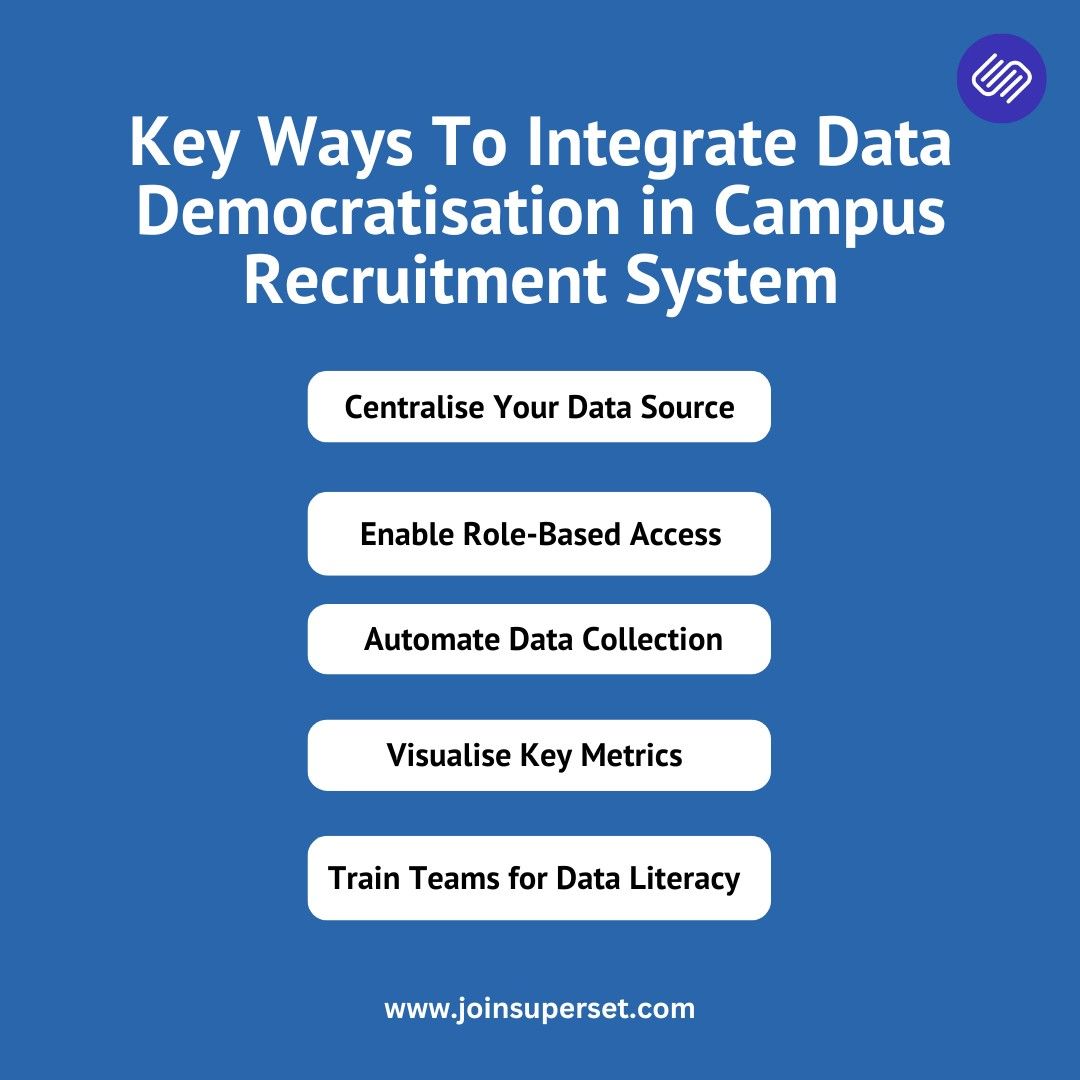
- Centralise Your Data Source: Consolidate all recruitment data—assessment results, interview feedback, and offer details—into one platform.
- Enable Role-Based Access: Provide recruiters, managers, and university coordinators access to relevant dashboards based on their roles.
- Automate Data Collection: Use a campus recruitment system that automates updates from placement drives, tests, and interviews. This eliminates manual errors.
- Visualise Key Metrics: Build interactive dashboards highlighting KPIs such as offer-to-join ratios, candidate conversion, and diversity representation.
- Train Teams for Data Literacy: Democratisation only works if your hiring teams can interpret and act on data. Invest in analytics training sessions for recruiters and HR leads.
Platforms like Superset already integrate these capabilities—turning raw recruitment data into a unified, accessible, and actionable information hub.
How Superset Makes Campus Recruitment Truly Data-Driven
Superset is a leading campus recruitment platform that transforms hiring by putting data democratisation at the core. It connects companies, universities, and students through a seamless digital experience, enabling smarter, faster, and fairer campus recruitment.
- Centralised Dashboards: Provide real-time visibility into every stage of the recruitment process, allowing teams to track candidate progress and campus performance instantly.
- AI-Driven Analytics: Offers predictive insights on candidate performance and joining probability, helping recruiters prioritise high-potential talent.
- Role-Based Permissions: Ensures tailored access for recruiters, hiring managers, and university coordinators, keeping data relevant and secure.
- Seamless Communication: Centralises invites, assessments, feedback, and offer rollouts, reducing delays and manual coordination.
- Data Integrity: Maintains secure, compliant storage with transparent audit trails to ensure accuracy and accountability.
Superset empowers stakeholders to make informed, objective, and efficient decisions across large-scale campus recruitment drives.
The Future of Campus Recruitment: AI, Automation, and Open Data
The future of campus recruitment is being shaped by AI, automation, and open data, creating smarter, faster, and more transparent hiring processes.
- AI-Driven Predictions: Companies will use AI to forecast skill demand, identify high-potential candidates, and optimise sourcing strategies across multiple universities, ensuring the right talent is targeted efficiently.
- Automation of Processes: Routine tasks like data collection, sorting, and evaluation will be automated, freeing recruiters to focus on strategic decisions and human interactions.
- Open Data Ecosystems: Democratized access to real-time insights will enable transparency and collaboration, allowing all stakeholders—recruiters, hiring managers, and placement officers—to make informed decisions.
A modern campus recruitment system like Superset integrates these capabilities, combining analytics, automation, and accessibility. The result is a scalable, efficient, and ethical recruitment process that builds trust, consistency, and collaboration across teams, while preparing organisations for the next generation of talent acquisition.
Conclusion
Data democratisation isn’t just a technology shift—it’s a mindset that empowers hiring teams to make smarter, faster, and fairer decisions. In a competitive talent landscape, democratized insights improve efficiency, quality, and fairness. Integrating Superset into your campus recruitment plan provides unified visibility across drives, accelerates decision-making, ensures objective, bias-free assessments, and aligns with campus recruiting best practices. For companies aiming to build a scalable, data-driven, and transparent campus hiring process, Superset is the ideal partner.