


Campus Recruitment: Strategy & Execution Guide for Companies in 2026

Campus recruitment does not break because companies fail to plan. It breaks because execution cannot keep up with the reality of scale.
Most organisations begin their campus hiring cycle with clarity. Hiring targets are defined early. Campuses are shortlisted based on past performance, brand presence, and talent availability. Timelines are mapped carefully around academic schedules, and evaluation frameworks are discussed across stakeholders.
At this stage, everything feels structured.
There is alignment, there is intent, and there is a sense that the process is under control.
But this version of campus recruitment exists only in planning.
The moment execution begins, the environment changes in ways that are difficult to predict and even harder to manage. Different campuses operate at different speeds. Candidate participation varies. Internal coordination begins to stretch as multiple hiring pipelines run in parallel.
What looked like a structured process starts depending increasingly on manual effort.
And this is where the gap between strategy and execution begins to take shape.
It is not that the strategy fails. It is that the system expected to execute that strategy was never designed to handle the complexity that comes with scale.
As companies move from planning to execution, campus recruitment stops being a sequence of defined steps and starts becoming a continuous flow of interconnected decisions.
What is often described as a simple process—applications, assessments, interviews, offers—is in reality a network of dependencies. Each stage relies on the previous one moving forward without delay, and when that continuity breaks, even slightly, the effects are rarely contained.
To understand this better, it helps to move away from the documented version of campus recruitment and instead look at how it actually unfolds inside a company that is hiring across multiple campuses.
A single hiring cycle may involve ten or fifteen campuses, each operating on its own schedule. Some begin earlier, some later. Some generate high application volumes, while others remain unpredictable. While these external variables are at play, internal teams are managing interview panels, aligning with hiring managers, and trying to maintain consistency in evaluation.
None of this happens in isolation.
Every action taken in one part of the process influences another. A delay in screening slows down assessments. A delay in assessments affects interview scheduling. Interview delays compress decision timelines, which in turn affects offer acceptance.
This is why campus recruitment rarely fails at a single point.
It drifts.
That drift is subtle at first.
Applications are still collected successfully. Initial filtering is completed. Assessment links are sent out. From a distance, everything appears to be working.
But beneath that surface, small inefficiencies begin to accumulate.
Some candidates receive communication later than others. Some miss assessment deadlines due to unclear instructions. Results begin to come in, but they are spread across systems, requiring manual consolidation. Shortlists are created based on incomplete visibility.
At this point, the process is still moving.
But it is no longer aligned.
Interview scheduling begins, and coordination becomes more complex. Recruiters follow up across channels. Candidates respond at different times. Panels are not always available when needed.
Time between stages begins to stretch.
And this is where candidate behaviour starts to shift in ways that are often overlooked.
Without clear timelines or consistent communication, candidates begin to disengage. Not always actively, but gradually. They explore other opportunities. They delay responses. Some accept competing offers while still in the process.
This pattern of candidate drop-offs in campus hiring is not caused by a single issue. It is the result of accumulated uncertainty across stages.
By the time companies reach the final stages of hiring, the pipeline they started with has already changed.
Not because candidates were rejected.
But because the system could not move them forward efficiently.
At this stage, most hiring teams respond in a predictable way.
They increase effort.
More follow-ups are introduced. More coordination happens across teams. Additional tracking mechanisms are created to regain visibility. Recruiters spend more time ensuring that the process continues moving.
And while this approach helps in keeping things operational, it also reveals a deeper problem.
The system is no longer driving the process.
People are.
When recruiters become the bridge between every stage, scalability becomes difficult. The more the hiring volume increases, the more pressure is placed on coordination. The process begins to rely on individual effort rather than structural efficiency.
This is where most traditional campus recruitment models start to struggle.
Not because the tools used are ineffective, but because they are disconnected.
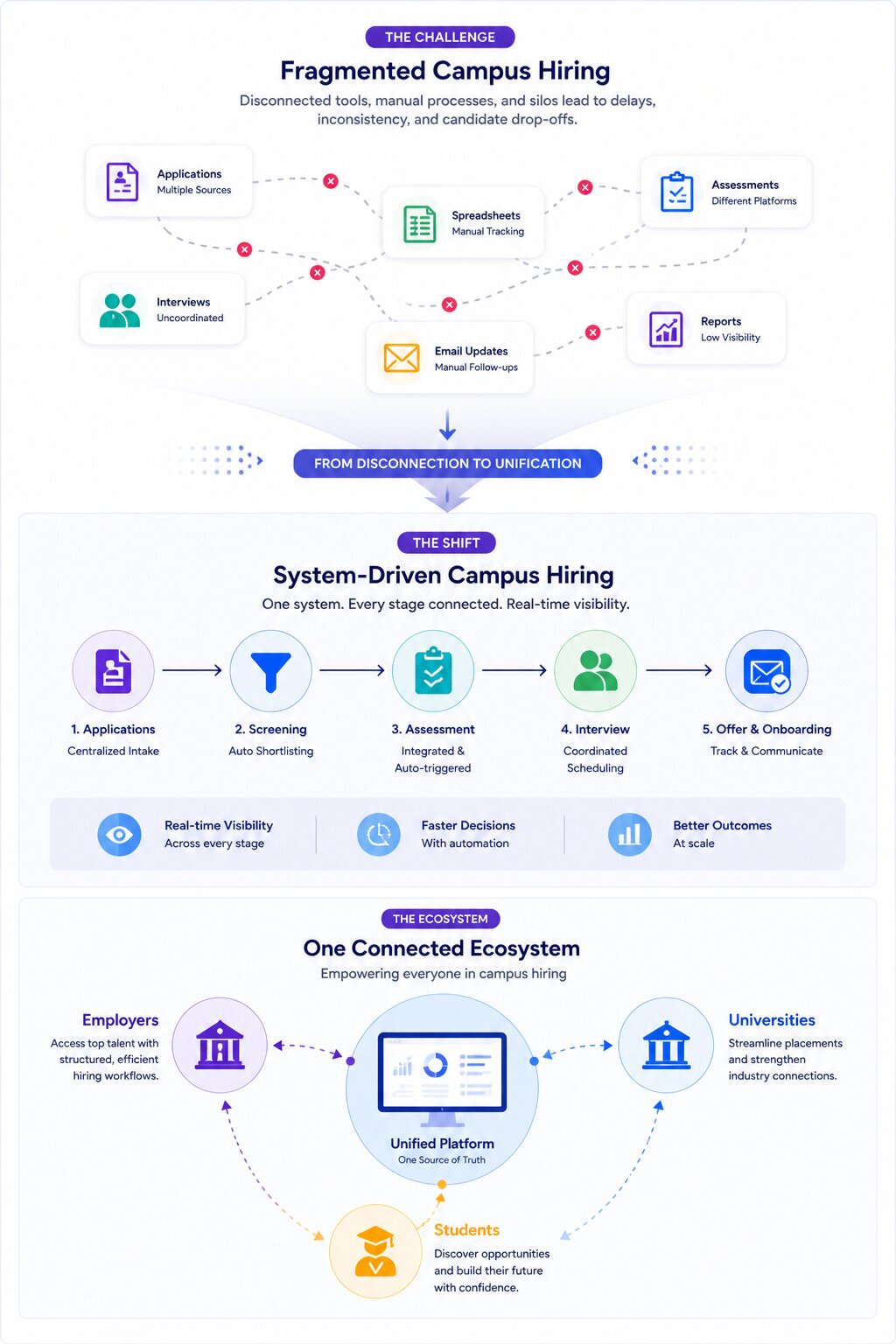
Applications might be collected through one system, assessments conducted on another, interviews coordinated through emails or spreadsheets, and final tracking maintained separately. Each tool performs its function, but the connection between them is manual.
This creates fragmentation.
Data needs to be moved repeatedly. Updates need to be communicated across channels. Visibility into the pipeline becomes inconsistent.
When compared to a structured fresher hiring process, where every stage is connected and measurable, these inefficiencies become more apparent.
At scale, fragmentation is not just inconvenient.
It is limiting.
What begins to change outcomes is not an increase in effort, but a shift in how the system itself is designed.
The transition from coordination-driven execution to system-driven execution is what defines modern campus recruitment.
In a coordination-driven model, recruiters are responsible for connecting every stage. They ensure that candidates move forward, that communication happens, and that delays are managed.
In a system-driven model, the process itself ensures continuity.
Candidate data is captured once and flows across stages without needing to be transferred manually. Screening criteria are applied consistently. Assessments are integrated into the workflow rather than treated as separate activities.
Interview scheduling happens within the same system, reducing dependency on external coordination.
Most importantly, visibility becomes immediate.
Hiring teams do not need to ask where candidates are in the process.
They can see it.
This shift changes how decisions are made.
Instead of reacting to delays after they occur, teams can identify where movement is slowing down and act early. Instead of increasing effort, they improve flow.
To understand the impact of this shift, it helps to revisit the earlier scenario.
The same company is hiring across multiple campuses. The complexity remains unchanged. The number of candidates, the variability across campuses, and the internal coordination requirements all stay the same.
What changes is the system supporting execution.
Applications flow into a centralised pipeline. Eligibility filters automatically identify relevant candidates. Recruiters review profiles within a unified interface instead of across multiple tools.
Assessments are triggered within the workflow, and results update in real time. Interview scheduling happens within the same system, ensuring consistency in communication and coordination.
At every stage, the hiring team has clarity.
They know how many candidates are progressing. They know where delays are occurring. They can act before those delays affect outcomes.
The complexity of campus recruitment has not reduced.
But the system is now capable of handling it.
This is the space where platforms like Superset operate, not as an additional tool in the hiring stack, but as a connected campus hiring platform that brings structure to execution.
Instead of treating applications, assessments, interviews, and tracking as separate processes, everything becomes part of a unified workflow. Candidate data does not need to be moved or reconciled across systems. It flows naturally, reducing manual effort and improving consistency.
This reflects the broader shift in how modern campus recruitment software is evolving.
From enabling individual tasks to supporting entire hiring systems.
When this shift happens, the role of the hiring team changes in a meaningful way.
They move from managing the process to improving it.
And once the process becomes stable, optimisation becomes possible.
As campus recruitment continues to evolve, data begins to play a more central role in shaping both strategy and execution.
Companies start looking beyond outcomes and into movement within the pipeline. They analyse which campuses consistently deliver strong candidates, where drop-offs occur, how long each stage takes, and what influences conversion.
This data becomes even more meaningful when campus recruitment is viewed as part of a broader early talent hiring strategy, where insights from one hiring cycle inform the next.
But the value of data depends on accessibility.
In fragmented systems, data exists but is difficult to use. In structured systems, data becomes a tool for decision-making.
This is what allows companies to move from reactive hiring to proactive planning.
The future of campus recruitment will not be defined by how many campuses a company engages with or how many candidates it attracts.
It will be defined by how effectively it executes.
As hiring volumes increase and competition for talent intensifies, the ability to maintain clarity, consistency, and speed becomes a differentiator. Candidates expect timely communication. Hiring teams need real-time visibility. Leadership expects predictable outcomes.
In this environment, execution is no longer just an operational concern.
It becomes a strategic advantage.
Frequently Asked Questions
Why do candidates drop off during campus recruitment
Drop-offs typically occur due to delays, unclear communication, and lack of transparency in the hiring process.
What are the biggest challenges in campus recruitment execution
Managing high volumes, coordinating across campuses, maintaining consistency, and ensuring timely movement between stages.
How can companies improve campus recruitment outcomes
By reducing friction in the process, improving communication, and using systems that connect every stage of hiring.
What is the role of technology in campus recruitment
Technology enables structured workflows, reduces manual effort, and provides real-time visibility into hiring pipelines.
When should companies invest in a campus hiring platform
When hiring volume increases and manual coordination begins to impact efficiency, consistency, and outcomes.