



Fresher hiring is no longer a volume problem. It is a systems problem.
Most companies don’t struggle to attract fresh graduates.
If anything, they receive more applications than they can handle. A single hiring drive can bring in thousands of candidates across campuses.
On the surface, this looks like an advantage.
More candidates should mean better hiring outcomes.
But in reality, the opposite often happens.
Hiring teams spend more time filtering than evaluating. Processes slow down. Communication becomes inconsistent. By the time interviews are completed, the candidate pool has already weakened.
Not because candidates were rejected.
But because the system failed to keep them engaged.
This is where fresher hiring starts to break.
Not at the top of the funnel, but in the way the process is structured.
What Fresher Hiring Actually Looks Like Inside Companies
Fresher hiring is often described in simple terms.
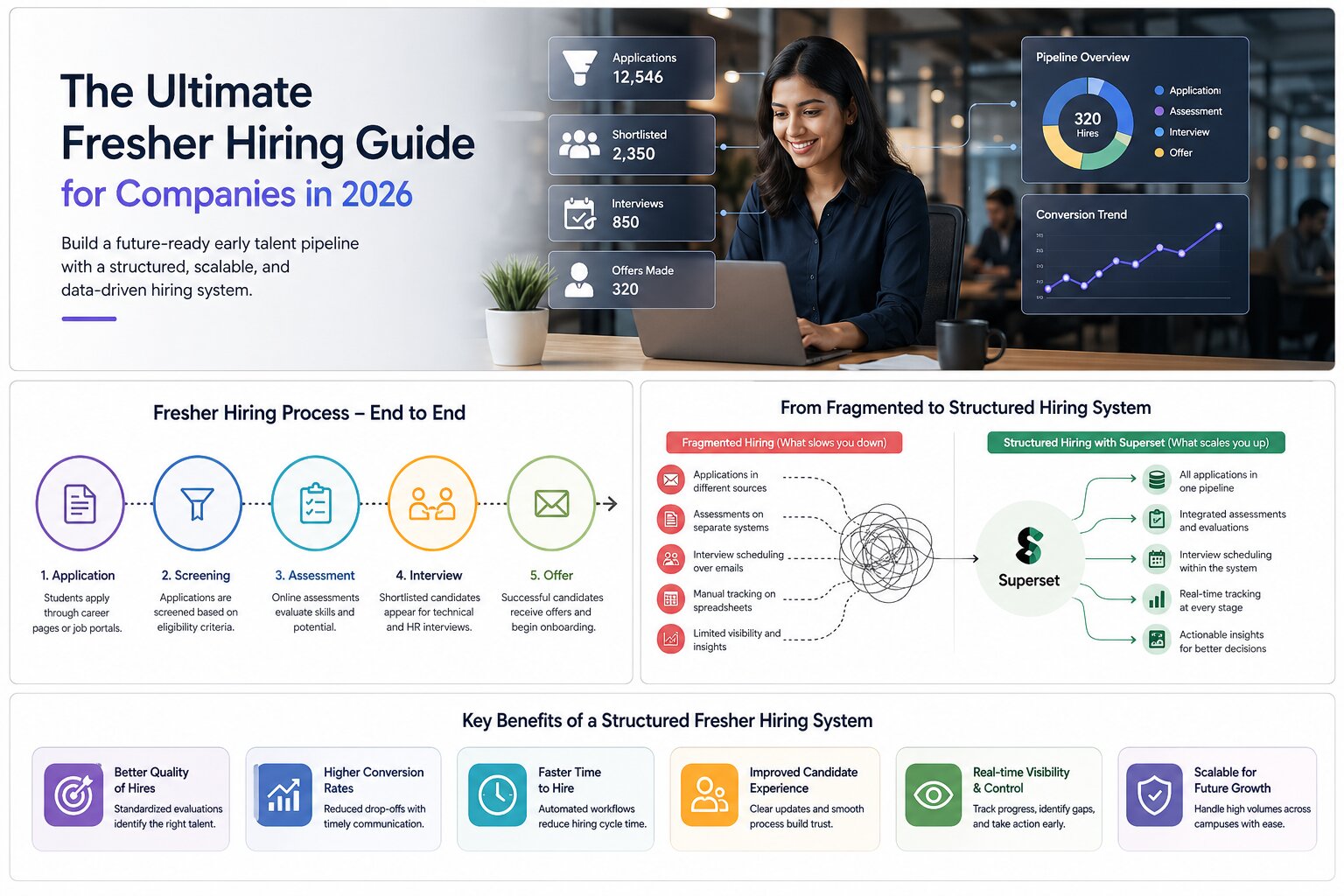
Students apply. Companies shortlist. Assessments are conducted. Interviews follow. Offers are rolled out.
This description is accurate, but incomplete.
Inside a company, fresher hiring is not a sequence of steps.
It is a continuous flow of decisions, data movement, and coordination.
A typical hiring cycle might involve multiple campuses running in parallel. Each campus has its own timelines, eligibility criteria, and student pool.
Applications start flowing in quickly. Thousands of profiles need to be reviewed or filtered. Assessment links need to be shared. Interview panels need to be aligned.
At every stage, decisions need to be made.
Who moves forward. Who gets rejected. Who needs follow-up.
When these decisions are supported by a structured system, the process feels controlled.
When they are not, hiring becomes reactive.
And that is when inefficiencies start to appear.
Why Fresher Hiring Becomes Difficult at Scale
The challenge with fresher hiring is not complexity in isolation.
It is compounded complexity.
Each part of the process might work independently.
Application collection works. Assessments work. Interviews happen.
But when these parts are not connected, the process begins to fragment.
Recruiters start maintaining separate trackers. Data needs to be moved manually between stages. Updates are communicated across multiple channels.
Nothing is technically broken.
But nothing is fully connected either.
This creates invisible friction.
A delay in one stage affects the next. A communication gap leads to candidate confusion. A missed update results in drop-offs.
Individually, these are small issues.
At scale, they become systemic.
Where Most Fresher Hiring Processes Start to Break
The breaking point is rarely obvious.
It does not happen when applications increase.
It happens when coordination fails to keep up.
Consider a scenario where a company is hiring across ten campuses simultaneously.
Applications have been collected successfully. The initial screening is complete.
Now assessments need to be conducted.
Some candidates receive links on time. Others don’t. Some complete the assessment. Others miss it due to unclear communication.
The data from assessments needs to be consolidated. Shortlists need to be created.
At this stage, recruiters often rely on multiple tools.
Assessment platforms provide results. Spreadsheets are used to track progress. Emails are used to communicate updates.
This is where gaps begin to form.
Candidates who should have progressed are missed. Communication delays create uncertainty. Some candidates accept other offers while waiting.
By the time interviews begin, the pipeline is already weaker.
Not because the candidates were not good.
But because the system failed to move them forward efficiently.
The Hidden Cost of an Unstructured Hiring Process
Most companies respond to these challenges by increasing effort.
More recruiters are added. More follow-ups are initiated. More manual tracking is introduced.
This keeps the process moving.
But it does not make it better.
In fact, it introduces new problems.
Recruiters spend more time managing operations than evaluating candidates. Decision-making slows down because information is scattered.
Candidates experience inconsistent communication. Some receive timely updates. Others are left waiting.
This inconsistency affects perception.
And in a competitive hiring environment, perception matters.
A candidate who feels uncertain is more likely to disengage.
This is the hidden cost of an unstructured system.
It does not just slow down hiring.
It affects outcomes.
Why Increasing Input Does Not Improve Output
When hiring outcomes decline, the instinct is to increase input.
More campuses are added. More candidates are sourced. More drives are conducted.
This creates the illusion of progress.
The funnel looks bigger.
But conversion does not improve.
Because the problem is not at the top of the funnel.
It is within the flow of the funnel.
If candidates are dropping off between stages, adding more candidates does not solve the issue.
It only increases the volume of inefficiency.
This is why many companies struggle to translate campus hiring efforts into actual hires.
The system is working harder.
But not working better.
What a Broken Fresher Hiring System Looks Like
In many organisations, fresher hiring operates across disconnected layers.
Applications are collected through one system. Assessments are conducted on another platform. Interview coordination happens through emails or calls. Final tracking is maintained separately.
Each of these tools performs its function.
But the connection between them is manual.
This leads to repeated data entry, inconsistent updates, and lack of synchronisation.
Recruiters often find themselves asking basic questions.
How many candidates have completed assessments. Who has been shortlisted. Which interviews are pending.
The answers exist.
But not in one place.
This lack of visibility creates dependency on manual tracking.
And manual tracking does not scale.
What a Scalable Fresher Hiring System Looks Like
A scalable fresher hiring system is not defined by the number of hires it can handle.
It is defined by how smoothly candidates move through the process.
In a structured system, candidate data is captured once and used across all stages.
Applications automatically map to eligibility criteria. Screening is consistent. There is no ambiguity in who qualifies.
Assessments are integrated into the workflow. Candidates receive timely updates. Results flow directly into the hiring pipeline.
Interviews are scheduled within the same system. Recruiters do not need to coordinate across multiple tools.
At every stage, the hiring team has visibility.
They know how many candidates are in the pipeline. They know where movement is slowing down. They can identify drop-offs early.
This allows them to act before issues escalate.
The process becomes predictable.
And predictability is what enables scale.
How Companies Improve Fresher Hiring Outcomes
Improving fresher hiring is not about adding more steps.
It is about improving flow.
Companies that see consistent outcomes focus on reducing friction across stages.
They ensure that candidates do not experience unnecessary delays. Communication is clear and timely. Expectations are defined upfront.
They also standardise evaluation.
Instead of relying on subjective decisions, they use structured criteria to ensure consistency across campuses and roles.
Most importantly, they shift from tracking outcomes to tracking movement.
Instead of only measuring how many offers were rolled out, they focus on how candidates progressed through each stage.
This helps them identify where improvements are needed.
And once those gaps are addressed, outcomes improve naturally.
How Platforms Like Superset Enable Structured Fresher Hiring
Platforms like Superset are designed to bring structure to fresher hiring by connecting every stage into a single system.
When a hiring drive is initiated, candidate applications flow into a centralised pipeline.
Eligibility criteria are applied automatically, ensuring that only relevant candidates move forward.
Recruiters can review profiles, track progress, and make decisions within the same environment.
Assessments are integrated into the workflow. Candidates receive updates without relying on external communication channels.
Interview scheduling is handled within the system, reducing coordination effort.
At any point, the hiring team has real-time visibility into the pipeline.
They do not need to consolidate data from multiple sources.
This reduces manual effort, improves consistency, and allows hiring teams to focus on evaluation rather than coordination.
The result is not just faster hiring.
It is more controlled and reliable hiring.
The Shift That Defines the Future of Fresher Hiring
The future of fresher hiring is not about doing more.
It is about doing things differently.
Companies are moving away from fragmented processes toward connected systems.
They are replacing manual coordination with structured workflows. They are using data to make decisions instead of relying on assumptions.
This shift is not optional.
As hiring volumes increase and competition for talent intensifies, the ability to operate efficiently becomes a differentiator.
Companies that invest in structured hiring systems will not just hire faster.
They will hire better.
Final Thought
Fresher hiring does not become difficult because of scale.
It becomes difficult because the system does not evolve with scale.
Once hiring is treated as a connected system instead of a set of tasks, the same process starts delivering very different results.
Not because the effort increased.
But because the system finally supports it.
Curious How AI Can Improve Your Hiring Outcomes?
Frequently Asked Questions
Why do companies struggle with fresher hiring at scale
Because most processes are fragmented and not designed to handle high application volumes and parallel hiring workflows.
How can companies reduce drop-offs in fresher hiring
By improving communication, reducing delays between stages, and using structured systems that maintain candidate engagement.
What is the fresher hiring process
It typically includes application, screening, assessment, interviews, and offer rollout, managed as a continuous workflow.
How do companies hire freshers efficiently
By using centralised platforms that connect all hiring stages and provide real-time visibility.
What is the difference between campus hiring and fresher hiring
Campus hiring is one channel within fresher hiring. Fresher hiring can also include off-campus recruitment.
How does Superset support fresher hiring
It provides a unified system that connects applications, assessments, interviews, and tracking into a single workflow.