



Campus placement is no longer a peripheral university activity. It directly impacts student outcomes, institutional reputation, employer trust, and long-term credibility. Yet in many universities, campus placement still operates without clear ownership—scattered across people, emails, spreadsheets, and informal processes. As campus placements grow in scale and scrutiny, this lack of accountability is becoming a serious risk. Universities now face not just missed offers, but loss of continuity and control. This blog explores why campus placement without ownership has become a systemic issue and why platforms like Superset are emerging as essential infrastructure.
The Ownership Gap in Campus Placement
Campus placement challenges often begin not with execution, but with the absence of clearly defined and system-backed ownership.
- Fragmented responsibility: Although the placement cell is officially responsible, campus placement execution is spread across placement officers, department coordinators, faculty members, students, administrators, and recruiters. No single owner oversees the full process.
- Lack of a central system: Each stakeholder manages tasks using their own methods—emails, spreadsheets, or messages—resulting in disconnected workflows.
- Situational accountability: When ownership rests with individuals rather than platforms, accountability changes with people, not processes.
- Inconsistent decision-making: Eligibility rules, approvals, and communications are often handled informally, leading to confusion.
- Outcome dependency: Placement success depends heavily on who is in charge at the time, revealing the core ownership gap in campus placement.
Why Campus Placement Ownership Matters More Than Ever
Campus placement ownership matters more than ever because today’s placement ecosystem is far more complex, visible, and risk-prone than before.
- Placement volumes were manageable: Earlier, fewer students and recruiters allowed manual coordination without major breakdowns.
- Recruiter expectations were lower: Recruiters accepted delays and informal communication, relying on relationships over process quality.
- Processes were slower and relationship-driven: Timelines were flexible, and decisions depended on personal follow-ups.
- Hundreds of recruiters: Universities now manage simultaneous engagements, requiring consistent communication and tracking.
- Thousands of students: Large volumes make manual monitoring error-prone and unfair.
- Multiple eligibility rules: Complex criteria demand system-enforced accuracy.
- Parallel hiring workflows: Overlapping drives need clear ownership to avoid conflicts.
- Compliance and reporting needs: Audits and rankings require reliable, structured data.
Without defined ownership, campus placement turns reactive instead of dependable.
The Hidden Costs of Campus Placement Without Accountability
Campus placement without clear accountability creates invisible operational costs that affect universities, students, and recruiters alike.
- Inconsistent Processes Across Departments: Without a central campus placement portal, departments interpret rules independently. This results in conflicting eligibility criteria, repeated recruiter communication, student complaints, and inconsistent experiences—ultimately reducing recruiter confidence in the institution.
- Knowledge Loss Every Academic Year: When placement officers change, critical recruiter history, offer trends, and process insights are lost. Campus placement digitisation ensures institutional knowledge is retained beyond individual roles.
- No Single Source of Truth: Relying on emails and spreadsheets leads to fragmented data, manual reporting, and subjective decisions due to unreliable information.
- Recruiter Trust Erosion: Delayed responses, unclear timelines, and inconsistent shortlists create process fatigue, causing recruiters to disengage over time.
Campus Placement Is Not an Event—It’s an Institutional System
Campus placement is no longer a one-time activity—it is a continuous institutional function that reflects how mature and prepared a university truly is.
- A year-round engagement cycle: Campus placement runs continuously, involving ongoing recruiter engagement, student readiness tracking, internships, and future cohort preparation rather than a single annual drive.
- A data-rich institutional process: Every campus placement cycle generates critical data on students, recruiters, and hiring trends that, when structured, enable informed planning and long-term decisions.
- A reflection of operational maturity: Effective campus placements signal strong systems, clear accountability, and consistent processes, supported by campus placement automation that moves universities beyond event-based execution.
Why Informal Ownership Fails at Scale
As campus placements grow in scale and complexity, informal ownership models begin to break down, creating operational and accountability challenges for universities.
- Manual approvals delay workflows: When approvals rely on individuals, processes slow down during peak placement periods, causing missed timelines and recruiter dissatisfaction.
- Individual dependencies increase risk: Critical knowledge and decisions rest with specific people, making the process vulnerable to absences, role changes, or attrition.
- Exceptions become the norm: Without defined rules, ad-hoc decisions multiply, leading to inconsistency and student grievances.
- Defined workflows: Campus placement automation standardises each step, ensuring processes run smoothly regardless of volume.
- Role-based access: Responsibilities are clearly assigned, improving accountability and reducing confusion.
- Rule-driven eligibility: Automated rules eliminate subjective decisions and ensure fairness.
- Time-stamped accountability: Every action is recorded, creating transparency and audit-ready records.
Campus Placement Digitisation as a Governance Strategy
Campus placement digitisation is not just about speed or convenience—it is about governance and institutional control.
- Define ownership at each stage: Digitised campus placement systems clearly assign responsibility across pre-placement, hiring, and post-placement phases, reducing ambiguity and dependence on individuals.
- Track actions and decisions: Every approval, change, and communication is logged, creating transparency and accountability throughout the campus placement process.
- Maintain historical records: Universities retain recruiter data, student outcomes, and process insights across academic years, ensuring continuity despite staff changes.
- Ensure compliance readiness: Structured records and reports support audits, accreditations, and ranking requirements.
With platforms like Superset, campus placements shift from ad-hoc execution to auditable, repeatable institutional processes.
Where Ownership Breaks Down in Traditional Campus Placements
Campus placement ownership often breaks down across different stages of the process, creating gaps in accountability and consistency.
- Pre-Placement: Recruiter onboarding, eligibility sharing, and approvals rely on emails and informal communication, leading to delays, misinterpretation, and individual-driven decisions.
- During Placement Drives: Scheduling conflicts, manual shortlisting, and communication overload slow down campus placements and create inconsistencies for recruiters and students.
- Post-Placement: Fragmented offer tracking, shallow outcome analysis, and missing historical data limit universities’ ability to improve future campus placements.
A modern campus placement portal centralises ownership across all three phases, ensuring continuity, clarity, and accountability.
How Superset Restores Ownership in Campus Placement
Superset restores ownership in campus placement by embedding accountability directly into the system—ensuring processes don’t depend on individuals but on structured workflows.
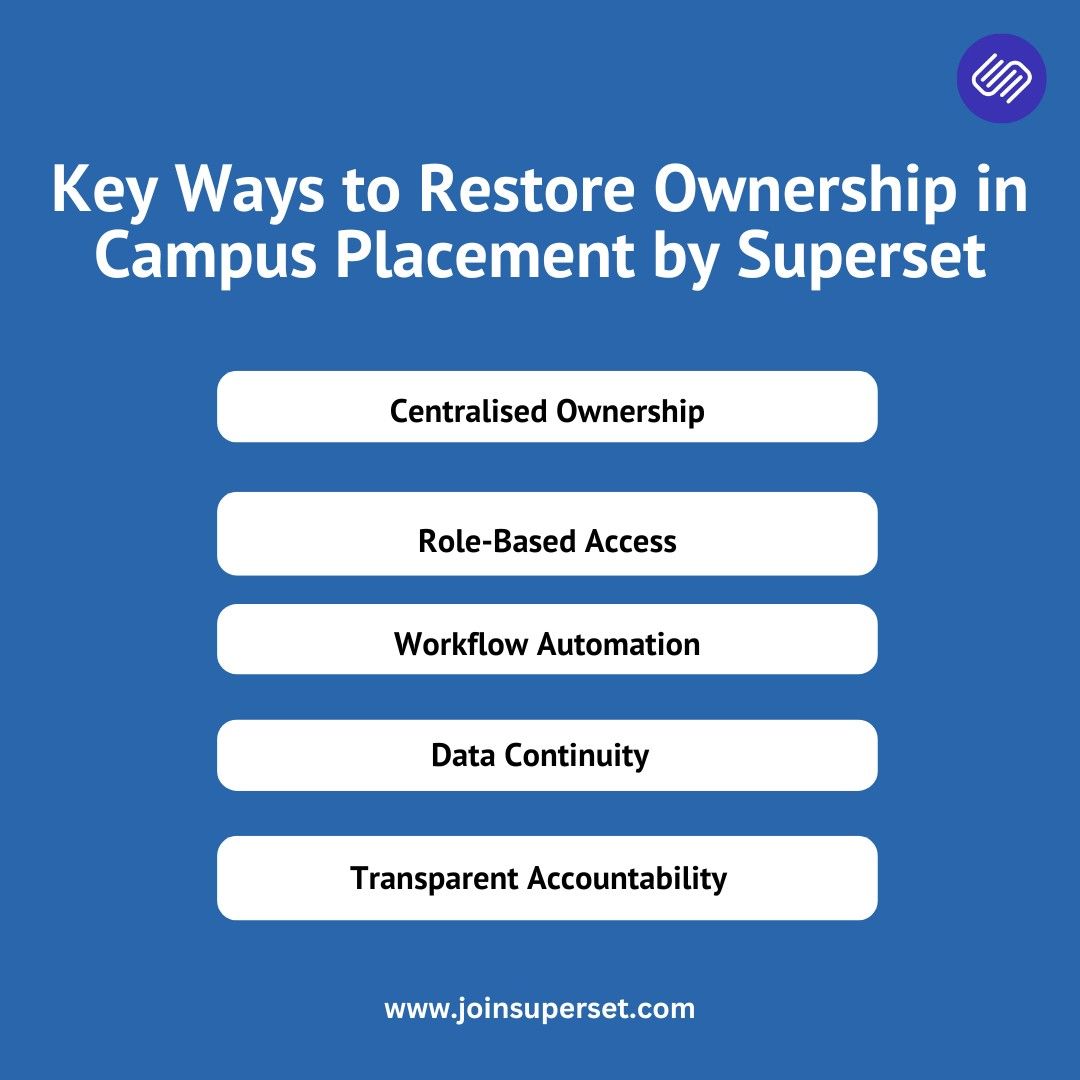
- Centralised Ownership: A single campus placement platform brings all placement activities into one system, eliminating fragmented tools and ensuring every stakeholder works from the same source of truth.
- Role-Based Access: Placement officers, departments, and recruiters have clearly defined responsibilities, reducing overlaps and confusion.
- Workflow Automation: Automated eligibility checks, structured recruiter workflows, and time-bound approvals remove manual dependency and delays.
- Data Continuity: Historical recruiter data, student performance tracking, and multi-year outcome analytics preserve institutional memory.
- Transparent Accountability: Action logs, decision trails, and real-time dashboards ensure that every step is traceable and auditable.
Why Universities Without Ownership Will Struggle Long-Term
Without clear ownership, campus placement becomes a long-term institutional risk rather than a strategic advantage.
- Declining recruiter engagement: Fragmented campus placement processes lead to delays, inconsistent communication, and repeated manual follow-ups, causing recruiters to disengage over time.
- Increased student dissatisfaction: Lack of accountability results in unclear eligibility rules, missed updates, and unequal experiences across departments, directly affecting student trust.
- Audit and accreditation challenges: Dispersed records and manual reporting make it difficult to present accurate, verifiable campus placement data during audits.
- Reputation risk: Operational inefficiencies reflect poorly on institutional maturity, impacting employer perception.
- Operational stability: Campus placement digitisation centralises processes and reduces dependency on individuals.
- Stronger employer relationships: Structured workflows improve consistency and reliability.
- Better decision-making: Centralised data enables informed planning.
- Long-term placement credibility: System-owned placements ensure continuity across academic years.
Campus Placement Ownership and University Reputation
Campus placement ownership today directly impacts how universities are perceived externally. As placements become more transparent and data-driven, multiple stakeholders now evaluate how structured and accountable a university’s placement process truly is.
- Ranking bodies: Consistent, well-documented campus placement processes support accurate reporting of outcomes, employability metrics, and recruiter engagement—factors increasingly considered in institutional rankings.
- Accreditation agencies: Structured ownership demonstrates process maturity, compliance, and continuity, reducing dependency on individuals and strengthening audit readiness.
- Prospective students: Clear, reliable campus placement systems signal institutional credibility and long-term career support, influencing enrolment decisions.
- Employers: Accountable placement ownership builds trust through predictable processes, timely communication, and professional engagement, encouraging repeat hiring.
From Placement Cell Dependency to Institutional Capability
Campus placement becomes sustainable only when universities move from individual dependency to system-driven capability. Here’s how that shift creates long-term institutional strength:
- Reduce dependency on individuals: System-led campus placement cell online ensures processes don’t break when placement officers change roles, go on leave, or exit the institution.
- Preserve institutional memory: All recruiter interactions, student outcomes, and historical data are centrally stored, preventing knowledge loss year after year.
- Scale placements without chaos: Automated workflows and structured rules allow universities to handle higher placement volumes without manual overload or errors.
- Maintain accountability across years: Clear ownership, action logs, and audit-ready records ensure consistent accountability beyond individual tenures.
The Future of Campus Placements Is System-Owned
The future of campus placements depends on system-owned processes, not manual coordination. As placement volumes and expectations grow, universities need platforms that embed ownership, accountability, and continuity into everyday operations.
- Attract better recruiters: System-owned campus placements deliver consistent communication, structured workflows, and predictable timelines that build recruiter trust and long-term partnerships.
- Deliver consistent student outcomes: Platform-driven ownership ensures uniform eligibility rules, fair shortlisting, and reliable offer tracking across departments and academic years.
- Operate placements with confidence: Embedded ownership reduces individual dependency, minimises errors, and allows universities to scale campus placements without operational disruption.
Universities without this shift will continue managing the same problems year after year.
Conclusion
Ownership in campus placement is no longer optional—it is essential for universities seeking consistent results, recruiter trust, and institutional continuity. Fragmented processes create inefficiencies, data loss, and operational risks that affect long-term credibility. By adopting campus placement automation and leveraging a campus placement portal like Superset, universities can digitise workflows, maintain historical records, and ensure accountability. Investing in structured ownership transforms campus placements from ad-hoc events into repeatable, auditable, and scalable institutional processes, safeguarding both student success and university reputation.