



Campus hiring has become one of the most critical functions for companies building long-term talent pipelines, but most organisations are still running it like an operational exercise instead of a scalable system.
From the outside, campus recruitment looks straightforward. Engage with universities, collect applications, assess candidates, conduct interviews, and roll out offers.
Inside a hiring team, it rarely feels that simple.
The moment hiring expands beyond a handful of campuses, the process starts showing cracks. Communication becomes inconsistent. Shortlisting slows down. Candidates drop off without clear reasons. Recruiters spend more time coordinating logistics than evaluating talent.
At that point, the issue is no longer effort. It is structure.
Why Campus Hiring Feels Manageable Until It Doesn’t
Most companies don’t notice problems early because the system works at small scale.
A team hiring from five campuses can manage workflows through spreadsheets and emails. Everyone knows what is happening. Coordination is still within control.
Scale changes everything.
When the same team expands to twenty or thirty campuses, the volume of applications increases exponentially. Different universities follow different processes. Candidate data comes in inconsistent formats. Timelines overlap.
What used to feel manageable becomes unpredictable.
Recruiters are no longer running a hiring process. They are reacting to it.
What Campus Hiring Actually Looks Like Behind the Scenes
A typical hiring cycle involves multiple moving parts happening at the same time.
Recruiters reach out to placement teams across universities. Each university shares candidate data differently. Some rely on spreadsheets. Others use internal systems. A few depend entirely on email communication.
Assessments need to be scheduled across thousands of candidates. Results arrive in batches. Shortlisting begins, often under time pressure.
Interview coordination becomes the biggest bottleneck. Aligning candidate availability, hiring manager schedules, and university timelines turns into a complex task. Conversations spread across long email threads. Updates get missed.
By the time offers are rolled out, most teams are not evaluating talent anymore. They are managing operations.
This is not an edge case. This is the default experience for most hiring teams.
The Core Issue: Fragmentation Across the Hiring Process
The biggest misconception about campus hiring is that it is inefficient.
It is not just inefficient. It is fragmented.
Each stage exists, but they are disconnected.
Applications are collected in one place. Assessments happen somewhere else. Interview feedback sits in separate trackers. Decisions are made without a complete view of the pipeline.
This leads to a constant lack of clarity.
Ask a hiring team simple questions during an active campus drive.
Which campuses are performing the best?
Where are candidates dropping off?
How long does it take to move from assessment to interview?
Most teams cannot answer these in real time. Not because they lack expertise, but because their systems do not support visibility.
Why Scaling Campus Hiring Is Fundamentally Different
Campus hiring does not behave like lateral hiring.
In lateral hiring, recruiters control the pace. They decide when to open roles, when to move candidates forward, and how to structure timelines.
In campus hiring, the timeline is externally driven.
Universities operate on fixed calendars. Students apply in large volumes at the same time. Hiring windows are limited.
This creates a constraint most teams underestimate.
You cannot slow down campus hiring. You can only make it more structured.
When scale increases, inefficiencies do not grow linearly. They multiply.
The Breaking Point Most Companies Hit
Every campus hiring program reaches a tipping point.
It usually appears when:
- The number of campuses crosses twenty
- Candidate volume runs into thousands
- Multiple roles are hired simultaneously
At this stage, systems begin to fail visibly.
Spreadsheets become outdated within hours. Email threads become impossible to track. Interview scheduling delays pile up. Recruiters lose visibility into pipeline progress.
The most critical impact is not operational.
It is talent loss.
Strong candidates drop off because of slow communication, unclear timelines, or inconsistent experience.
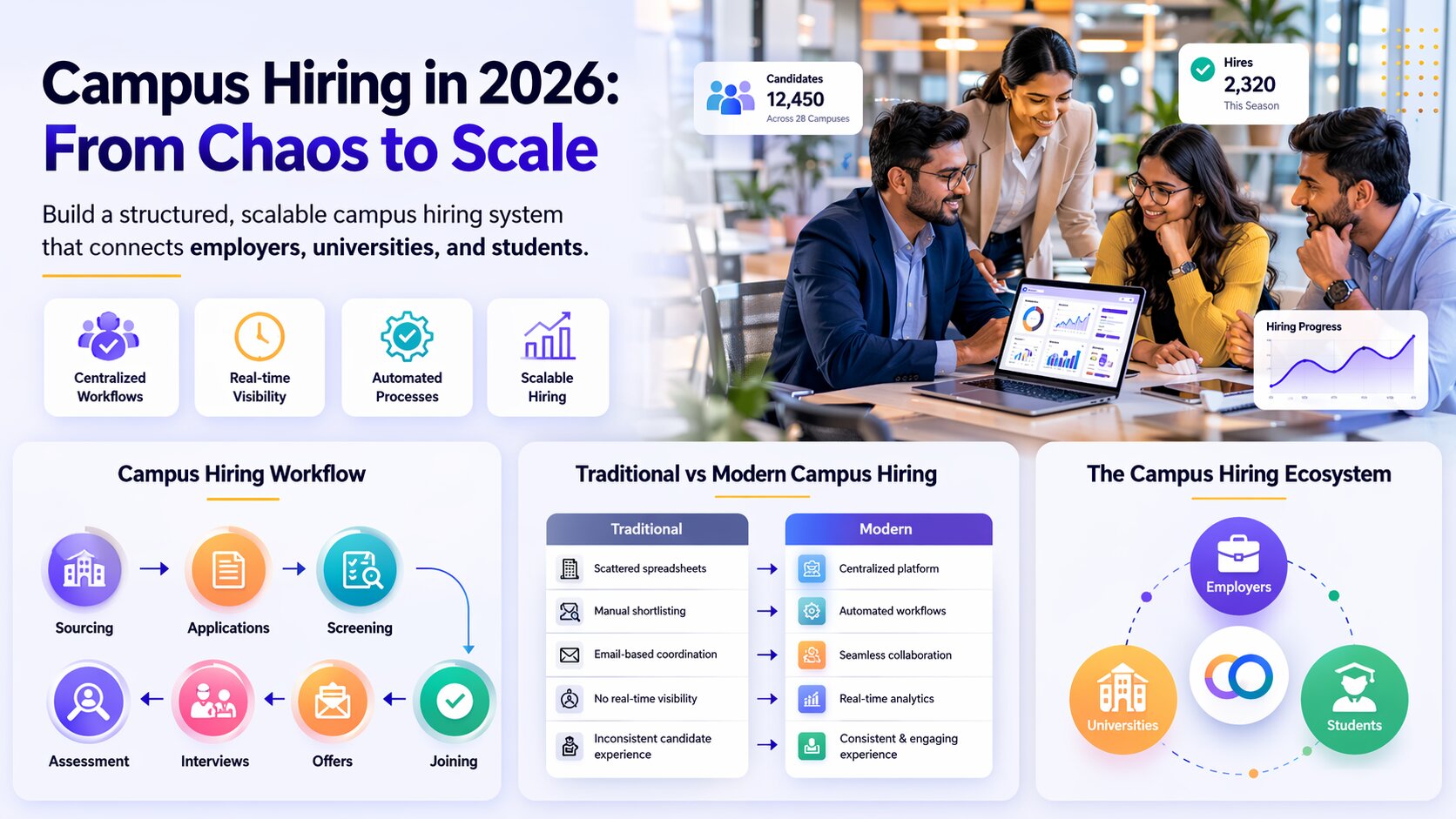
What High-Performing Campus Hiring Teams Do Differently
The difference between average and high-performing teams is not effort.
It is how the system is designed.
Strong teams stop treating campus hiring as a set of individual activities. They build a structured process that works across all campuses.
Applications follow a consistent flow. Assessment frameworks are standardised. Interview stages are clearly defined.
More importantly, they remove dependency on manual coordination.
Shortlisting is not done by scanning spreadsheets. Scheduling does not rely on email back and forth. Communication is structured and timely.
This shift changes how recruiters operate.
Instead of managing chaos, they focus on decision-making.
From Tools to Infrastructure: The Shift That Changes Everything
Most organisations try to fix campus hiring challenges by adding more tools.
A tool for assessments. Another for interviews. A tracker for applications.
The problem is not lack of tools.
It is lack of connection between them.
Campus hiring at scale requires infrastructure.
Infrastructure connects every stage of the hiring process into a single system. Applications, assessments, interviews, and offers are no longer isolated steps. They become part of a continuous flow.
This is what enables visibility, consistency, and speed at the same time.
Where Campus Hiring Platforms Come In
A modern campus hiring platform is not just a system of record. It is a system of execution.
It allows recruiters to:
- Manage all campuses in one place
- Track candidate progress in real time
- Automate repetitive workflows
- Standardise hiring stages
- Collaborate seamlessly with universities
Instead of reacting to hiring challenges, teams operate with clarity and control.
How This Translates in Real Hiring Workflows
When hiring runs on a structured platform:
Application data flows into a single system instead of scattered formats. Shortlisting happens through defined criteria instead of manual filtering. Assessments are integrated into the workflow rather than managed separately.
Interview scheduling becomes coordinated within the system, reducing back and forth communication. Recruiters and hiring managers have visibility into candidate status at every stage.
Most importantly, decisions are made based on real-time data rather than assumptions.
This is the difference between managing hiring and controlling it.
How Superset Enables Structured Campus Hiring at Scale
Platforms like Superset are designed to function as infrastructure for campus hiring.
Instead of operating across disconnected systems, employers, universities, and students interact within a unified ecosystem.
This creates three immediate advantages.
First, visibility improves because all hiring data exists in one place.
Second, processes move faster because workflows are predefined and automated.
Third, collaboration becomes seamless because every stakeholder operates within the same system.
The result is not just efficiency. It is predictability.
And predictability is what allows organisations to scale hiring without losing control.
Frequently Asked Questions
Why is campus hiring important
It helps companies build a strong pipeline of early talent and reduce long-term hiring costs.
What are the biggest challenges in campus hiring
Fragmentation, manual coordination, lack of visibility, and scalability issues.
How can companies scale campus hiring
By standardising processes, using automation, and adopting campus hiring platforms.
What is a campus hiring platform
A platform that manages the entire campus recruitment lifecycle in a structured and centralized way.
How does automation help campus hiring
It reduces manual work, speeds up processes, and improves consistency.
What is a virtual campus drive
A hiring process where assessments and interviews are conducted online.
How do recruiters select campuses
Based on historical performance, talent quality, and hiring goals.
What metrics matter in campus hiring
Conversion rates, time to hire, offer acceptance rate, and campus performance.
How does Superset help in campus hiring
Superset provides a centralised platform to manage, automate, and scale campus hiring efficiently.