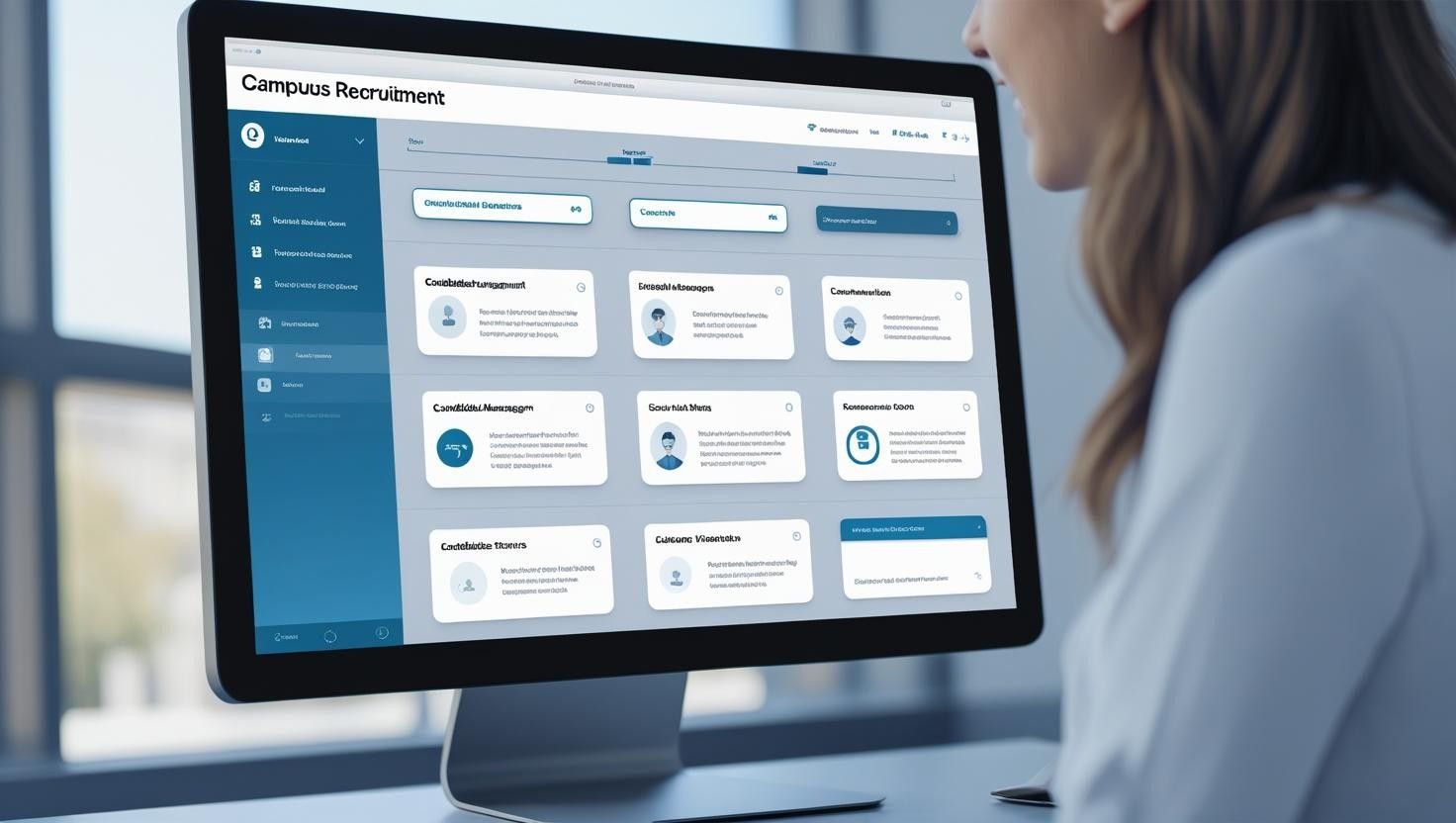



A few years ago, virtual campus hiring was viewed as an alternative approach used only when physical hiring was difficult. Today, that perception no longer exists.
For many organisations, online campus hiring has become the default operating model for scaling early talent recruitment across multiple campuses and geographies.
This shift is not simply about moving interviews online.
It represents a deeper transformation in how hiring systems are designed, executed, and measured.
Companies are no longer constrained by travel schedules, physical campus visits, or regional hiring limitations. Recruiters can now engage with institutions across the country simultaneously, conduct assessments remotely, and evaluate candidates without requiring a physical presence.
At first glance, this appears to make campus hiring easier.
But in reality, virtual hiring introduces a completely different layer of operational complexity.
Because once hiring becomes distributed, visibility becomes harder to maintain, coordination becomes more dependent on systems, and candidate engagement becomes significantly more fragile.
The companies that succeed in virtual campus hiring are not necessarily the ones conducting the most drives.
They are the ones building systems capable of sustaining scale without losing continuity.
The shift toward virtual hiring changed where complexity exists
In traditional campus recruitment, complexity was visible.
Recruiters travelled to campuses. Placement teams coordinated physical logistics. Students gathered in auditoriums for assessments and interviews. Hiring delays could often be identified immediately because the entire process was happening in a shared environment.
Virtual hiring redistributed that complexity into digital systems.
Now applications arrive from multiple campuses simultaneously. Assessments are conducted remotely. Interviews happen across distributed schedules. Communication occurs asynchronously across email, messaging platforms, and hiring systems.
Nothing is physically visible anymore.
And that changes how hiring problems emerge.
In a physical hiring model, inefficiencies were easier to spot because teams were present inside the process. In a virtual model, inefficiencies accumulate silently until they begin affecting candidate movement and hiring outcomes.
This is one of the biggest reasons many companies struggle when scaling virtual campus hiring.
The process continues to function on the surface, but internally, fragmentation begins to increase.
Candidates miss communications. Assessment timelines stretch. Interview scheduling slows down. Recruiters spend increasing amounts of time coordinating manually across disconnected tools.
By the time these inefficiencies become visible, the hiring pipeline has already weakened.
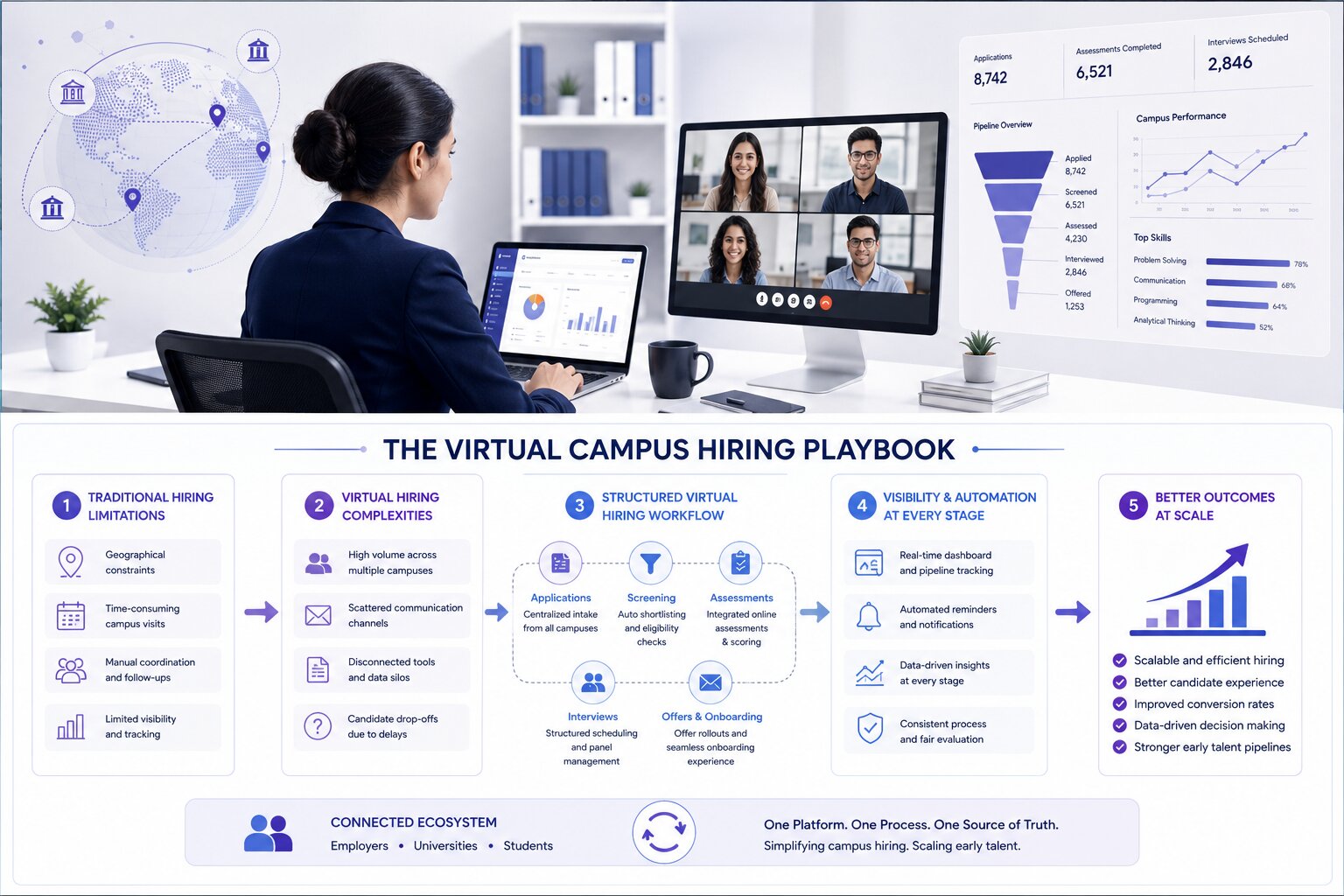
Virtual hiring does not reduce coordination. It changes the form of coordination
One of the most common misconceptions in online campus hiring is that removing physical logistics automatically simplifies execution.
What actually happens is that physical coordination gets replaced by workflow coordination.
Instead of managing campus visits, recruiters now manage digital movement across stages.
Applications need to be screened consistently. Assessments must be triggered on time. Interview schedules need to align with candidate availability and hiring panel bandwidth. Communication has to remain clear across every stage.
Each activity may appear manageable independently.
The challenge emerges when all these activities happen simultaneously across multiple campuses.
At this point, hiring success no longer depends on whether each stage works individually.
It depends on whether the stages remain connected.
This is where many virtual campus hiring processes begin to break down.
Applications may exist in one platform. Assessments may happen through another tool. Interviews might be coordinated manually through spreadsheets and emails.
Every stage technically functions.
But the process itself becomes fragmented.
Recruiters become the bridge between disconnected systems, spending more time moving information than improving hiring outcomes.
The scalability illusion in online campus hiring
Virtual hiring creates the impression of infinite scalability.
Companies can now engage with significantly more campuses than before. Recruiters can conduct parallel hiring drives across regions without travel limitations. Candidate participation increases because access barriers reduce.
But scalability is not defined by how many candidates enter the pipeline.
It is defined by whether the system can sustain growth without creating operational instability.
This is where virtual campus hiring exposes weaknesses in hiring infrastructure.
As application volume increases, visibility decreases. Recruiters begin managing multiple spreadsheets and communication channels simultaneously. Assessment data gets distributed across tools. Interview coordination becomes increasingly reactive.
At smaller scale, manual effort can compensate for these gaps.
At larger scale, fragmentation compounds quickly.
And once fragmentation increases, candidate experience starts deteriorating.
Communication delays become more common. Interview schedules shift unexpectedly. Candidates lose visibility into the hiring process.
This is also where patterns like candidate drop-offs in campus hiring become significantly more pronounced.
Not because candidates are uninterested.
But because uncertainty increases as process continuity weakens.
Candidate experience becomes more important in virtual hiring environments
In physical campus hiring, candidate engagement is naturally reinforced by the environment itself.
Students are physically present. Placement teams actively coordinate participation. Recruiters interact directly with candidates. Momentum exists because the hiring process feels immediate and tangible.
Virtual hiring removes that environmental reinforcement.
Candidates now experience the hiring process individually through screens, emails, dashboards, and notifications.
This changes candidate behaviour in important ways.
When communication slows down, candidates disengage faster. When timelines become unclear, competing opportunities gain more attention. When assessment and interview experiences feel disconnected, trust in the process declines.
The absence of physical engagement means that the hiring workflow itself becomes the candidate experience.
This is why execution quality matters more in virtual campus hiring than in traditional models.
Candidates evaluate companies not only based on offers or compensation, but also on how structured and predictable the process feels.
A fragmented hiring experience creates uncertainty.
A structured process builds confidence.
Schedule A Demo
Why disconnected tools become a major limitation in virtual campus recruitment
Most hiring teams do not intentionally create fragmented workflows.
Fragmentation usually develops gradually as organizations adopt separate tools to solve specific operational needs.
One platform handles applications. Another conducts assessments. Interviews are coordinated through calendars and emails. Reporting is managed separately.
Initially, this appears efficient because each tool performs its own function effectively.
The problem is that campus hiring is not a collection of independent tasks.
It is a connected pipeline where continuity between stages determines efficiency.
When systems are disconnected, continuity depends entirely on manual coordination.
Recruiters spend time consolidating candidate data, updating stakeholders, reconciling assessment results, and tracking movement between stages.
This creates operational drag.
The more hiring scales, the more effort becomes necessary simply to maintain visibility.
And eventually, execution quality starts depending more on recruiter bandwidth than system capability.
This is where virtual hiring transitions from scalable to unstable.
What structured virtual campus hiring actually looks like
Companies that scale online campus recruitment successfully approach hiring differently.
They do not treat applications, assessments, interviews, and communication as separate activities.
They treat hiring as a connected system.
In a structured virtual hiring environment, candidate information flows naturally across stages instead of requiring repeated manual intervention.
Applications automatically move into centralised pipelines. Eligibility filters standardise shortlisting. Assessments integrate directly into candidate workflows, and results update in real time.
Interview scheduling becomes part of the same process rather than a disconnected coordination task.
Most importantly, visibility exists across the entire hiring lifecycle.
Recruiters know how many candidates are progressing, where delays are occurring, and which stages are slowing down.
This changes how hiring teams operate.
Instead of reacting to operational issues after they escalate, teams can identify process friction early and resolve it before outcomes are affected.
The complexity of campus hiring does not disappear.
But the system becomes capable of handling that complexity without creating instability.
The role of automation in virtual hiring execution
Automation in virtual campus hiring is often misunderstood.
Many organisations associate automation only with reducing manual effort.
But in practice, automation is more valuable because it improves continuity.
Automated assessment triggers reduce delays between stages. Scheduled communication ensures candidates receive consistent updates. Workflow-based interview coordination reduces dependency on manual follow-ups.
Each automation layer reduces friction.
Over time, this creates a hiring process that moves more predictably.
This matters because predictability directly influences conversion.
When candidates experience consistent communication and clear timelines, engagement improves. When hiring teams gain visibility into workflow movement, operational efficiency improves.
Automation is not replacing recruiters.
It is reducing fragmentation.
How platforms like Superset support online and virtual campus hiring
As virtual hiring complexity increases, organisations are increasingly moving toward connected hiring systems instead of isolated recruitment tools.
This is where platforms like Superset function as a structured campus hiring platform designed specifically for large-scale early talent recruitment.
Instead of requiring recruiters to coordinate multiple disconnected systems, applications, assessments, interviews, communication, and tracking exist within a unified workflow.
Candidate movement becomes easier to manage because the process itself maintains continuity.
Assessment results update directly within candidate pipelines. Interview coordination remains centralised. Hiring teams gain visibility into progress without relying on fragmented tracking methods.
This reflects the broader evolution of modern virtual hiring software, where the objective is not simply enabling remote hiring, but building scalable infrastructure for distributed recruitment.
When hiring systems become connected, recruiters spend less time managing process movement and more time improving hiring outcomes.
Data visibility becomes a strategic advantage in virtual hiring
One of the biggest advantages of online campus hiring is the ability to capture operational data continuously across every stage.
Companies can analyse:
- application conversion trends
- assessment completion rates
- interview progression patterns
- offer acceptance behaviour
- campus-wise hiring performance
But data alone is not valuable unless it is connected to decision-making.
In fragmented hiring systems, data exists across multiple tools but remains difficult to consolidate and interpret.
In connected systems, data becomes actionable.
Recruiters can identify where drop-offs occur, understand which campuses generate stronger outcomes, and optimise hiring timelines based on real workflow movement.
This becomes even more effective when virtual campus recruitment is aligned with a broader fresher hiring strategy, where insights from one hiring cycle continuously improve the next.
The future of campus hiring will be hybrid, but execution will remain digital
Physical campus engagement will continue to matter.
Employer branding, university relationships, and student engagement activities will still play an important role in attracting talent.
But execution itself is increasingly becoming digital-first.
Most organisations are moving toward hybrid hiring models where physical interaction supports engagement while virtual systems manage execution.
This allows companies to scale efficiently without increasing operational complexity at the same rate.
In the coming years, the companies that succeed in campus recruitment will not necessarily be the ones visiting the most campuses.
They will be the ones capable of maintaining consistency, visibility, and candidate engagement across distributed hiring environments.
Because modern campus hiring is no longer defined by physical presence.
It is defined by execution quality.
Final Thought
Online and virtual campus hiring is not simply a technological shift.
It is an operational shift in how organisations build hiring systems capable of sustaining scale.
Companies that continue treating virtual hiring as a temporary adaptation will continue facing fragmentation, coordination issues, and inconsistent hiring outcomes.
Companies that invest in connected, system-driven hiring infrastructure will gain something far more valuable than operational efficiency.
They will gain predictability.
And in high-volume campus recruitment, predictability is what ultimately enables scale.