


Campus placements have evolved beyond spreadsheets, emails, and manual coordination.
For years, universities and recruiters managed campus hiring through fragmented systems that relied heavily on human coordination.
Placement teams manually tracked student eligibility. Recruiters coordinated assessments through multiple tools. Interview schedules were managed through spreadsheets and email chains. Communication between students, universities, and employers often depended on continuous follow-ups.
At smaller scale, these systems appeared manageable.
But as placement activity expanded across larger student populations, multiple recruiters, and hybrid hiring models, the limitations of traditional placement workflows became increasingly visible.
The challenge was not simply operational inefficiency.
The real problem was fragmentation.
Different stakeholders were operating inside disconnected systems while attempting to manage a process that required continuity across every stage.
This is one of the primary reasons modern universities and employers are increasingly moving toward structured campus placement software and connected placement portals.
Not because technology alone improves hiring.
But because campus placements today require infrastructure capable of sustaining visibility, coordination, and scalability simultaneously.
Why traditional campus placement processes become unstable at scale
In smaller institutions or limited hiring cycles, manual coordination often appears sufficient.
Placement officers can track student applications individually. Recruiters can coordinate directly with placement teams. Communication remains manageable because hiring volumes are relatively controlled.
The situation changes entirely when the placement activity scales.
Large universities may manage:
- thousands of eligible students
- multiple recruiters simultaneously
- parallel hiring drives
- assessments across departments
- interview scheduling across timelines
- offer management and reporting
At this scale, operational dependency on spreadsheets and fragmented communication creates instability.
Data becomes inconsistent. Eligibility tracking slows down. Communication gaps increase. Recruiters lose visibility into candidate movement. Students experience delays and confusion.
Most importantly, placement teams spend increasing amounts of time maintaining workflows manually instead of improving placement outcomes strategically.
The issue is not effort.
It is that traditional systems were never designed to support modern placement complexity.
This is also where modern campus recruitment strategy frameworks become increasingly important for universities and recruiters attempting to scale efficiently.
Campus placement software is no longer just a management tool
Many organisations still interpret placement software as a digital replacement for spreadsheets.
That definition is outdated.
Modern online campus placement software functions as an operational infrastructure connecting universities, students, and recruiters within a structured hiring ecosystem.
It does not simply store candidate information.
It orchestrates placement workflows.
Applications, eligibility filters, assessments, interview coordination, recruiter communication, reporting, and offer tracking all operate within connected systems instead of disconnected administrative layers.
This changes how campus hiring functions operationally.
Instead of relying on continuous manual coordination, workflows move systematically across stages while maintaining visibility for all stakeholders.
The objective is not merely digitisation.
It is continuity.
The difference between placement portals and placement infrastructure
The terms “placement portal” and “placement platform” are often used interchangeably.
But there is an important difference between a basic portal and true placement infrastructure.
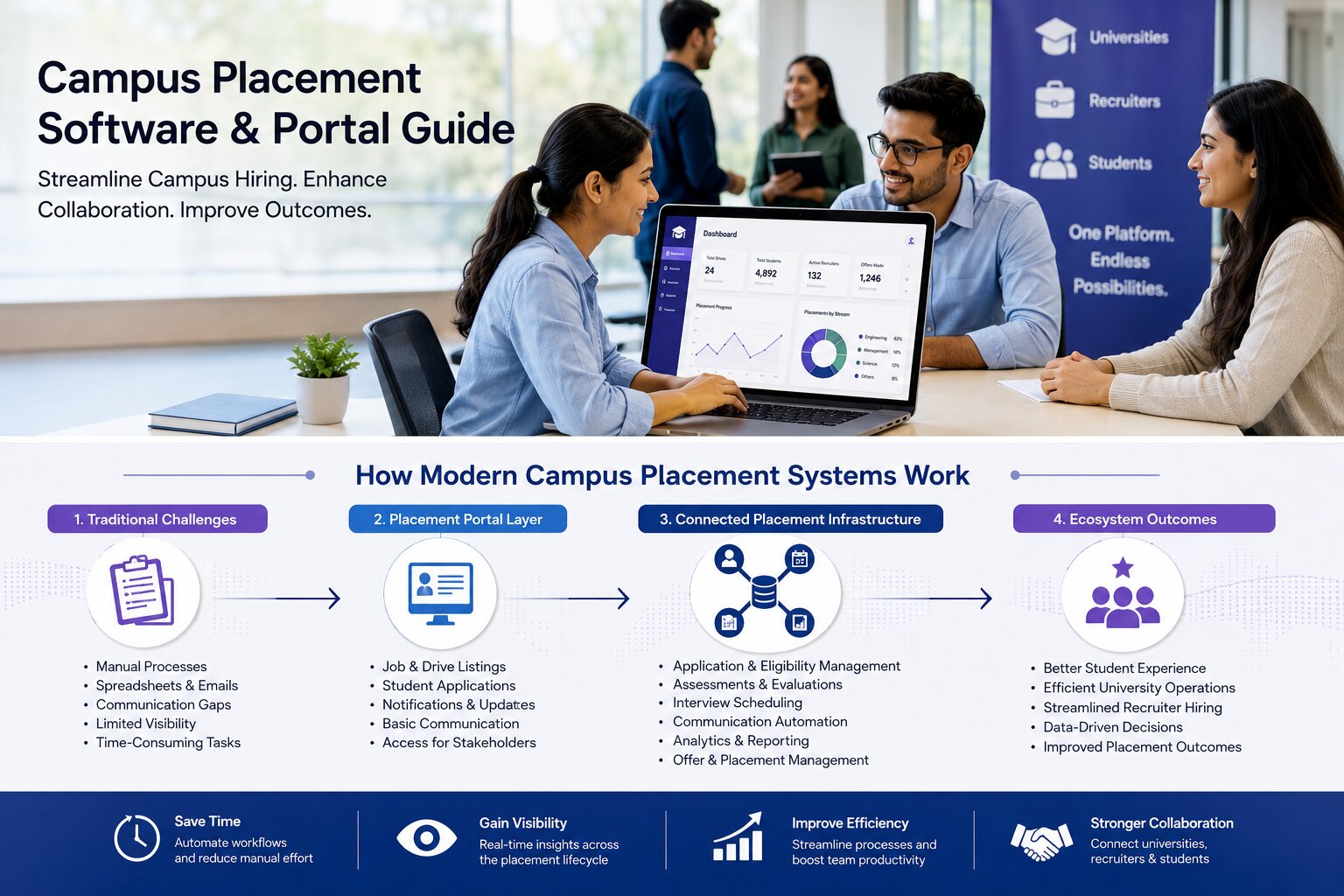
A traditional campus placement portal primarily acts as an access layer.
Students can view job opportunities, apply for roles, and receive notifications. Placement officers may manage recruiter communication and eligibility lists.
While this improves accessibility, the underlying workflow often remains fragmented.
Assessment platforms operate separately. Interview scheduling remains manual. Reporting requires consolidation across tools.
Infrastructure-driven placement systems function differently.
Instead of acting only as access points, they connect every stage of placement activity into a unified operational workflow.
Applications feed directly into eligibility pipelines. Assessments integrate into candidate progression. Recruiters gain centralised visibility into hiring movement. Placement teams can monitor activity without relying on scattered coordination.
This distinction becomes critical as the placement scale increases.
Because access alone does not solve fragmentation.
Connected workflows do.
Why universities are rapidly adopting online placement systems
The growth of digital hiring models has fundamentally changed university placement expectations.
Students now expect:
- real-time visibility
- faster communication
- digital assessments
- remote interview coordination
- centralized placement access
Recruiters also expect more structured engagement.
Companies hiring at scale need standardised workflows, predictable coordination, and visibility into candidate pipelines across campuses.
Traditional placement methods struggle to support these expectations simultaneously.
This is why institutions are increasingly adopting online campus placement software capable of managing placement operations centrally.
These systems reduce operational dependency on manual processes while improving consistency across hiring cycles.
More importantly, they allow placement teams to transition from administrative coordination toward strategic placement management.
This shift is also accelerating alongside virtual campus hiring models that require centralised digital workflows.
Fragmented hiring systems create invisible operational costs
One of the biggest misconceptions in campus recruitment is that fragmentation only creates inconvenience.
In reality, fragmented workflows create compounding operational costs.
When applications, assessments, interviews, and reporting exist across disconnected systems:
- recruiters spend more time coordinating
- placement teams duplicate administrative effort
- candidate communication becomes inconsistent
- visibility gaps increase
- reporting accuracy weakens
Over time, this impacts placement quality itself.
Students experience slower processes. Recruiters encounter coordination delays. Placement teams struggle to scale operations during peak hiring periods.
The hidden cost is not simply inefficiency.
It is reduced process continuity.
And continuity is what determines whether campus hiring can scale sustainably.
Organisations focusing on scalable fresher hiring strategies are increasingly prioritising connected hiring systems instead of fragmented operational workflows.
How placement automation changes placement operations
Automation within placement systems is often misunderstood as a mechanism for reducing manual work alone.
Its larger impact is operational consistency.
For example:
- eligibility filtering becomes standardised
- communication workflows become predictable
- assessment triggers reduce delays
- interview scheduling becomes centralised
- reporting updates automatically
Each automation layer reduces process dependency on constant human intervention.
This matters because campus hiring involves multiple stakeholders operating simultaneously.
Without structured automation, continuity depends entirely on manual coordination.
With automation, workflows maintain momentum even at larger scale.
The placement process becomes more stable, predictable, and scalable.
Broader digital hiring ecosystem trends published by NASSCOM also show growing adoption of connected hiring infrastructure across universities and enterprises.
The role of placement software in improving student experience
Placement systems influence more than operational efficiency.
They directly affect student perception of the placement process itself.
In fragmented systems, students often experience:
- delayed communication
- unclear timelines
- inconsistent updates
- limited visibility into application status
This creates uncertainty.
Modern placement platforms improve transparency by centralising information and communication.
Students gain visibility into:
- application status
- interview schedules
- eligibility requirements
- placement updates
- recruiter communication
This improves engagement because the placement journey feels structured rather than unpredictable.
And in highly competitive placement environments, structured candidate experience significantly improves participation and responsiveness.
A connected placement portal becomes critical in maintaining transparency across the student journey.
Why recruiters increasingly prefer structured campus recruitment platforms
Campus hiring teams are also adapting to increasing recruitment complexity.
Companies hiring across multiple institutions need systems capable of maintaining consistency across:
- candidate screening
- assessments
- interviews
- communication
- reporting
When universities operate through disconnected workflows, recruiters encounter operational friction.
Processes slow down. Visibility decreases. Coordination becomes reactive.
Structured campus recruitment platforms simplify this by centralising hiring workflows across campuses.
Recruiters gain:
- centralized candidate access
- consistent evaluation workflows
- real-time tracking
- simplified interview coordination
- streamlined communication
This improves execution quality while reducing operational overhead.
Industry-wide recruitment technology insights from LinkedIn Talent Solutions also indicate that recruiters increasingly prioritise centralised hiring visibility and workflow continuity.
Data visibility is becoming central to placement management
One of the biggest advantages of digital placement systems is visibility into operational performance.
Modern placement platforms allow universities and recruiters to track:
- placement participation rates
- application conversion trends
- recruiter engagement
- hiring timelines
- offer acceptance rates
- department-wise placement performance
This transforms placements from reactive coordination into measurable operations.
Placement teams can identify bottlenecks, optimise timelines, and improve future hiring cycles using real workflow insights.
Data visibility also improves collaboration between universities and recruiters because decisions become based on operational patterns instead of assumptions.
How platforms like Superset support connected placement ecosystems
As campus hiring complexity increases, institutions and employers increasingly require infrastructure capable of connecting every stakeholder within the placement ecosystem.
This is where Superset operates differently from standalone placement tools.
Instead of functioning only as a student access portal, Superset acts as a connected placement infrastructure platform that integrates:
- universities
- recruiters
- students
- assessments
- interviews
- communication
- analytics
The objective is not simply enabling online applications.
It is creating operational continuity across the entire placement lifecycle.
Students gain centralised visibility. Universities manage placement workflows systematically. Recruiters execute hiring through structured pipelines instead of fragmented coordination.
This reflects the broader evolution of modern placement automation software, where scalability depends less on individual tools and more on connected infrastructure.
The future of campus placements will be ecosystem-driven
Campus placements are no longer isolated university activities.
They are becoming interconnected talent ecosystems involving:
- educational institutions
- recruiters
- students
- assessment systems
- analytics platforms
- virtual hiring infrastructure
As this ecosystem expands, disconnected workflows become increasingly difficult to sustain.
Future-ready placement systems will prioritise:
- interoperability
- workflow continuity
- real-time visibility
- centralized communication
- scalable automation
The institutions and recruiters that adapt successfully will not necessarily be the ones using the most tools.
They will be the ones operating through the most connected systems.
Because modern campus hiring is no longer defined by isolated activities.
It is defined by how effectively the ecosystem functions together.
The broader future workforce infrastructure conversation explored by McKinsey is increasingly centred around connected operational ecosystems and scalable digital workflows.
Final Thought
Campus placement software is no longer an optional infrastructure for universities and recruiters operating at scale.
The complexity of modern campus hiring requires systems capable of maintaining continuity across applications, assessments, interviews, communication, and analytics.
Organisations that continue relying on fragmented workflows will increasingly face operational instability as hiring scale expands.
Organisations that adopt connected placement infrastructure will gain something significantly more valuable than administrative efficiency.
They will gain visibility, consistency, and scalability.
And those three capabilities are what define successful placement ecosystems today.