



Campus placements are one of the most crucial milestones in a student’s academic journey and an equally critical metric for universities. Yet, a silent challenge is emerging across India’s campuses—students rejecting job offers after successful placement drives. For universities and placement officers, this trend not only disrupts placement statistics but also damages long-term recruiter relationships. In today’s competitive landscape, where campus placement digitisation and automation are redefining the ecosystem, ignoring silent dropouts is no longer an option. This blog explores why students reject campus placement offers, what it means for universities and recruiters, and how adopting a campus placement portal like Superset can help prevent these costly mismatches.
The Rise of Silent Dropouts in Campus Placements
Campus placements have long been a moment of pride for students and universities, but a worrying trend is surfacing—silent dropouts. These occur when students, despite securing offers, fail to follow through.
- Declining Offers Before Joining: Some students accept offers initially but later withdraw, often due to better opportunities or misalignment with career goals.
- Ghosting Recruiters After Letter of Intent: In certain cases, students stop responding entirely, leaving recruiters uncertain and frustrated.
- Accepting Multiple Offers Without Commitment: With more accessible application processes, some students secure multiple offers but only honor one, leaving others unfulfilled.
Though not always openly discussed, silent dropouts have serious implications. Recruiters begin doubting the reliability of campus placement numbers, students risk damaging their professional reputation, and universities are left repairing relationships with industry partners. This rising trend demands urgent attention and preventive strategies.
Why Students Reject Campus Placement Offers
To tackle the problem, universities must first understand the root causes behind these dropouts.
1. Mismatch Between Job Role and Student Expectations
Many students apply for placements under pressure without fully aligning their interests and skills with the offered role. When the job finally materializes, the mismatch becomes evident, and they prefer waiting for a better opportunity.
2. Compensation and Career Growth Concerns
Students today benchmark salaries and career paths against peers across universities. If the offered package seems lower than market standards, they may reject the offer—sometimes at the last minute.
3. Multiple Offers and Lack of Commitment
With the introduction of campus placement automation, students often apply to a wide range of recruiters through centralized platforms. While this improves access, it also leads to a “try all” mentality, where students secure multiple offers and later choose only one, leaving others hanging.
4. Lack of Transparency During Recruitment
When job descriptions are vague, or recruiters fail to clarify career paths, students feel uncertain about long-term prospects. This lack of clarity contributes to offer rejections.
5. Peer Influence and Social Pressure
A significant number of dropouts happen because students perceive better offers among peers. Even if the role is a good fit, they delay or reject joining due to perceived “better” opportunities.
The Ripple Effect of Silent Dropouts on Universities
Silent dropouts don’t just affect students—they have far-reaching consequences for universities and placement officers.
- Eroded Recruiter Trust: Recruiters invest heavily in time, money, and resources during placement drives. When candidates back out, companies feel their efforts have been wasted, leading to reduced participation in future placement seasons.
- Damaged University Reputation: Universities pride themselves on high campus placement numbers. Silent dropouts make these numbers look inflated, raising questions about reporting accuracy.
- Strained Alumni Relations: Since alumni networks often play a role in recruiting, frequent dropouts create reputational risks that may discourage alumni from returning as recruiters.
- Loss of Competitive Advantage: Universities are increasingly evaluated on placement outcomes. Dropouts create gaps in performance metrics, weakening rankings and prospective student admissions.
Why Traditional Placement Management Can’t Solve This
Traditional placement cells are unable to effectively manage silent dropouts because of outdated, manual systems. Key challenges include:
- Manual Coordination – Spreadsheets and offline communication create inefficiencies, errors, and delays in tracking student and recruiter activities.
- Fragmented Recruiter Engagement – Without a centralised system, universities struggle to maintain transparent communication and consistent updates with recruiters.
- Late Discovery of Dropouts – Placement officers often learn about dropouts only after recruiters report no-shows, leaving no chance for intervention.
- Reactive Instead of Proactive – Without campus placement digitisation, universities cannot predict risks or monitor student acceptance patterns in real time.
- Lack of Data Insights – Manual systems fail to provide analytics on multiple offers, student preferences, or recruiter trends, preventing early action.
As a result, traditional models lack the agility and visibility needed today, making campus placement automation essential.
How Campus Placement Digitisation Helps
Modern campus placement portals like Superset offer universities the ability to digitise and automate their end-to-end placement process. This isn’t just about efficiency—it’s about preventing silent dropouts through data-driven insights and smarter student-recruiter matching.
Here’s how campus placement automation can address the problem:
1. Smarter Student-Job Matching: AI-powered platforms analyse student profiles, skills, and career aspirations to recommend suitable recruiters. This reduces the likelihood of mismatched offers that students later reject.
2. Transparent Pre-Placement Engagement: Universities can facilitate pre-placement webinars, recruiter Q&A sessions, and employer branding campaigns through the campus placement portal, ensuring students understand the role before applying.
3. Offer Commitment Tracking: Digital portals track student responses in real time. Universities can monitor who has accepted, rejected, or left offers pending, enabling proactive follow-ups.
4. Predictive Analytics to Spot Risk Cases: Placement platforms use analytics to flag students who are more likely to drop out—for example, those holding multiple offers or showing delayed confirmations.
5. Integrated Communication Channels: Automated reminders and structured communication reduce confusion and ensure students stay engaged with recruiters.
The Role of Superset in Reducing Silent Dropouts
Superset, India’s leading campus placement portal, goes beyond digitisation—it transforms how universities, recruiters, and students interact. Here’s why Superset stands out:
- Centralised Placement Management: All stakeholders—students, recruiters, and universities—operate on one integrated platform.
- Customised Workflows: Placement officers can configure rules for multiple offers, acceptance deadlines, and recruiter preferences.
- Data-Driven Insights: Advanced analytics provide visibility into offer acceptance trends, enabling placement officers to intervene early.
- Scalable Automation: From application filtering to offer letter tracking, Superset automates repetitive tasks, freeing placement officers to focus on strategy.
- Improved Recruiter Experience: By reducing no-shows and dropouts, Superset strengthens employer confidence in university placements.
When silent dropouts decline, recruiter trust improves, leading to more opportunities and stronger placement outcomes.
Best Practices to Prevent Silent Dropouts in Campus Placements
Technology plays a central role, but universities must also adopt strategic practices alongside digitisation:
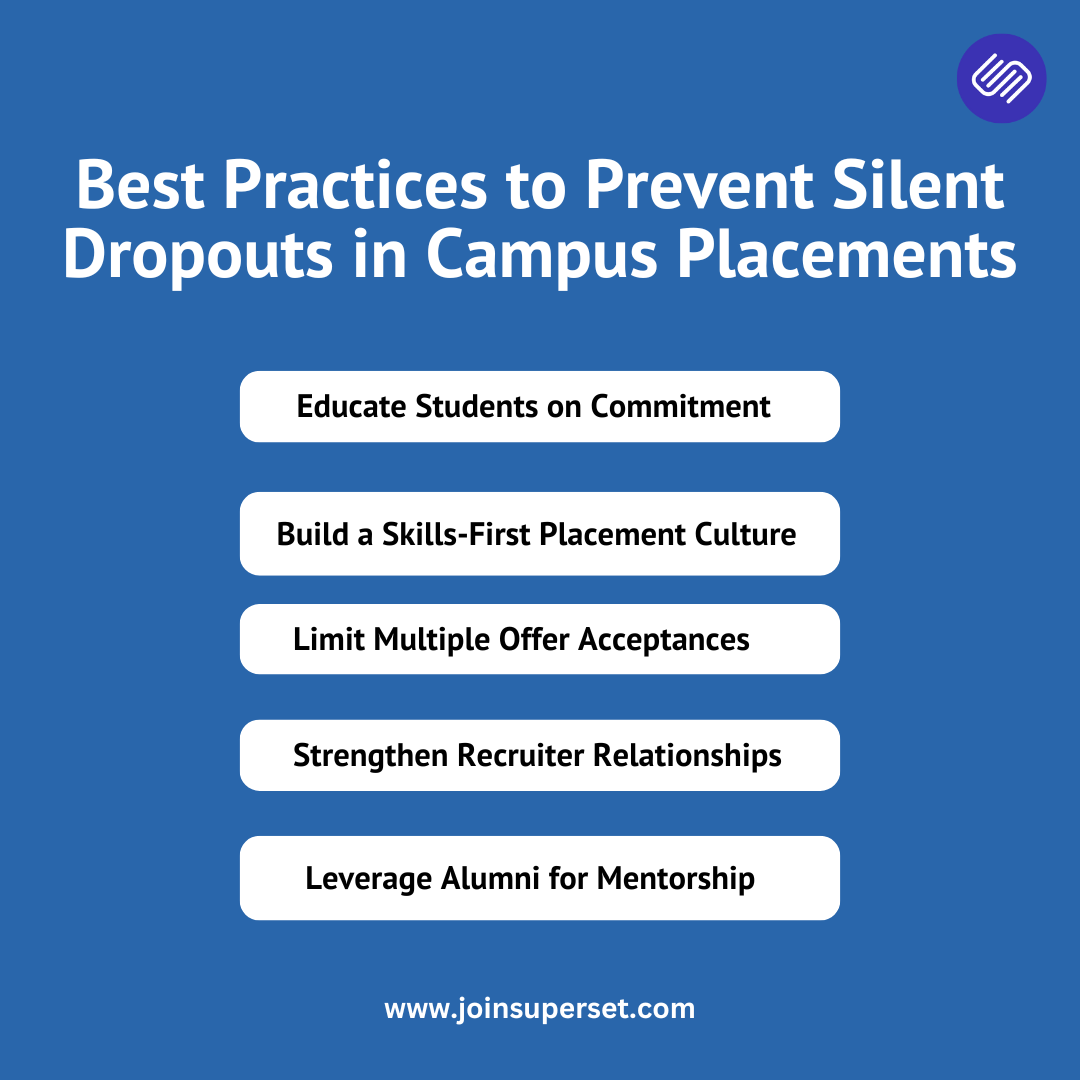
1. Educate Students on Commitment
Host sessions on the professional and ethical responsibilities of accepting offers. Reinforce that rejecting offers impacts both their career and the university’s reputation.
2. Build a Skills-First Placement Culture
Encourage students to focus on roles aligned with their skills rather than chasing high salaries. Use tools like campus placement automation to match skills with recruiters.
3. Limit Multiple Offer Acceptances
Leverage platform features to regulate the number of concurrent offers a student can hold, ensuring higher commitment levels.
4. Strengthen Recruiter Relationships
Maintain transparent communication with recruiters about student expectations and offer acceptance data. This builds long-term trust.
5. Leverage Alumni for Mentorship
Involve alumni in guiding current students on making informed decisions about offers. Peer mentoring reduces indecision and dropouts.
Future of Campus Placements: From Volume to Value
The future of campus placements is shifting from chasing higher numbers of job offers to focusing on meaningful, long-term matches. Universities that embrace campus placement digitisation and automation will be able to deliver more reliable, transparent, and sustainable outcomes.
- Provide recruiters with reliable talent pipelines: Digitised platforms ensure recruiters get access to well-prepared candidates whose skills align with industry needs.
- Reduce dropout risks through predictive insights: Automation tools can flag students likely to reject offers, allowing placement officers to intervene early.
- Enhance student satisfaction by aligning roles with career aspirations: Smart matching systems help students secure jobs suited to their interests and skills, reducing mismatches.
- Improve institutional reputation with transparent, data-backed outcomes: Universities gain credibility when they share accurate placement data, strengthening trust with recruiters and prospective students.
This approach ensures placements create value beyond offer letters.
Why Now is the Time to Act in Campus Placements
Silent dropouts in campus placements may seem like one-off cases, but they reflect a deeper change in how students approach careers. Today’s graduates are influenced by three major shifts:
- Skill-First Hiring – Employers are increasingly prioritising skills over degrees. If universities don’t align placements with this trend, students will disengage from mismatched roles.
- Digital Recruitment Platforms – Companies now use tech-driven systems to streamline hiring. Universities that still rely on manual placement processes risk looking outdated and less reliable to recruiters.
- Student Career Mindset – Gen Z students seek meaningful work, flexibility, and growth. They won’t hesitate to reject offers that don’t fit these aspirations.
By adopting a modern campus placement portal like Superset, universities can address immediate dropout challenges while building future-ready placement cells that match evolving student and recruiter expectations.
Conclusion
Silent dropouts in campus placement are a growing challenge, but not an unsolvable one. By embracing campus placement digitisation and automation, universities can move from reactive problem-solving to proactive placement management. Platforms like Superset empower placement officers with the tools, data, and workflows needed to minimise offer rejections, strengthen recruiter trust, and elevate placement success.