



In today’s evolving campus recruitment landscape, even a strong campus recruitment plan can fail without accounting for student unpredictability. No-shows, declined offers, and dropouts are growing challenges that disrupt hiring timelines and ROI. To stay ahead, companies need a risk-aware campus hiring strategy that anticipates and minimises behavioural risks. Platforms like Superset enable this shift by offering automation, transparency, and real-time insights, helping organisations build resilient, data-driven, and scalable campus recruitment systems that ensure better predictability and hiring success.
Understanding the Problem: Why No-Shows and Dropouts Are Rising
In recent years, no-shows and offer dropouts have become a recurring challenge in the campus recruitment process. Here’s a breakdown of the key reasons and their impact:
- Multiple Offers, Minimal Commitment:
Many top students receive several offers, making them uncertain about which to accept. This leads to delayed decisions or declined offers at the last minute. - Unclear Communication:
Delays in sharing updates about assessments, interviews, or onboarding create confusion and cause candidates to lose interest. - Lack of Engagement Post-Offer:
After rolling out offers, some companies fail to maintain regular touchpoints, making students feel disconnected and undervalued. - Unrealistic Role Expectations:
Vague job descriptions or compensation mismatches often result in disappointment, prompting students to reject offers.
A risk-aware campus recruitment plan helps mitigate these issues by using data, predictive insights, and consistent communication to improve offer-to-join conversions.
Why Every Company Needs a Risk-Aware Campus Recruitment Plan
A risk-aware campus recruitment plan is essential for companies aiming to move beyond mere headcount targets and focus on long-term value retention. Unlike traditional plans, which often prioritise offer rollouts and reactive problem-solving, a risk-aware approach proactively addresses potential challenges such as no-shows, declined offers, or dropouts.
- Focus on Offer Acceptance, Joining, and Retention: Instead of just making offers, this plan emphasises ensuring candidates accept, join, and stay, improving overall hiring quality.
- Predicts Risks Proactively: By analysing historical data and engagement patterns, companies can anticipate which candidates may decline offers or disengage.
- Automated Tracking and Analytics: Manual follow-ups are replaced by data-driven tracking of candidate progress, engagement, and likelihood to join.
- Personalised Engagement Across Campuses: Tailored communication and outreach for each university increases candidate commitment and reduces dropouts.
Platforms like Superset enable recruiters to implement these strategies efficiently, providing real-time insights into high-risk candidates and optimising recruitment outcomes.
The Hidden Cost of No-Shows and Dropouts
- Budget Inefficiency: Travel, accommodation, and logistics expenses for students who don’t join increase the cost per hire significantly.
- Wasted Interview Bandwidth: HR teams and hiring managers spend time on unproductive interviews, reducing their capacity to focus on high-potential candidates.
- Reduced Workforce Readiness: Declined offers or dropouts create skill gaps in business units and can delay important projects.
- Employer Brand Damage: Poor communication or disorganisation during recruitment drives can lead to negative word-of-mouth across campuses, affecting future hiring cycles.
Embedding risk management into your campus recruitment plan can minimise these issues. Tools like Superset’s campus recruitment system help forecast risks, track high-risk candidates, and streamline processes, ensuring better conversion rates, optimised recruitment ROI, and more efficient operations.
Key Pillars of a Risk-Aware Campus Recruitment Plan
Let’s break down what a truly risk-aware campus hiring strategy should look like :
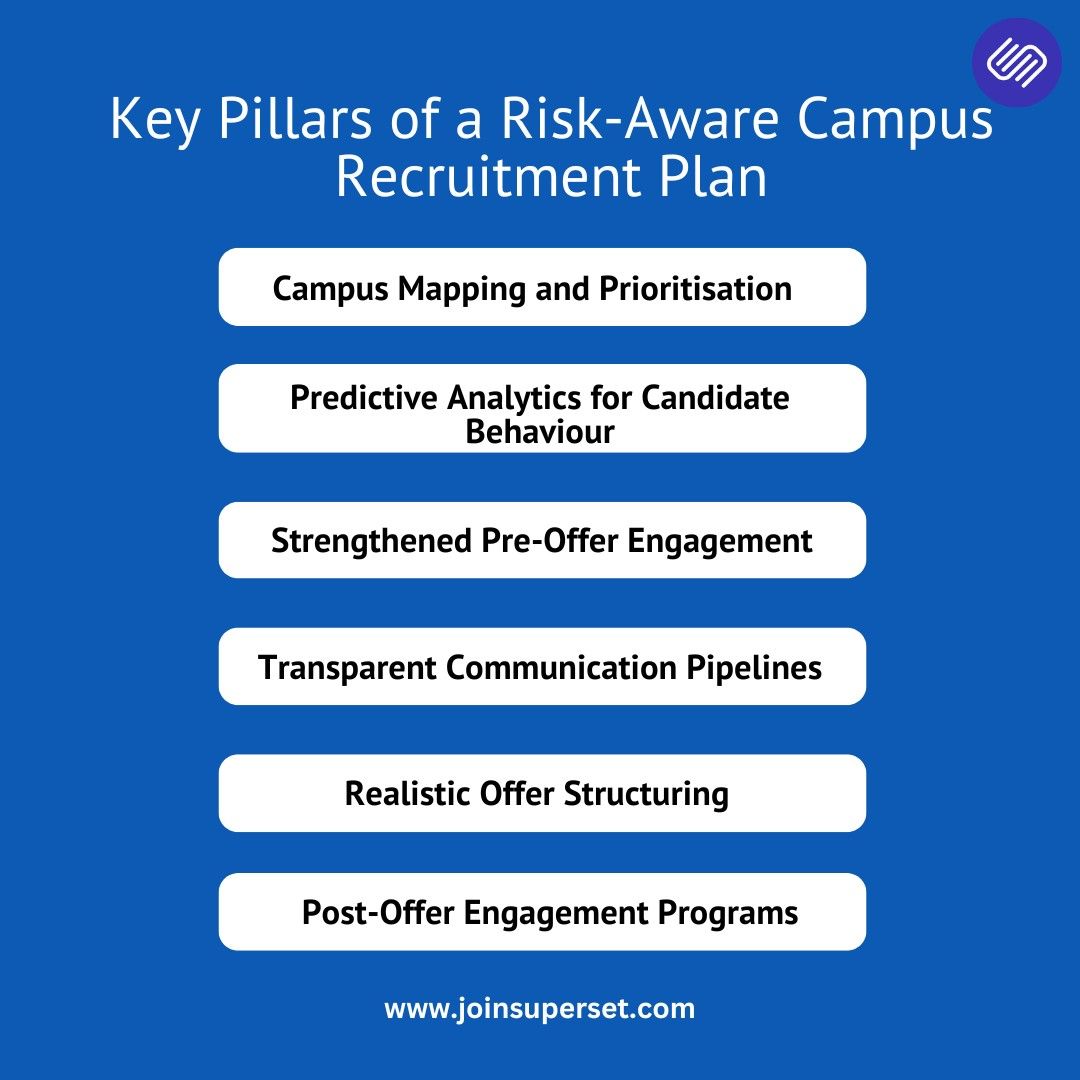
a. Campus Mapping and Prioritisation
Instead of spreading resources thin across dozens of campuses, smart organisations:
- Analyse historical offer-to-join ratios
- Identify campuses with consistent acceptance behaviour
- Prioritise programs and departments that align with long-term retention
Superset helps companies consolidate multi-year data to identify which universities deliver not just quality hires, but dependable conversions.
b. Predictive Analytics for Candidate Behaviour
Today, recruitment isn’t just about selection — it’s about prediction. Using AI-driven analytics within a campus recruitment system, companies can:
- Score candidates based on engagement signals
- Detect early signs of disinterest
- Predict which offers might face a higher risk of rejection
Superset’s dashboards visualise engagement patterns (like application speed, assessment scores, or communication responsiveness), allowing HR managers to act before dropouts happen.
c. Strengthened Pre-Offer Engagement
Student engagement doesn’t start at the job offer; it starts when they first hear your brand name. Here’s how to ensure top candidates remain committed:
- Host pre-placement webinars and micro-challenges
- Introduce gamified assessments that boost excitement
- Use Superset’s event management tools to automate invites and track participation
- Maintain continuous brand presence across the student journey
These engagement initiatives make your company not just a recruiter, but a career partner in students’ eyes.
d. Transparent Communication Pipelines
Silence kills candidate interest. Automate updates, clarify next steps, and personalise communication using your campus recruitment system. With Superset, HR teams can send bulk updates, shortlist announcements, and onboarding instructions — all within a centralised dashboard. This transparency reduces anxiety, boosts trust, and cuts down on ghosting incidents.
e. Realistic Offer Structuring
A key cause of offer declines is misaligned expectations. Companies must:
- Benchmark compensation packages with industry averages
- Clarify growth paths and skill trajectories
- Share transparent job role previews
Superset’s integrated survey and feedback tools allow you to collect post-drive insights, helping refine future offers to match student expectations more effectively.
f. Post-Offer Engagement Programs
This is where most companies fail. Once the offer is made, they disappear — and that’s when competitors swoop in. A smart campus hiring strategy includes continuous post-offer engagement:
- Regular touchpoints (emails, mentorship calls, or virtual coffee chats)
- Early onboarding sessions before joining
- Company culture sneaks through Superset’s campaign tools
Engaged candidates are 60% less likely to drop out before joining. Superset enables automated workflows to sustain engagement throughout the waiting period.
Integrating Technology into Risk Management in Campus Recruitment
Manual recruitment processes cannot efficiently detect behavioural risks like dropouts or offer declines. An integrated campus recruitment system like Superset addresses this by centralising operations:
- Data Integration: Stores all student applications, assessment results, and engagement scores in one platform, providing a complete view of each candidate.
- Workflow Automation: Reduces repetitive manual tasks, allowing recruiters to focus on high-value interactions and personalised engagement.
- Predictive Risk Analytics: Uses data to identify candidates most likely to decline offers or delay joining, enabling proactive interventions.
- Offer Tracking: Monitors acceptances, rejections, and silent dropouts automatically, ensuring recruiters never miss critical updates.
When paired with campus recruiting best practices, this technology reduces human errors, improves transparency, and gives HR teams visibility across the entire candidate lifecycle, making your campus recruitment plan more risk-aware and efficient.
Embedding Risk Awareness into Each Stage of Recruitment
A campus recruitment plan must be risk-aware across its entire lifecycle — not just at the end. Let’s break it down:
Stage 1: Pre-Drive Planning
- Use data from previous years to predict likely dropout rates.
- Adjust offer numbers accordingly.
- Automate outreach and candidate mapping using Superset.
Stage 2: Drive Execution
- Monitor real-time attendance, test completions, and assessment results.
- Use dashboards to spot sudden disinterest or low participation.
Stage 3: Post-Offer Engagement
- Segment candidates by risk score and create targeted retention campaigns.
- Keep communication frequency high using Superset’s automation tools.
Stage 4: Onboarding & Conversion
- Use Superset’s integration capabilities to track joining confirmations.
- Identify bottlenecks — documentation delays, relocation issues, etc. — and resolve them before the joining day.
By embedding risk management principles into every phase, you create a recruitment plan that is proactive rather than reactive.
Key Metrics for a Risk-Aware Campus Recruitment Plan for Measuring Success
To ensure your campus recruitment plan effectively reduces risks like dropouts and declines, track these key metrics:
- Offer Acceptance Rate (OAR): Measures the percentage of students accepting offers after being shortlisted. A higher OAR indicates your engagement and offers resonate well with candidates.
- Offer-to-Join Ratio (OJR): tracks the percentage of accepted offers that result in actual joining. This reveals how many students follow through, helping identify potential dropouts early.
- Engagement Score: Evaluates candidate participation in pre- and post-offer activities, such as webinars, assessments, or mentorship programs. Higher engagement often correlates with better retention.
- Communication Lag Time: Measures the duration between candidate actions (like application submission) and recruiter responses. Faster communication reduces uncertainty and dropout risk.
- Cost per Successful Hire (CPSH): Calculates total recruitment spend divided by onboarded candidates, showing the efficiency of your hiring strategy.
Superset automates these metrics, giving HR teams real-time insights for smarter decision-making.
Continuous Improvement: Evolving the Plan Year Over Year
A risk-aware campus hiring strategy is dynamic and improves with each recruitment cycle. Continuous improvement ensures your campus recruitment plan becomes more efficient, reduces risks, and delivers better outcomes over time. Key steps include:
- Conduct Annual Post-Mortems: Review each campus drive to identify successes, challenges, and areas of improvement.
- Evaluate Success Metrics and Engagement Data: Analyse offer acceptance rates, no-show statistics, and candidate engagement to measure effectiveness.
- Recalibrate Campus Priorities: Focus on campuses that consistently deliver high-quality candidates while reallocating resources from less productive ones.
- Refresh Communication Templates and Offer Structures: Update emails, engagement campaigns, and offer packages based on past feedback to enhance candidate experience.
- Leverage Superset’s Historical Data: Superset archives previous hiring cycles, making it easy to compare results, identify trends, and adjust strategies for future recruitment drives.
By following these steps, companies can iteratively refine their campus hiring strategy, reducing risks and improving overall recruitment efficiency.
Building a Culture of Predictability in Campus Hiring
Risk awareness in campus recruitment goes beyond processes; it requires a mindset shift across HR teams. By embedding predictability into every stage of the campus recruitment process, organisations can achieve consistent outcomes and reduce surprises like no-shows or offer declines.
Key benefits include:
- Make Data-Driven Offer Decisions: HR teams can analyse historical data and candidate engagement metrics to issue offers with a higher acceptance probability.
- Build Resilient Candidate Pipelines: By anticipating risks and identifying backup candidates, companies maintain a strong talent pool that can handle last-minute dropouts.
- Enhance Credibility Among University Partners: Consistent, transparent engagement and reliable recruitment outcomes strengthen relationships with colleges and faculty.
Platforms like Superset facilitate this cultural shift by integrating workflows, automating tracking, and providing real-time analytics, promoting precision, transparency, and accountability in campus hiring.
Conclusion
In today’s competitive hiring landscape, uncertainty is the only constant — but it doesn’t have to be unmanageable. A well-structured, risk-aware campus recruitment plan empowers companies to anticipate candidate behaviour, safeguard hiring outcomes, and preserve recruitment ROI. Platforms like Superset enable you to achieve this with precision — automating engagement, analysing risks, and ensuring every offer made converts into a successful onboarding.