


In today’s competitive hiring landscape, online campus recruitment has evolved beyond virtual job fairs and bulk shortlisting. Leading organisations now use AI-driven segmentation to identify the right universities, match relevant talent pools, and build long-term relationships with the most suitable campuses. For companies seeking quality over quantity, smart segmentation is becoming a critical differentiator in their campus hiring strategy. As the future of recruitment turns digital, data-driven segmentation through platforms like Superset helps HR teams transition from reactive hiring to predictive talent acquisition—targeting only those campuses that align with their skill requirements, hiring goals, and culture fit.
The Evolution of Online Campus Recruitment
Campus hiring has long been vital for entry-level talent acquisition, but traditional methods—campus visits, multiple assessments, and heavy logistics—were time-consuming and costly. The shift to online campus recruitment platforms transformed this process, enabling companies to scale outreach, engage remotely, and tap into broader talent pools through virtual campus recruitment. However, with efficiency came new challenges like managing high application volumes and identifying the right-fit campuses. Today, AI-powered segmentation is redefining how companies target and engage universities with precision and data-driven insights.
Why Traditional Campus Selection No Longer Works
Traditional campus selection relied on brand reputation and convenience, not real performance data. But as skill demands evolve—AI, data science, product design, full-stack development—top-tier campuses alone no longer guarantee the right talent. Companies now need data-driven approaches to identify campuses that truly align with modern hiring needs.
Without data-led segmentation, companies risk:
- Misalignment of skills between job roles and campus strengths.
- Excessive hiring costs from unproductive campus visits.
- Lower conversion rates from offer to joining.
- Underutilised partnerships with high-potential yet lesser-known institutions.
To make campus recruitment truly strategic, HR teams need a smarter campus selection system—one that uses insights, not assumptions.
What Is Smart Segmentation in Online Campus Recruitment?
Smart segmentation refers to the process of using AI and analytics to categorise campuses and student populations based on multiple parameters—skills, placement history, academic performance, domain alignment, and hiring outcomes.
Through intelligent data mapping, an AI-driven campus recruitment system can help companies identify:
- Which universities produce candidates with the most relevant technical or domain expertise?
- Which regions or programs consistently deliver high retention rates?
- Which students are most likely to accept offers based on historical conversion trends?
Instead of a broad-brush approach, companies can strategically segment and prioritise campuses that align with their business and talent strategy. Platforms like Superset empower recruiters to visualise these insights through dashboards and predictive models—making segmentation not only accurate but also actionable.
How AI Enables Smart Campus Segmentation
Artificial Intelligence is transforming online campus recruitment by enabling data-driven campus targeting and precision hiring. Here’s how it enhances segmentation across the recruitment funnel:
- Data Aggregation and Normalisation: AI gathers student data from multiple universities—academic scores, certifications, internships—and standardises it into a consistent, comparable format. This minimises bias from inconsistent grading or incomplete records.
- Pattern Recognition: Machine learning algorithms analyse past recruitment data to identify which campuses produced top-performing hires or had high offer-to-join ratios, creating a foundation for predictive campus ranking.
- Skill-Based Clustering: AI groups students by skill readiness, course specialisation, and performance, helping recruiters target precise talent segments instead of relying on general demographics or college reputation.
- Predictive Scoring: AI assigns predictive scores to both campuses and candidates, enabling companies to forecast hiring success. Platforms like Superset use these insights to align recruitment strategies with evolving skill demands.
The Strategic Benefits of Smart Segmentation
Smart segmentation in online campus recruitment empowers companies to make data-driven decisions and build more effective hiring pipelines. By leveraging AI, HR teams can move from mass outreach to precision-based engagement, improving efficiency, diversity, and overall ROI.
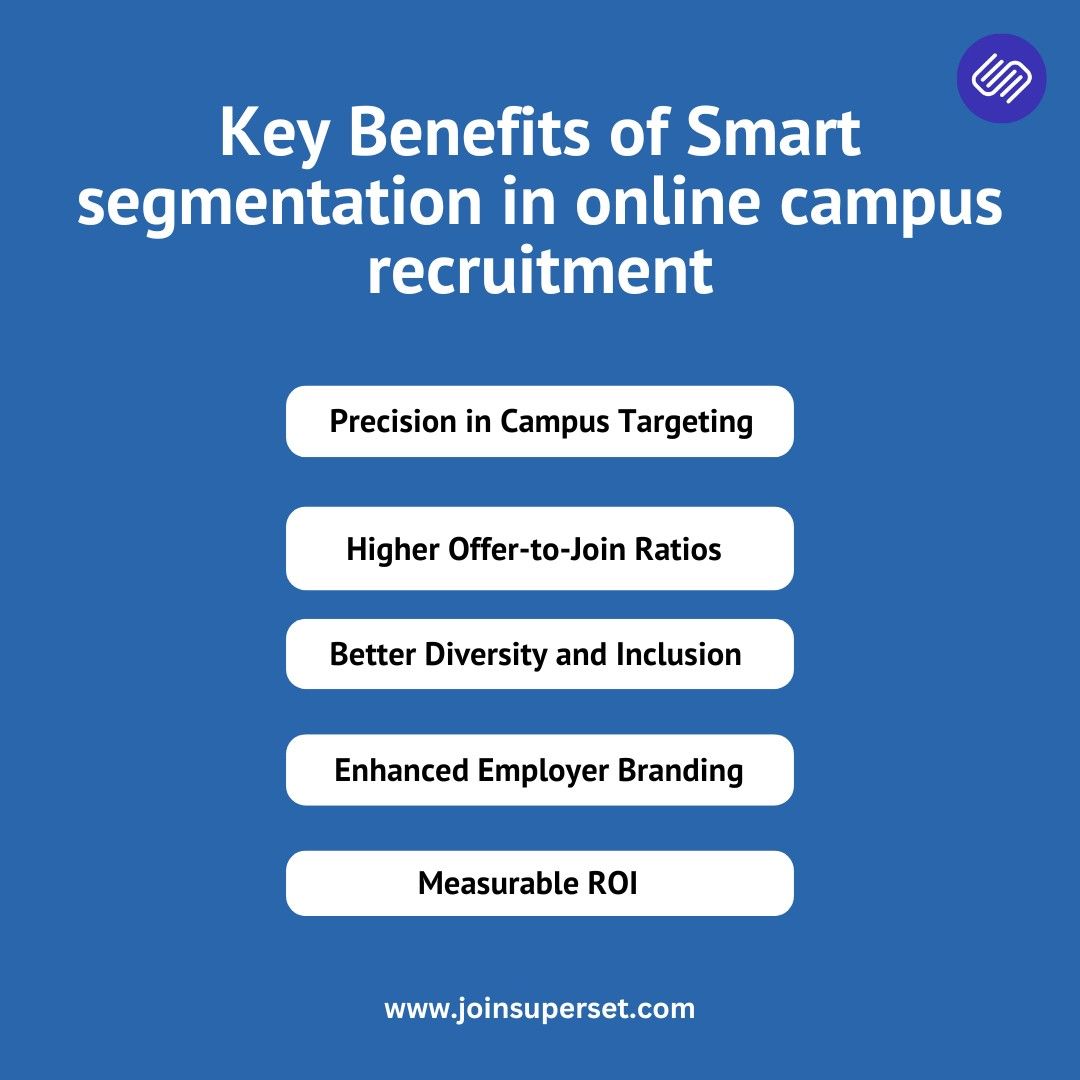
- Precision in Campus Targeting – AI helps identify the most relevant 10 campuses, rather than reaching out to 50, reducing costs and focusing efforts where talent quality is highest.
- Higher Offer-to-Join Ratios – Predictive models analyse behaviour and history to find students more likely to accept offers, enhancing conversion rates.
- Better Diversity and Inclusion – AI expands outreach to non-traditional campuses, ensuring a more inclusive and balanced talent pool.
- Enhanced Employer Branding – Consistent, strategic engagement builds stronger brand presence using Superset’s virtual campus recruitment tools.
- Measurable ROI – Real-time analytics track every hiring stage, allowing HR leaders to measure performance and optimise recruitment investments.
The Role of Superset in Enabling Smart Segmentation
Superset, India’s leading online campus recruitment platform, empowers companies to manage the entire hiring journey—from campus selection to offers—through one seamless digital system. Its advanced AI-driven segmentation engine helps recruiters make data-backed decisions instead of relying on assumptions.
- Analyse historical data: Identify which campuses have consistently produced top-performing hires and focus efforts where ROI is highest.
- Discover emerging institutions: Spot universities showing rising talent quality to expand the company’s hiring footprint strategically.
- Cluster students by skills and academics: Group candidates based on domain expertise, grades, and employability, enabling precise targeting.
- Automate eligibility and shortlisting: Use predictive algorithms to filter candidates who best match role requirements, saving time and reducing bias.
By embedding segmentation within its campus recruitment system, Superset shifts companies from operational hiring to strategic, insight-led campus recruitment that improves efficiency and talent outcomes.
Integrating Smart Segmentation into the Larger Recruitment Ecosystem
Integrating smart segmentation into the broader recruitment ecosystem ensures that insights from online campus recruitment flow seamlessly across HR systems. Instead of operating in silos, companies can connect their campus recruitment system with tools like ATS, onboarding, and learning platforms to create a unified hiring journey.
With Superset’s API integrations, recruiters can:
- Sync shortlisted candidates directly to ATS systems, eliminating manual data entry and ensuring a smooth handoff from campus selection to final hiring.
- Track post-hiring performance, helping HR teams identify which campuses deliver top-performing employees.
- Feed performance data back into AI models, enabling continuous learning and refining future segmentation accuracy.
This interconnected ecosystem transforms into a self-learning recruitment engine—where every hiring cycle builds on the previous one, making campus selection more intelligent, efficient, and aligned with long-term business goals.
Key Metrics to Track in AI-Driven Campus Segmentation
Tracking the right metrics is essential to evaluating the success of AI-driven campus segmentation. HR leaders can gain deep insights by focusing on key performance indicators that reflect both efficiency and quality.
- Cost-per-hire reduction highlights savings achieved by targeting only the most relevant campuses instead of conducting broad outreach.
- Offer-to-join ratio improvements indicate better alignment between candidates’ expectations and company roles, reducing offer drop-offs.
- Skill match percentage measures how closely hired candidates’ competencies align with job requirements, ensuring role readiness.
- Campus performance index evaluates each university’s historical hiring outcomes, helping companies prioritise high-performing campuses.
- Recruitment cycle time tracks how quickly hiring progresses from campus selection to final offer rollout, revealing operational efficiency.
Superset’s intelligent analytics dashboards make it easy to monitor these metrics in real time, giving HR teams clear visibility, faster decision-making, and complete control over their online recruiting outcomes.
Overcoming Implementation Challenges
Implementing AI-based segmentation in online campus recruitment can be complex, as it requires both technological and organisational readiness. Companies often encounter three main challenges.
- Data quality issues: Integrating legacy campus databases can lead to inconsistent or incomplete data, reducing the accuracy of segmentation models.
- Change management resistance: Recruitment teams used to manual or traditional hiring methods may initially struggle to adapt to digital workflows and automated processes.
- Algorithmic bias: If AI models are trained on limited or skewed datasets, they can unintentionally favour certain profiles or institutions.
Partnering with a robust platform like Superset helps overcome these challenges. Its AI models are trained on extensive, anonymised data across hundreds of universities, ensuring fairness and reliability.
Future Trends: The Next Phase of Smart Segmentation
The next phase of smart segmentation in online campus recruitment goes beyond data analysis—it’s about intelligent prediction and continuous collaboration.
- Predictive career mapping: AI will match students’ growth potential with future skill demands.
- Adaptive engagement: Recruitment touchpoints will personalise dynamically based on candidate responses.
- AI-generated campus benchmarking: Recruiters will access live performance indices for every campus.
Together, these trends mark a shift from one-time hiring drives to co-creating data-driven talent ecosystems, where companies and universities collaborate seamlessly to nurture, assess, and deploy emerging talent for the future.
Conclusion
In the era of digital transformation, online campus recruitment is no longer about visiting more campuses—it’s about visiting the right ones. AI-powered segmentation turns campus hiring from a logistical operation into a strategic growth lever. By leveraging Superset’s intelligent campus recruitment system, companies can identify high-impact campuses, engage talent proactively, and optimise hiring ROI with every cycle. The shift toward virtual campus recruitment is not just a cost-saving measure—it’s a move toward smarter, more sustainable, and inclusive hiring.