


In today’s competitive talent market, campus hiring is moving beyond traditional placement drives. Companies want more than aptitude tests and quick interviews—they seek deeper ways to identify and nurture early-career talent before final selections. Micro-internships and project-based assessments are emerging as powerful pre-campus hiring funnels, enriching the campus hiring process and supporting data-driven strategies. By integrating short-term projects into the pipeline, employers gain insights into skills, problem-solving, and cultural fit, while students gain hands-on exposure. This blog explores how these methods redefine hiring campus talent and how Superset streamlines the journey with smarter campus hiring solutions.
Why Traditional Campus Hiring Needs Reinvention
The traditional campus hiring process is fast-paced but often flawed. Companies visit multiple universities, run recruitment events over one or two days, conduct aptitude tests, and rush through group discussions and interviews before making quick offers. While efficient in scale, this model has significant drawbacks.
- Surface-level assessments: Aptitude tests evaluate theoretical knowledge but rarely capture real-world problem-solving or creativity.
- High mismatch rates: Rapid hiring often results in students being placed in roles misaligned with their skills, affecting productivity.
- Attrition risk: Many campus hires leave within 12–18 months when job expectations don’t match reality.
- Cost inefficiency: Travel, branding campaigns, and logistics make the process expensive without ensuring quality hires.
To overcome these challenges, companies are adopting modern campus hiring solutions like micro-internships and project-based assessments. These approaches enable deeper skill evaluation, stronger cultural fit, and better long-term retention of early-career talent.
What Are Micro-Internships?
Micro-internships are short-term, project-based work opportunities that usually last from a few days to a few weeks. Unlike traditional internships, they focus on specific, outcome-oriented tasks that deliver tangible results. For students, these experiences provide multiple benefits:
- Work on specific, outcome-based tasks – Students complete defined assignments, such as data analysis, coding modules, or marketing campaigns, showcasing their ability to deliver results.
- Gain exposure to real-world business challenges – They experience practical industry problems, preparing them for the complexities of full-time roles.
- Demonstrate technical and soft skills – Through projects, students reveal both their subject expertise and workplace skills like teamwork, communication, and time management.
- Build portfolios of relevant work – Completed projects add value to their resumes and serve as proof of their abilities to future employers.
For companies, micro-internships provide a low-risk, high-insight hiring channel, allowing HR managers to assess real performance rather than relying solely on grades or aptitude tests.
What Are Project-Based Assessments?
Project-based assessments are a modern approach to evaluating students by moving beyond theoretical knowledge and testing how they apply skills in real-world scenarios. Unlike standard exams or interviews, these assessments replicate actual workplace challenges, giving employers a clearer view of a candidate’s potential.
- Hackathons & coding challenges test technical problem-solving, logical thinking, and the ability to deliver functional solutions under time pressure.
- Case study presentations reveal analytical ability, structured thinking, and communication skills crucial for consulting and management roles.
- Marketing simulations assess creativity, data-driven decision-making, and persuasion skills required in sales and business development.
- Design tasks showcase innovation, user empathy, and aesthetic sense—key for creative and UX-focused positions.
By mirroring real job demands, project-based assessments act as a pre-hire audition, helping companies evaluate teamwork, creativity, and adaptability more effectively than traditional interviews.
Why Micro-Internships & Projects Work as a Pre-Campus Hiring Funnel
1. Skill-Based, Not Just Credential-Based
Academic grades don’t always predict job performance. By leveraging project-based assessments, companies can identify candidates with practical skills—even those outside the top tier of universities.
2. Reduces Early Attrition
Campus hires who’ve already experienced the work environment through micro-internships are less likely to be surprised by job realities, leading to higher retention rates.
3. Builds a Stronger Employer Brand
Offering pre-placement projects signals to students that the company invests in learning and growth. This strengthens the employer’s reputation on campuses and attracts more motivated applicants.
4. Cost-Efficient Screening
Instead of interviewing hundreds of candidates blindly, companies can funnel only the top performers from micro-internships into the main campus hiring process, reducing time and resource wastage.
5. Data-Driven Decision Making
Platforms like Superset enable recruiters to track project outcomes, performance metrics, and student engagement. This data forms the backbone of a smarter campus hiring strategy.
How to Integrate Micro-Internships into Campus Hiring
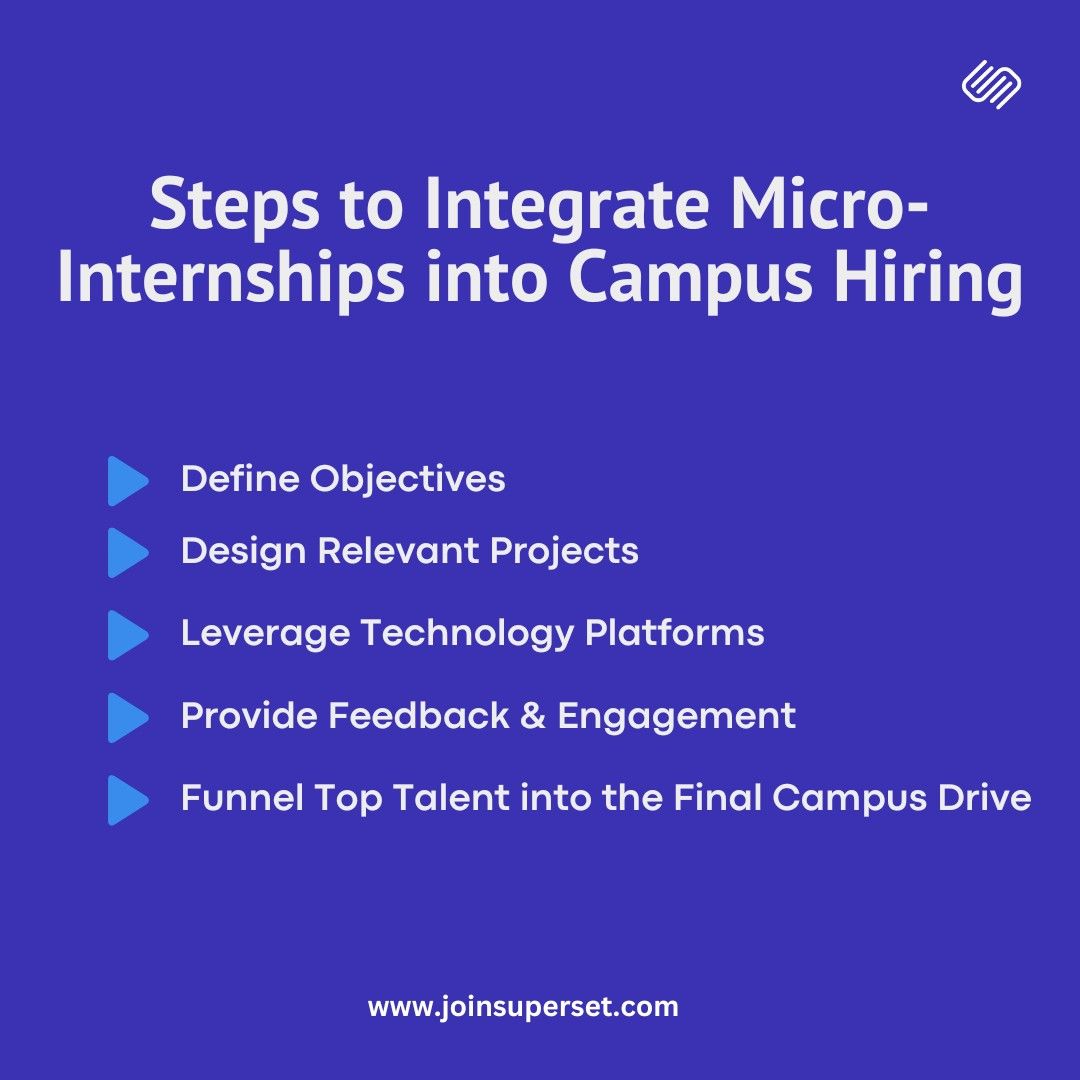
Step 1: Define Objectives
Decide what you want to measure—technical proficiency, communication, teamwork, or problem-solving.
Step 2: Design Relevant Projects
Ensure micro-internship projects mirror the actual challenges employees face. For example, a SaaS company might assign a project to design a product feature mock-up.
Step 3: Leverage Technology Platforms
Use a campus hiring solution like Superset to manage applications, assign tasks, track submissions, and evaluate performance seamlessly.
Step 4: Provide Feedback & Engagement
Offer structured feedback to students. Even those not selected will leave with a positive perception of the company, strengthening the employer brand.
Step 5: Funnel Top Talent into the Final Campus Drive
Shortlisted students from micro-internships can skip preliminary screening stages during final placements, ensuring a faster and more accurate process.
How Project-Based Assessments Enhance Hiring Campus Talent
Project-based assessments are transforming the campus hiring process by providing a more holistic view of candidates beyond grades and aptitude tests.
- Real-World Simulation: Unlike abstract exams, these assessments replicate actual business scenarios such as case studies, coding challenges, or marketing simulations. This helps companies evaluate how students apply theoretical knowledge to real problems.
- Soft Skills Evaluation: Projects demand collaboration, communication, creativity, and time management. These essential workplace skills are rarely measured in traditional campus hiring exams but are critical for long-term success.
- Fairness & Diversity: By focusing on skills instead of pedigree, students from tier-2/3 colleges and non-traditional universities can prove their capabilities. This levels the playing field and widens the talent pool.
- Predictive Performance Insights: Candidates who excel in these projects often mirror high workplace performance, helping employers make better long-term hiring decisions.
Role of Superset in Streamlining Pre-Campus Hiring Funnels
Superset, India’s largest campus hiring automation platform, enables companies to seamlessly adopt micro-internships and project-based assessments as part of their hiring strategy.
- Digital Workflows: HR managers can assign projects, collect submissions, and evaluate performance on a single dashboard, eliminating manual effort and confusion.
- Automated Shortlisting: AI-driven filters help quickly identify top-performing candidates, ensuring only the best talent moves forward.
- Integration with Campus Hiring Events: Students who excel in projects can be directly funneled into the placement pipeline, saving time during final hiring rounds.
- Analytics & Reporting: Recruiters gain access to detailed insights on participation, performance, and engagement, enabling data-backed decision-making.
- Scalability Across Universities: Superset allows organizations to standardize assessments across hundreds of campuses, removing logistical barriers and ensuring consistency.
By centralizing these processes, Superset transforms micro-internships from ad hoc initiatives into a structured, scalable, and measurable campus hiring solution.
Challenges and How to Overcome Them
While micro-internships and project-based assessments offer immense value in the campus hiring process, companies may face a few challenges when implementing them at scale.
- Scalability: Managing thousands of student projects manually can be overwhelming. The solution lies in automation—platforms like Superset streamline workflows, from assignment to evaluation, making large-scale execution seamless.
- Student Engagement: Some candidates may treat micro-internships casually. To boost commitment, companies should offer certificates, structured feedback, and fast-track interview opportunities as incentives.
- Evaluation Bias: Subjective grading risks unfair assessments. Using structured rubrics, clear performance criteria, and multiple evaluators ensures fairness and consistency.
- Integration with University Schedules: Academic calendars often clash with project timelines. Offering flexible schedules and virtual submissions allows students to participate without academic disruption.
By addressing these hurdles with smart campus hiring solutions, companies can successfully build a reliable pre-hiring funnel that identifies and nurtures high-potential talent.
Future of Campus Hiring: From Volume to Value
The future of campus hiring is moving away from bulk hiring numbers toward strategies that emphasize quality and long-term value. Digital-first industries demand employees who are not only academically strong but also work-ready from day one. This is where micro-internships and project-based assessments redefine the campus hiring process.
- Encouraging experiential learning: Students gain hands-on exposure, bridging the gap between theory and practice.
- Filtering candidates through demonstrated skills: Companies can assess real-world problem-solving instead of relying solely on grades or aptitude scores.
- Reducing bias: Standardized projects ensure fair evaluation across diverse institutions and backgrounds.
- Aligning capabilities with organizational needs: Projects are designed to mirror actual workplace challenges, helping identify candidates who fit specific roles.
Organizations that adopt these value-driven models not only build stronger pipelines of job-ready talent but also reduce attrition, improve cultural fit, and maximize ROI from their campus hiring strategy.
Conclusion
The era of rushed interviews and generic tests is ending. Companies need smarter ways to identify and nurture early talent, and micro-internships combined with project-based assessments provide exactly that. By embedding these initiatives into the campus hiring process, organizations can make more informed decisions, strengthen employer branding, and reduce attrition. With Superset’s campus hiring solutions, the entire workflow—from project design to candidate evaluation and final hiring—becomes seamless and scalable.